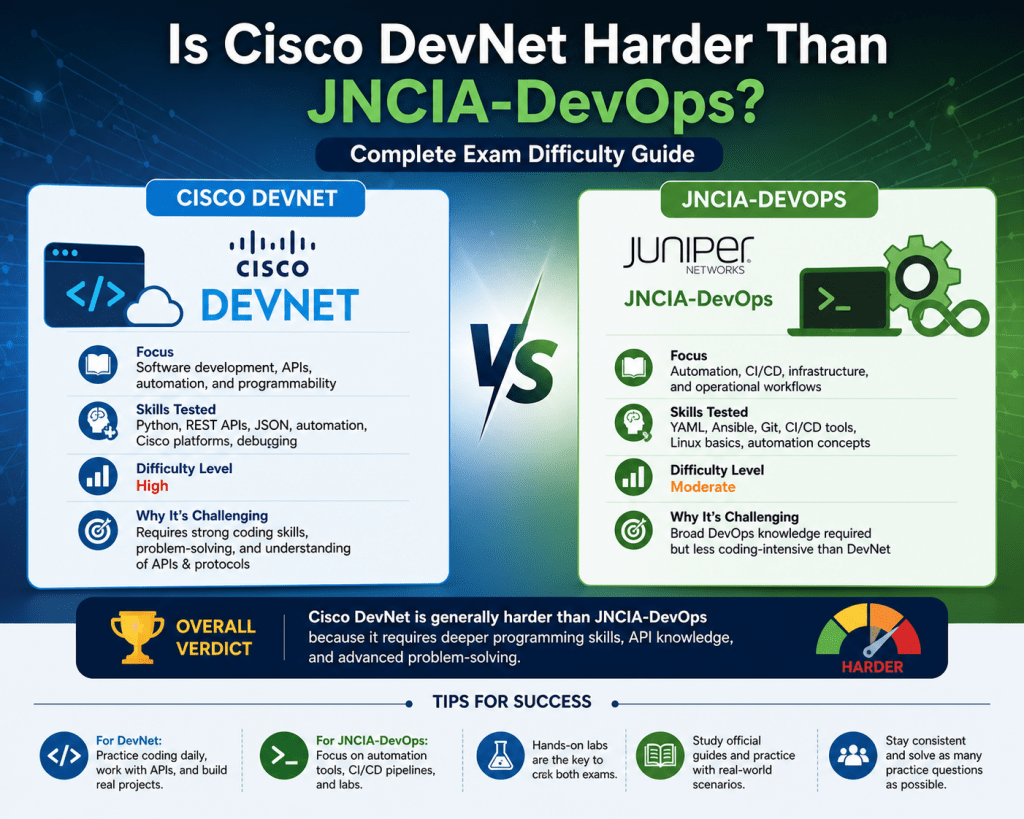
Networking has moved far beyond manual configuration and static infrastructure management. Modern IT environments rely heavily on automation, orchestration, and software-driven control of network systems. This shift has created a strong demand for professionals who understand both traditional networking and software development principles. As organizations adopt cloud computing, DevOps practices, and infrastructure-as-code methodologies, certifications that validate automation skills have become increasingly important.
Cisco DevNet Associate and Juniper JNCIA-DevOps are two certifications that represent this transition. Both are designed to validate entry-level knowledge in network automation, but they approach the subject from different perspectives. Cisco focuses on a broader software development and networking integration model, while Juniper emphasizes practical automation within its own ecosystem. Understanding these differences is essential for evaluating their difficulty and relevance in modern IT careers.
Cisco DevNet Associate Certification Structure and Purpose
The Cisco DevNet Associate certification is designed to bridge the gap between software development and networking operations. It validates the ability to use programming concepts and APIs to automate and manage network infrastructure. The certification is not limited to traditional networking tasks but extends into application development, system integration, and infrastructure orchestration.
This certification targets professionals seeking roles that combine coding and networking. These roles include automation engineers, DevOps specialists, and infrastructure developers. The certification encourages candidates to think beyond manual configuration and instead focus on programmable infrastructure models.
The DevNet Associate exam evaluates knowledge across multiple domains, including software development fundamentals, API usage, Cisco platforms, infrastructure automation, and application deployment. This broad coverage requires candidates to understand both theoretical concepts and practical implementation techniques.
Core Knowledge Areas in Cisco DevNet Associate Exam
The Cisco DevNet Associate exam covers a wide range of topics that reflect the interdisciplinary nature of modern network automation. One of the primary areas is software development fundamentals. This includes understanding programming logic, debugging techniques, version control systems, and application lifecycle processes. Candidates are expected to be familiar with how software is designed, tested, and deployed in real-world environments.
Another major focus is API integration. APIs serve as the foundation of modern automation, allowing different systems to communicate and exchange data. The exam requires understanding RESTful APIs, authentication methods, request and response structures, and data formats such as JSON and XML. These concepts are essential for interacting with network devices programmatically.
Infrastructure automation is also a critical component of the certification. Candidates learn how to automate network configurations, manage device states, and integrate automation workflows into enterprise environments. This involves understanding how Cisco platforms expose programmable interfaces for automation tasks.
In addition, the certification includes network fundamentals to ensure candidates understand the underlying systems they are automating. This includes routing concepts, switching principles, and basic network architecture. The combination of networking and software development creates a broad learning scope that requires consistent study and practical experience.
Cisco Platforms and Automation Ecosystem
A key aspect of the DevNet Associate certification is its focus on Cisco platforms and tools. These platforms provide APIs and development frameworks that allow automation of network infrastructure. Candidates must understand how these systems interact with applications and how automation workflows are built on top of them.
The certification also introduces tools used for network simulation, automation testing, and application deployment. These tools help professionals build and test automation scripts before deploying them in production environments. Understanding how to use these tools effectively is essential for success in real-world DevNet roles.
Cisco’s ecosystem is widely used in enterprise environments, which means DevNet-certified professionals often work in large-scale network infrastructures. This makes the certification highly relevant for organizations that rely on Cisco technologies for their core operations.
Juniper JNCIA-DevOps Certification Overview and Focus
The Juniper JNCIA-DevOps certification is designed to validate foundational knowledge in network automation within Juniper’s ecosystem. Unlike Cisco DevNet, which covers a broad range of software development concepts, JNCIA-DevOps focuses more specifically on automation tools and protocols used in Juniper environments.
This certification is intended for professionals who work with Junos OS and want to develop automation skills using DevOps methodologies. It emphasizes practical implementation of automation workflows rather than theoretical software development concepts.
The certification reflects the growing importance of automation in service provider and data center environments where Juniper technologies are commonly deployed. It prepares candidates to manage network infrastructure using programmatic methods rather than manual configuration.
Core Knowledge Areas in JNCIA-DevOps Exam
The JNCIA-DevOps certification focuses on a more specialized set of topics compared to Cisco DevNet. One of the primary areas is data serialization, which includes formats such as XML, JSON, and YAML. These formats are essential for structured communication between systems and play a key role in automation workflows.
Another important area is configuration automation using tools like Ansible. Ansible is widely used for managing network devices and automating repetitive tasks. Candidates are expected to understand how playbooks work and how they can be used to configure Juniper devices.
NETCONF is another key protocol covered in the certification. It provides a standardized way to manage network devices programmatically. Understanding how NETCONF operates and how it interacts with Junos OS is essential for automation tasks.
Python scripting is also included, particularly through the use of PyEZ libraries. These libraries allow developers to interact with Juniper devices using Python, enabling advanced automation capabilities. Candidates are expected to understand basic scripting concepts and how they apply to network automation.
The certification also covers REST APIs, which are commonly used for web-based communication between systems. These APIs allow network devices to be managed through standard HTTP requests, making automation more flexible and scalable.
Junos OS Automation and DevOps Integration
A defining feature of the JNCIA-DevOps certification is its focus on Junos OS automation. Junos OS provides built-in capabilities for programmatic management, allowing network engineers to automate configurations and system operations.
The certification teaches how to use these capabilities effectively within DevOps workflows. This includes integrating automation tools into continuous deployment pipelines and managing infrastructure through code-based methods. These skills are highly relevant in environments where rapid deployment and scalability are required.
Juniper’s approach to automation is more structured and focused compared to broader software development certifications. This makes JNCIA-DevOps more specialized but also more predictable in terms of exam content.
Comparing Scope and Learning Requirements
When comparing Cisco DevNet Associate and Juniper JNCIA-DevOps, one of the most significant differences lies in scope. Cisco DevNet covers a wide range of topics that include software development, APIs, networking, and automation. This broad coverage requires candidates to learn multiple disciplines simultaneously.
In contrast, JNCIA-DevOps focuses more narrowly on automation within Juniper environments. While it still includes programming and DevOps concepts, its scope is more contained and specialized. This makes it easier for candidates who already work with Juniper systems, but potentially challenging for those unfamiliar with its ecosystem.
The learning requirements for Cisco DevNet are generally more extensive due to its multidisciplinary nature. Candidates must be comfortable with both coding and networking concepts at a conceptual and practical level. JNCIA-DevOps requires less breadth but demands a strong understanding of specific tools and protocols.
Industry Application and Career Relevance
Both certifications are highly relevant in modern IT environments, but they serve slightly different purposes. Cisco DevNet Associate is widely applicable in enterprise networking environments where Cisco technologies dominate. It is often used as a foundation for careers in network automation engineering and DevOps integration.
JNCIA-DevOps is more commonly associated with service provider networks and organizations that rely on Juniper infrastructure. It is particularly valuable in environments where automation is tightly integrated with Junos OS and related tools.
Despite these differences, both certifications provide foundational skills that are transferable across the broader field of network automation. Professionals trained in either certification gain experience in APIs, scripting, and infrastructure management.
Shift Toward Software-Defined Networking Skills
The rise of software-defined networking has changed how professionals approach infrastructure management. Traditional manual configuration methods are being replaced by automated, code-driven systems. Both Cisco DevNet and JNCIA-DevOps reflect this shift by emphasizing programming and automation skills.
This transition requires professionals to develop hybrid skill sets that combine networking knowledge with software development capabilities. As a result, certifications in this space are becoming increasingly valuable for career growth and technical advancement.
Network engineers are now expected to understand APIs, scripting languages, and automation frameworks. This shift has made certifications like DevNet and JNCIA-DevOps essential stepping stones in modern IT career paths.
Understanding Exam Design Philosophy in Network Automation Certifications
Modern network automation certifications are no longer built around memorization alone. Instead, they are designed to test applied understanding of systems, tools, and workflows used in real IT environments. Both Cisco DevNet Associate and Juniper JNCIA-DevOps reflect this shift, but they do so with different design philosophies.
Cisco DevNet follows a broad, multi-domain approach that blends software engineering concepts with networking fundamentals. It expects candidates to understand how different technologies interact across APIs, applications, and infrastructure layers. Juniper JNCIA-DevOps, on the other hand, focuses on practical automation within a more controlled ecosystem. Its exam design prioritizes operational understanding of tools like Ansible, NETCONF, and Junos OS automation interfaces.
These differences in philosophy significantly influence how candidates experience exam preparation and perceived difficulty.
Cisco DevNet Exam Structure and Cognitive Load
The Cisco DevNet Associate exam is structured to evaluate knowledge across several interconnected domains. Candidates are assessed on their ability to interpret automation workflows, understand programming logic, and analyze network behavior through APIs and software tools.
One of the defining characteristics of this exam is its cognitive load. Candidates must switch between multiple domains such as software development, networking principles, and infrastructure automation. This requires not only memorization but also conceptual integration of different technologies.
The exam includes scenario-based questions that simulate real-world automation challenges. Candidates may be required to interpret code snippets, understand API responses, or identify correct automation workflows for specific networking tasks. This makes the exam more analytical rather than purely theoretical.
Another important aspect is the emphasis on problem-solving under abstraction. Instead of focusing on a single tool or platform, candidates are expected to understand generalized automation principles that apply across multiple Cisco technologies.
Skill Distribution in Cisco DevNet Preparation
Preparation for the DevNet Associate exam typically requires balanced skill development across three major areas. The first area is programming fundamentals, where candidates must understand basic coding logic, variables, loops, and data structures. Python is commonly used as the primary language for understanding automation concepts.
The second area is networking knowledge. Candidates must understand how data flows across networks, how devices communicate, and how protocols operate. This foundational knowledge is necessary for understanding how automation interacts with infrastructure.
The third area is API and platform integration. Candidates must understand how REST APIs function, how authentication works, and how data is exchanged between systems. This area often requires practical experimentation to fully grasp.
The combination of these three areas creates a broad and demanding preparation process. Candidates often spend significant time connecting theoretical concepts with practical implementations.
Juniper JNCIA-DevOps Exam Structure and Focused Scope
The JNCIA-DevOps exam is structured with a more focused approach compared to Cisco DevNet. It emphasizes operational understanding of automation tools within Juniper environments rather than broad software development concepts.
The exam is designed to evaluate how well candidates understand automation workflows using Junos OS and related technologies. Instead of testing general programming knowledge, it focuses on applied automation tasks such as configuration management, device interaction, and system orchestration.
Candidates are expected to understand how different automation tools interact with Juniper infrastructure. This includes understanding structured data formats, API communication, and automation frameworks used in enterprise environments.
The exam tends to be more direct in its questioning style, focusing on practical knowledge rather than abstract problem-solving across multiple domains.
Skill Concentration in JNCIA-DevOps Preparation
Preparation for JNCIA-DevOps is typically more concentrated compared to Cisco DevNet. Candidates focus heavily on a smaller set of technologies and tools.
One major area is automation tooling, particularly Ansible. Candidates must understand how automation playbooks are structured and how they are used to configure and manage devices. This includes understanding task execution, variables, and orchestration logic.
Another key area is data representation formats such as XML, JSON, and YAML. These formats are essential for communication between systems and are widely used in automation workflows.
NETCONF is also a critical component. Candidates must understand how this protocol enables structured device management and how it integrates with Junos OS.
Python scripting, particularly through PyEZ, plays a supporting role in automation tasks. While not as broad as Cisco’s programming expectations, it still requires a foundational understanding of scripting logic.
This focused skill set allows candidates to concentrate their preparation more efficiently, but also demands a strong understanding of specific technologies.
Comparing Cognitive Complexity Between Both Exams
Cognitive complexity refers to how much mental effort is required to process and integrate information during an exam. Cisco DevNet generally has higher cognitive complexity due to its multidisciplinary nature.
Candidates must constantly shift between programming concepts, networking fundamentals, and API interactions. This creates a layered thinking process where multiple domains must be understood simultaneously.
In contrast, JNCIA-DevOps has lower cognitive complexity in terms of domain switching. However, it compensates with a deeper focus on specific tools and workflows. Candidates must develop a strong familiarity with Junos automation systems and related technologies.
This difference means that Cisco DevNet may feel more challenging for candidates who are not comfortable with software development, while JNCIA-DevOps may feel more challenging for those unfamiliar with Juniper ecosystems.
Real-World Application of Cisco DevNet Skills
Cisco DevNet skills are widely applicable in enterprise environments where automation and orchestration are critical. Professionals with DevNet knowledge often work on automating large-scale network infrastructures using APIs and software tools.
These skills are especially valuable in cloud-integrated environments where networking and application deployment are closely connected. DevNet professionals may work on integrating network services with cloud platforms, developing automation scripts, or managing infrastructure through code.
Another key application area is DevOps integration. DevNet skills enable professionals to collaborate with software development teams and integrate networking into continuous deployment pipelines. This improves efficiency and reduces manual configuration errors.
The broad scope of DevNet skills makes them adaptable across multiple industries and technology stacks.
Real-World Application of JNCIA-DevOps Skills
JNCIA-DevOps skills are primarily applied in environments where Juniper infrastructure is dominant. These include service provider networks, data centers, and enterprise environments using Junos OS.
Professionals with JNCIA-DevOps skills often focus on automating configuration tasks, managing device states, and integrating automation tools into operational workflows. These tasks improve network efficiency and reduce operational overhead.
The use of tools like Ansible and NETCONF allows for consistent and repeatable automation processes. This is particularly important in large-scale environments where manual configuration is impractical.
JNCIA-DevOps skills are highly practical and directly tied to operational tasks, making them valuable for network engineers working in production environments.
Tool Ecosystem Differences Between Cisco and Juniper Automation
One of the major differences between the two certifications lies in their tool ecosystems. Cisco DevNet operates within a broad ecosystem that includes multiple platforms, APIs, and development tools.
This ecosystem supports integration with external applications, cloud platforms, and third-party automation frameworks. It encourages flexibility and cross-platform compatibility.
Juniper JNCIA-DevOps operates within a more controlled ecosystem centered around Junos OS and associated automation tools. This ecosystem is highly structured and optimized for consistency and reliability.
While Cisco’s ecosystem is broader and more flexible, Juniper’s ecosystem is more focused and predictable. This difference influences how candidates approach learning and exam preparation.
Learning Curve Differences in Practical Implementation
The learning curve for Cisco DevNet is generally steeper due to its multidisciplinary nature. Candidates must learn programming concepts, networking principles, and API interactions simultaneously.
This creates a more challenging initial learning phase, especially for candidates without programming experience. However, once foundational concepts are understood, DevNet skills become highly versatile.
JNCIA-DevOps has a more linear learning curve. Candidates focus on a smaller set of technologies, making initial understanding easier. However, mastering Junos automation workflows still requires consistent practice and familiarity with specific tools.
The difference in learning curves often influences a candidate’s perception of difficulty more than the actual exam content.
Industry Expectations and Role Alignment
Employers expect different skill sets from candidates holding these certifications. Cisco DevNet professionals are often expected to work across multiple systems and integrate networking with software development environments.
They may be involved in designing automation frameworks, developing APIs, or managing hybrid cloud infrastructures. The role expectations are broad and require adaptability.
JNCIA-DevOps professionals are typically expected to focus on operational automation within Juniper environments. Their responsibilities often include maintaining infrastructure stability, automating configurations, and optimizing network performance.
These roles are more specialized but highly critical in environments that rely heavily on Juniper technology.
Adaptability of Skills Across IT Environments
Cisco DevNet skills tend to be more adaptable across different environments due to their emphasis on general programming and API integration. Professionals can apply these skills in cloud platforms, enterprise networks, and hybrid systems.
JNCIA-DevOps skills are more specialized but highly effective within Juniper-based infrastructures. While less broadly applicable, they provide deep expertise in a specific ecosystem.
Both certifications contribute to the growing demand for automation professionals, but they serve different strategic purposes in career development.
How Difficulty Is Actually Measured in Network Automation Certifications
Difficulty in technical certifications is often misunderstood as a simple measure of exam toughness. In reality, it is influenced by multiple factors, including breadth of syllabus, depth of technical knowledge required, familiarity with tools, and the cognitive load involved in integrating concepts.
For Cisco DevNet Associate and Juniper JNCIA-DevOps, difficulty cannot be measured purely through pass rates or exam duration. Instead, it emerges from how candidates interact with the subject matter. A certification that covers multiple domains simultaneously can feel harder, even if individual topics are not deeply complex. Conversely, a focused certification may feel easier initially but require strong mastery of specific tools and workflows.
Cisco DevNet and JNCIA-DevOps represent two different models of difficulty: breadth-driven complexity versus depth-driven specialization.
Cisco DevNet Difficulty Profile and Learning Pressure
Cisco DevNet Associate is widely considered more challenging due to its broad coverage of topics. Candidates must understand programming fundamentals, networking concepts, API interactions, and automation workflows simultaneously. This creates a layered learning structure that demands both conceptual clarity and practical exposure.
One of the primary difficulty factors is the requirement to understand software development concepts. Candidates who come from a traditional networking background often find this challenging because it introduces programming logic, data structures, and application design principles.
Another difficulty factor is the integration of multiple technologies. DevNet does not isolate concepts into separate categories; instead, it expects candidates to understand how APIs interact with network devices, how automation scripts execute configurations, and how software systems communicate across infrastructure layers.
The exam also introduces scenario-based thinking, where candidates must analyze situations and determine the correct automation approach. This requires not just knowledge but also interpretation skills and logical reasoning.
JNCIA-DevOps Difficulty Profile and Technical Focus
JNCIA-DevOps presents a different type of difficulty. Instead of broad coverage, it focuses deeply on a smaller set of automation tools and protocols. While this reduces the overall syllabus scope, it increases the importance of mastering specific technologies.
Candidates must develop a strong familiarity with Junos OS automation mechanisms, NETCONF communication, and Ansible-based orchestration. These tools require a precise understanding of configuration structures and operational workflows.
The difficulty in JNCIA-DevOps often comes from its technical precision. Candidates must understand how data flows through structured formats and how automation tasks are executed reliably across systems. Small misunderstandings in these areas can lead to incorrect interpretations of exam questions.
Unlike DevNet, which spreads cognitive load across multiple domains, JNCIA-DevOps concentrates cognitive effort into a narrower but more detailed technical environment.
Comparative Cognitive Load Analysis
Cognitive load plays a significant role in perceived difficulty. Cisco DevNet imposes a higher cognitive load due to frequent switching between different knowledge domains. Candidates must mentally transition between programming logic, networking theory, and API usage.
This constant switching increases mental effort and makes the exam feel more demanding. It also requires stronger memory retention and conceptual integration.
JNCIA-DevOps, in contrast, has a lower domain-switching requirement. Candidates remain within a more consistent technical environment focused on automation tools and Junos OS operations. However, the depth of understanding required within this domain is significant.
This creates a different type of cognitive challenge: instead of switching between concepts, candidates must deeply understand a smaller set of technical workflows.
Practical Skill Difficulty in Real-World Application
Difficulty is not limited to exams; it also extends to real-world applications of skills. Cisco DevNet skills are widely applicable across enterprise environments, cloud systems, and hybrid infrastructures.
Professionals must be comfortable writing scripts, integrating APIs, and managing automation pipelines. This requires adaptability and continuous learning, as technologies evolve rapidly.
The real-world difficulty lies in combining software development practices with networking operations. This hybrid skill set requires both technical versatility and problem-solving ability.
JNCIA-DevOps skills are more specialized but operationally intensive. Professionals must ensure that automation workflows function correctly within Juniper environments. This involves managing configurations, debugging automation scripts, and maintaining system consistency.
While the scope is narrower, the precision required in execution adds to the difficulty in production environments.
Career Path Divergence Between Cisco DevNet and JNCIA-DevOps
Career paths associated with these certifications differ significantly based on industry demand and technology ecosystems.
Cisco DevNet often leads to roles such as network automation engineer, DevOps engineer, cloud integration specialist, and infrastructure developer. These roles are typically found in large enterprises, cloud service providers, and organizations with complex hybrid infrastructures.
These career paths require continuous learning due to the evolving nature of software and automation technologies. Professionals are expected to work across multiple platforms and integrate diverse systems.
JNCIA-DevOps leads to roles such as network automation engineer in Juniper environments, service provider network engineer, and infrastructure automation specialist. These roles are often more focused on operational stability and network performance optimization.
Career progression in this path tends to be more specialized but deeply technical within Juniper ecosystems.
Industry Demand and Market Relevance Comparison
Industry demand plays a key role in evaluating certification value. Cisco DevNet skills are in high demand due to Cisco’s widespread adoption in enterprise networks and cloud-integrated environments.
Organizations increasingly rely on automation to manage large-scale infrastructures, making DevNet skills highly relevant across multiple sectors. The versatility of these skills contributes to strong long-term career potential.
JNCIA-DevOps skills are in demand primarily in service provider networks and organizations that rely heavily on Juniper infrastructure. While the market is smaller compared to Cisco, it is highly specialized and stable.
Both certifications align with the global shift toward automation-driven networking, but Cisco DevNet has broader market exposure.
Salary Expectations and Professional Growth Potential
Salary expectations for both certifications depend on experience, job role, and geographic region. Cisco DevNet professionals often command competitive salaries due to their hybrid skill set that combines networking and software development.
These roles are associated with higher responsibility in automation design and infrastructure integration, which can lead to strong compensation growth over time.
JNCIA-DevOps professionals also receive competitive salaries, especially in service provider environments. Their expertise in Juniper automation systems is valuable in organizations that rely on high-performance network infrastructures.
While salary ranges may overlap, Cisco DevNet roles often offer broader growth opportunities due to cross-domain applicability.
Certification Progression Paths and Advanced Learning Tracks
Cisco DevNet serves as a foundation for advanced certifications in network automation and DevOps. Professionals can progress toward more specialized automation roles or integrate DevNet skills with cloud and security domains.
This progression path supports long-term career development across multiple technology areas. It encourages continuous learning and skill expansion beyond networking.
JNCIA-DevOps serves as a foundation for advanced Juniper certifications focused on automation and network engineering. Professionals can move into more specialized Juniper tracks that deepen expertise in Junos OS and automation frameworks.
This progression path is more focused but provides strong technical depth within its ecosystem.
Long-Term Relevance of Automation Certifications
The long-term relevance of both certifications is strongly tied to the global shift toward infrastructure automation. As organizations continue adopting cloud computing and software-defined networking, the demand for automation skills is expected to grow.
Cisco DevNet remains highly relevant due to Cisco’s global presence and integration with cloud ecosystems. Its broad skill coverage ensures adaptability across future technologies.
JNCIA-DevOps remains relevant within Juniper-centric environments, particularly in service provider networks where stability and automation efficiency are critical.
Both certifications are aligned with long-term industry trends, but their applicability differs based on ecosystem preference.
Strategic Decision-Making in Certification Selection
Choosing between Cisco DevNet and JNCIA-DevOps depends on multiple strategic factors, including career goals, existing technical background, and preferred technology ecosystems.
Candidates with an interest in software development, cloud integration, and cross-platform automation may find Cisco DevNet more aligned with their goals. Its broad scope supports diverse career opportunities.
Candidates who prefer structured automation within a specific network environment may find JNCIA-DevOps more suitable. Its focused approach allows for deep specialization in Juniper technologies.
Strategic selection should consider long-term career direction rather than short-term exam difficulty.
Evolving Role of Network Automation Professionals
Network automation professionals are increasingly expected to operate at the intersection of networking and software engineering. This evolution has transformed traditional networking roles into hybrid positions requiring coding, system integration, and automation design skills.
Both Cisco DevNet and JNCIA-DevOps contribute to this transformation by introducing candidates to automation-first thinking. Professionals are expected to design systems that are scalable, programmable, and resilient.
This shift continues to redefine job roles, making automation certifications essential for future-ready IT careers.
Balancing Specialization and Versatility in Career Growth
Cisco DevNet offers versatility by exposing candidates to multiple domains and technologies. This makes it suitable for professionals seeking broad career opportunities across industries.
JNCIA-DevOps offers specialization by focusing deeply on Juniper automation systems. This makes it suitable for professionals seeking expertise in specific network environments.
Both approaches have value depending on career objectives. Versatility supports adaptability, while specialization supports technical depth and niche expertise.
Conclusion
The comparison between Cisco DevNet Associate and Juniper JNCIA-DevOps ultimately reflects a broader transformation happening in the networking industry rather than a simple “which is harder” debate. Both certifications sit at the intersection of networking, automation, and software-driven infrastructure management, yet they approach the same destination from different technical and philosophical directions. Understanding their differences is less about ranking one above the other and more about recognizing how each aligns with distinct career paths, learning styles, and industry environments.
Cisco DevNet Associate represents a wide-angle view of network automation. It integrates software development principles, API-driven architecture, infrastructure automation, and foundational networking knowledge into a single certification framework. This breadth is both its strength and its challenge. Candidates are expected to think beyond traditional networking and engage with programming logic, application design, and system integration concepts simultaneously. As a result, the learning experience is expansive, requiring sustained effort to connect multiple domains into a unified understanding of automation-driven infrastructure.
This breadth also explains why DevNet is often perceived as more difficult. The challenge is not necessarily that any single topic is extremely advanced, but rather that candidates must become comfortable operating across several technical disciplines at once. A networking professional may need to learn programming concepts from scratch, while a software-oriented candidate may need to strengthen their understanding of routing, switching, and network protocols. This dual requirement creates a steeper learning curve, especially for those without prior exposure to hybrid IT environments.
Juniper JNCIA-DevOps, in contrast, takes a more focused and structured approach. Instead of spanning multiple domains, it concentrates on automation within the Juniper ecosystem, primarily using tools like Junos OS, NETCONF, Ansible, and structured data formats. The scope is narrower, but the depth within that scope is significant. Candidates are not required to explore broad software development concepts but must instead develop a precise operational understanding of automation workflows and system interactions within a defined environment.
This focused design creates a different kind of difficulty. While the overall syllabus may appear smaller, success depends on understanding how specific tools behave in real operational contexts. Small gaps in understanding automation workflows, data structures, or configuration models can have a disproportionate impact on performance. In this sense, JNCIA-DevOps rewards precision and familiarity with a tightly integrated technology stack rather than broad conceptual flexibility.
When comparing both certifications from a practical learning perspective, Cisco DevNet demands versatility, while JNCIA-DevOps demands specialization. DevNet encourages candidates to think like hybrid professionals who can move between coding, networking, and automation design. It aligns well with environments where infrastructure is distributed across multiple platforms, including cloud systems, enterprise networks, and third-party APIs. This makes DevNet skills highly transferable and adaptable in diverse technical environments.
JNCIA-DevOps, however, aligns more closely with operational excellence in environments where Juniper technologies are central. It emphasizes repeatable automation, system consistency, and structured configuration management. Professionals in this space often work in environments where reliability and predictable automation behavior are more important than cross-platform flexibility. This creates a strong niche specialization that is highly valued in specific sectors such as service provider networks and data centers.
From a career development perspective, Cisco DevNet tends to open broader opportunities due to Cisco’s global presence and the universal applicability of automation concepts taught within the certification. Skills in APIs, scripting, and infrastructure automation can be applied across multiple vendors and cloud platforms. This gives DevNet-certified professionals the flexibility to move between industries and adapt to evolving technology stacks.
JNCIA-DevOps, while more specialized, provides depth that is particularly valuable in organizations heavily invested in Juniper ecosystems. Professionals with this certification often develop strong operational expertise, which can be critical in maintaining large-scale, high-performance networks. Although the scope of application is narrower, the technical depth can lead to highly specialized and stable career roles.
Another important dimension of comparison is how each certification shapes professional thinking. DevNet encourages abstraction, modular thinking, and system integration. It pushes candidates to understand how different components of a system interact programmatically. This mindset is increasingly important in modern IT environments where infrastructure is treated as code and systems must be designed for scalability and automation from the ground up.
JNCIA-DevOps encourages operational discipline and precision. It focuses on how automation is implemented within a controlled environment and how systems behave when managed through structured workflows. This creates professionals who are highly effective in maintaining stability and efficiency within specific infrastructure boundaries.
In terms of long-term industry relevance, both certifications remain strongly aligned with the direction of network engineering. The industry is steadily moving toward automation-first architectures, where manual configuration is gradually being replaced by programmable infrastructure. In this context, both DevNet and JNCIA-DevOps serve as foundational entry points into a larger ecosystem of automation and DevOps-oriented networking roles.
However, their long-term value manifests differently. Cisco DevNet’s broader scope makes it adaptable to future technological shifts, including cloud-native networking, AI-driven infrastructure management, and multi-vendor automation systems. JNCIA-DevOps, while more contained, maintains strong relevance in environments where Juniper technologies continue to play a critical role in network architecture.
Ultimately, the question of which certification is harder cannot be answered in absolute terms. Difficulty is shaped by background, experience, and familiarity with underlying concepts. A software developer entering networking may find DevNet more intuitive, while a network engineer working with Juniper systems may find JNCIA-DevOps more straightforward. Conversely, each may present significant challenges depending on the candidate’s prior exposure to programming or vendor-specific technologies.
What remains consistent is that both certifications reflect the same industry evolution: the convergence of networking and software engineering. Traditional boundaries between network administration and software development are dissolving, replaced by hybrid roles that require automation expertise, scripting ability, and system-level thinking. In this context, both Cisco DevNet and JNCIA-DevOps serve not just as certifications, but as gateways into a new generation of networking careers where automation is no longer optional but essential.