
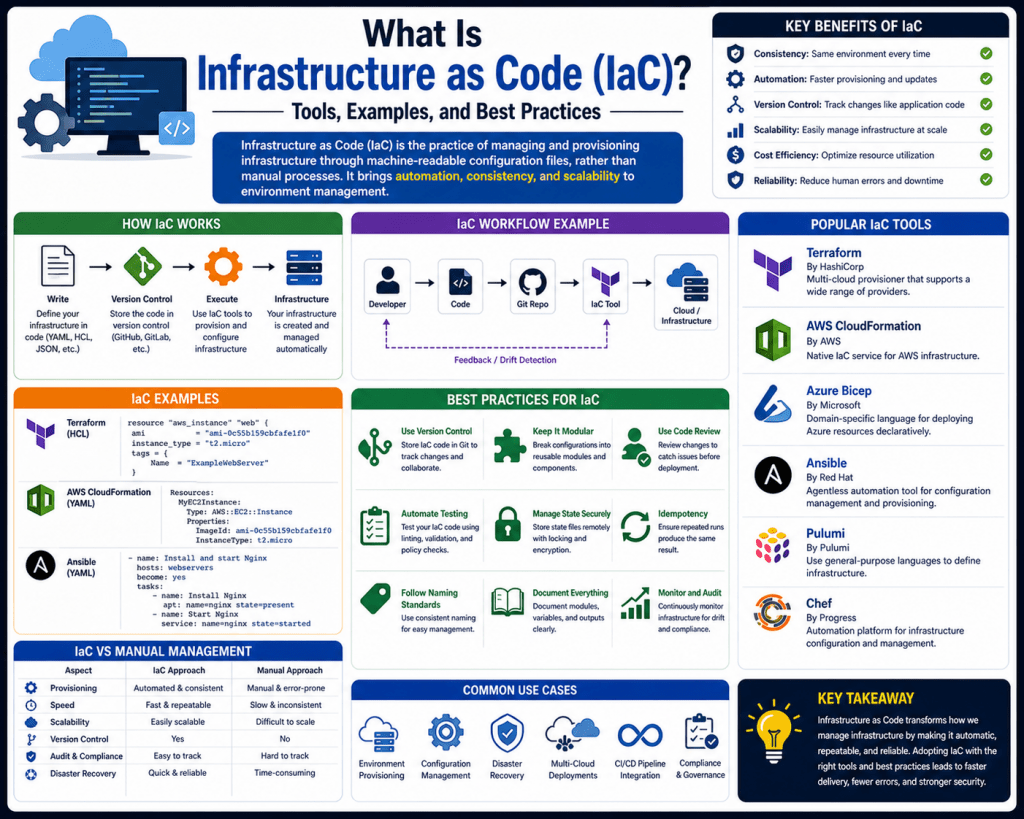
Infrastructure as Code, often abbreviated as IaC, is a methodology that allows IT infrastructure to be managed and provisioned through machine-readable configuration files rather than through manual processes. This approach fundamentally changes how organizations interact with their computing environments by replacing repetitive manual tasks with automated workflows. Instead of logging into servers, configuring settings individually, or relying on ad hoc scripts, administrators define the entire infrastructure in structured files that describe how systems should be set up and maintained.
At a foundational level, IaC treats infrastructure in the same way software developers treat application code. This means infrastructure configurations are written, stored, versioned, and executed using the same principles applied in software development. By doing so, it becomes possible to replicate environments consistently, track changes over time, and reduce the likelihood of human error.
The instructions used in IaC are typically written in structured data formats such as JSON or YAML, which are both human-readable and machine-parseable. These files define resources like servers, storage, networking components, and access controls. Once defined, an IaC tool reads the instructions and automatically provisions or modifies the infrastructure to match the desired state described in the code.
This model is especially valuable in modern environments where systems must be deployed rapidly and scaled dynamically. As organizations grow and their infrastructure becomes more complex, manual management becomes impractical. IaC addresses this issue by introducing consistency, automation, and repeatability into infrastructure management processes.
The Growing Complexity of IT Environments
Modern IT environments have evolved significantly over the past decade, becoming more distributed, dynamic, and interconnected. Organizations now operate across multiple platforms, including private data centers, public cloud environments, and hybrid infrastructures. Each of these environments introduces its own configurations, dependencies, and operational challenges.
As systems expand, managing infrastructure manually becomes increasingly difficult. Administrators must handle tasks such as configuring servers, setting up networks, managing storage, and ensuring security compliance. When performed manually, these tasks are not only time-consuming but also prone to inconsistencies. Even small configuration errors can lead to system failures, security vulnerabilities, or performance issues.
Another challenge is the need for rapid deployment. Businesses today demand faster time-to-market for applications and services, which requires infrastructure to be provisioned quickly and reliably. Manual processes cannot keep up with these demands, leading to delays and inefficiencies.
IaC provides a solution by automating infrastructure provisioning and management. By defining infrastructure in code, organizations can deploy environments in minutes rather than hours or days. This capability is particularly important in scenarios where multiple environments, such as development, testing, and production, must be maintained simultaneously.
In addition to speed, IaC enhances consistency. Since configurations are defined in code, the same setup can be applied across all environments without variation. This eliminates the common issue of configuration drift, where systems gradually become inconsistent over time due to manual changes.
Core Definition and Operational Model of IaC
Infrastructure as Code can be defined as the practice of managing and provisioning computing infrastructure through machine-readable definition files. These files act as blueprints that describe the desired state of the system, including resource specifications, configurations, and relationships between components.
The operational model of IaC revolves around the concept of desired state configuration. Instead of specifying each step required to achieve a particular setup, the user defines the end state of the infrastructure. The IaC tool then determines the necessary actions to reach that state. This approach simplifies the management process and reduces the complexity associated with manual configuration.
For example, a configuration file might specify that a system requires three servers, each with a certain amount of memory and processing power, connected to a specific network and secured with defined access controls. The IaC tool reads this file and automatically provisions the required resources, ensuring that they match the defined specifications.
This model also supports continuous updates. If changes are made to the configuration file, the IaC tool can apply those changes incrementally, updating the existing infrastructure without disrupting operations. This capability is essential for maintaining flexibility and adaptability in dynamic environments.
By abstracting the underlying complexity of infrastructure management, IaC allows administrators to focus on defining requirements rather than executing tasks. This shift improves efficiency and enables organizations to manage larger and more complex systems with fewer resources.
Historical Evolution of Infrastructure as Code
The concept of Infrastructure as Code did not emerge overnight but evolved alongside advancements in computing technologies. In the early days of IT, infrastructure management was entirely manual, with administrators configuring physical servers and network devices individually. This approach was manageable for small environments but quickly became unsustainable as systems grew in size and complexity.
The introduction of configuration management tools marked the first step toward automation. These tools allowed administrators to define system configurations in scripts, enabling consistent application across multiple servers. While this represented a significant improvement, it still required a procedural approach, where each step had to be explicitly defined.
The rise of virtualization further accelerated the evolution of IaC. By abstracting hardware resources into virtual machines, organizations gained greater flexibility in managing infrastructure. This abstraction made it easier to define and replicate environments using code, laying the groundwork for modern IaC practices.
Cloud computing played a pivotal role in the widespread adoption of IaC. Cloud platforms introduced programmable interfaces that allowed users to provision and manage resources through code. This capability transformed infrastructure management, making it possible to deploy entire environments with a few lines of configuration.
Containerization and orchestration technologies further advanced IaC by enabling lightweight, portable application environments. These technologies allowed developers to package applications with their dependencies and deploy them consistently across different systems. Orchestration platforms then automated the management of these containers, handling tasks such as scaling, load balancing, and recovery.
Together, these developments have shaped the modern IaC landscape, where infrastructure management is fully integrated with software development processes.
Key Principles That Define IaC
Infrastructure as Code is built on several key principles that guide its implementation and usage. One of the most important principles is consistency. By defining infrastructure in code, organizations can ensure that environments are configured in the same way every time, eliminating variability and reducing errors.
Another critical principle is repeatability. IaC allows configurations to be applied multiple times across different environments without modification. This ensures that development, testing, and production environments are identical, reducing the risk of issues caused by inconsistencies.
Immutability is another important concept in IaC. Instead of modifying existing infrastructure, new instances are created when changes are needed. This approach simplifies management and reduces the likelihood of configuration drift.
Version control is also central to IaC. By storing configuration files in a version-controlled repository, teams can track changes, collaborate effectively, and revert to previous versions if necessary. This enhances transparency and accountability in infrastructure management.
Automation is the driving force behind IaC, enabling rapid provisioning and management of resources. By automating repetitive tasks, organizations can reduce manual effort and improve efficiency.
These principles collectively enable IaC to deliver its core benefits, including scalability, reliability, and efficiency.
Declarative and Imperative Approaches in IaC
Infrastructure as Code can be implemented using either a declarative or imperative approach, each with its own characteristics and use cases. The declarative approach focuses on defining the desired state of the infrastructure without specifying how to achieve it. In this model, the user describes what the system should look like, and the IaC tool determines the necessary steps to reach that state.
This approach is generally preferred for its simplicity and reliability. By abstracting the execution details, declarative IaC reduces complexity and ensures consistent results. It also makes it easier to manage large-scale environments, as changes can be applied by simply updating the configuration file.
The imperative approach, on the other hand, involves specifying detailed instructions for each step of the configuration process. Users define exactly how resources should be created, configured, and connected. This provides greater control over the execution process but can also introduce complexity, especially in environments with many dependencies.
While both approaches have their advantages, the choice between them depends on the specific requirements of the project. Declarative models are typically used for managing large-scale systems, while imperative models are suited for scenarios that require precise control over execution.
Infrastructure as Data and Its Impact
Treating infrastructure as data is one of the most transformative aspects of IaC. By representing configurations as structured data, organizations can apply data management techniques to their infrastructure. This includes storing configurations in repositories, analyzing them for optimization, and reusing them across different environments.
This approach enables greater flexibility and efficiency in managing infrastructure. Configurations can be easily modified, shared, and applied to multiple systems, reducing the effort required to maintain consistency. It also supports better testing and validation, as configurations can be reviewed and tested before deployment.
Infrastructure as data also facilitates integration with other systems and processes. For example, configuration files can be incorporated into automated workflows, enabling continuous deployment and integration processes. This creates a seamless connection between infrastructure management and application development.
By treating infrastructure as data, organizations can achieve a higher level of control and visibility over their systems, improving overall efficiency and reliability.
Role of Version Control and Collaboration
Version control systems play a crucial role in IaC by providing a structured way to manage changes to infrastructure configurations. By storing configuration files in a repository, teams can maintain a complete history of modifications, including who made changes and when they occurred.
This transparency is essential for collaboration, as it allows multiple team members to work on the same infrastructure without conflicts. Changes can be reviewed and approved before being applied, ensuring that only validated configurations are deployed.
Version control also enables rollback capabilities, which are critical in case of errors or unexpected issues. If a configuration change causes problems, the system can be reverted to a previous state quickly, minimizing downtime.
In addition, version control supports branching strategies that allow teams to experiment with new configurations without affecting production environments. This flexibility encourages innovation while maintaining stability.
Automation and Orchestration in IaC Systems
Automation is the foundation of Infrastructure as Code, enabling the rapid provisioning and management of resources. By automating repetitive tasks, organizations can reduce manual effort and improve consistency across environments.
Orchestration builds on automation by coordinating multiple processes and ensuring that resources are deployed in the correct sequence. In complex systems, different components often depend on each other, requiring careful management to ensure proper functionality. Orchestration tools handle these dependencies, ensuring that each component is configured correctly and at the right time.
Together, automation and orchestration enable organizations to manage large-scale environments efficiently. They support dynamic scaling, where resources are adjusted automatically based on demand, and facilitate continuous delivery processes by integrating infrastructure deployment with application updates.
This combination of capabilities makes IaC an essential component of modern IT operations, providing the flexibility and efficiency needed to manage increasingly complex systems.
How Infrastructure as Code Works Under the Hood
Infrastructure as Code operates through a structured interaction between configuration files, orchestration engines, and underlying infrastructure platforms. At the center of this model is the IaC definition file, which contains a structured description of the desired infrastructure state. This file is written in a declarative or imperative format, depending on the chosen tool and methodology.
When executed, an IaC engine interprets the configuration file and compares it against the current state of the infrastructure. This comparison process is often referred to as reconciliation. If discrepancies are found between the desired state and the actual state, the engine determines the necessary actions required to align the system with the defined configuration.
This mechanism introduces a key abstraction layer. Instead of manually provisioning resources, administrators define requirements, and the system handles execution automatically. This abstraction reduces operational complexity and ensures that infrastructure changes are applied consistently.
Behind the scenes, IaC tools interact with application programming interfaces provided by infrastructure platforms. These APIs allow the creation, modification, and deletion of resources such as virtual machines, storage systems, and network components. The IaC engine translates configuration definitions into API calls, which are then executed by the underlying platform.
This architecture enables scalability and automation at a level that manual processes cannot achieve. It also ensures that infrastructure changes are reproducible, predictable, and traceable.
The Role of Desired State Configuration in IaC Systems
A central concept in Infrastructure as Code is desired state configuration. This principle defines how infrastructure should look at any given point in time. Instead of specifying step-by-step instructions for building infrastructure, users define the final state they want to achieve.
For example, a configuration might specify that a system should include a set number of servers, each configured with specific CPU, memory, and network settings. It may also define load balancing rules, security policies, and storage allocations. The IaC engine interprets this definition and ensures that the actual infrastructure matches it.
If any changes occur in the system—whether due to manual intervention, system failure, or scaling requirements—the IaC engine can automatically correct deviations. This self-healing behavior is a key advantage of the desired state model.
The system continuously monitors infrastructure and compares it to the defined configuration. When inconsistencies are detected, corrective actions are triggered. This ensures long-term stability and reduces the risk of configuration drift, which is one of the most common issues in manually managed environments.
By focusing on outcomes rather than procedures, desired state configuration simplifies infrastructure management and improves reliability.
Declarative Infrastructure Models in Depth
Declarative infrastructure models are widely used in modern IaC systems due to their simplicity and reliability. In this approach, users define what the infrastructure should look like, without specifying how to achieve that state.
This abstraction allows IaC tools to determine the most efficient sequence of actions required to provision resources. It reduces complexity for administrators, as they do not need to manage procedural logic or execution steps.
Declarative models are particularly effective in large-scale environments where multiple dependencies exist between components. For example, a database server may need to be created before an application server can connect to it. The IaC engine automatically handles these dependencies.
Another advantage of declarative systems is idempotence. This means that applying the same configuration multiple times will always produce the same result. If the system is already in the desired state, no changes are made. This prevents unnecessary modifications and reduces the risk of errors.
Declarative models also improve maintainability. Since configurations describe the end state, they are easier to read, understand, and modify. This makes collaboration between teams more efficient and reduces the learning curve for new users.
Imperative Infrastructure Models and Execution Control
In contrast to declarative models, imperative Infrastructure as Code requires explicit instructions for each step in the provisioning process. Users define exactly how resources should be created, configured, and connected.
This approach provides greater control over execution, which can be useful in scenarios where precise sequencing is required. For example, certain security configurations may need to be applied before a system is made accessible.
Imperative models allow administrators to define custom logic and workflows, making them suitable for complex or specialized environments. However, this flexibility comes at the cost of increased complexity.
Managing imperative configurations requires careful attention to dependencies and execution order. If steps are not correctly defined, infrastructure deployment may fail or produce inconsistent results.
Despite these challenges, imperative models remain valuable in certain use cases where fine-grained control is necessary. They are often used in combination with declarative approaches to balance flexibility and simplicity.
Infrastructure as Code Execution Workflow
The execution workflow of Infrastructure as Code involves several stages that transform configuration files into operational infrastructure. The first stage is parsing, where the IaC engine reads and interprets the configuration file.
Once parsed, the system performs a state evaluation. This involves comparing the desired state defined in the configuration with the current state of the infrastructure. Any differences between the two are identified as required changes.
The next stage is planning. During this phase, the IaC engine determines the sequence of actions needed to achieve the desired state. This may include creating new resources, updating existing ones, or removing outdated components.
After planning, the execution phase begins. In this stage, the IaC tool interacts with infrastructure APIs to apply the necessary changes. These actions are performed automatically without manual intervention.
Finally, the system enters a verification phase. Here, the IaC engine confirms that the infrastructure now matches the desired state. If discrepancies remain, additional corrective actions may be triggered.
This structured workflow ensures accuracy, consistency, and reliability in infrastructure management.
Role of APIs in Infrastructure Automation
Application Programming Interfaces (APIs) are the backbone of Infrastructure as Code systems. They provide the communication layer between IaC tools and infrastructure platforms.
Through APIs, IaC engines can perform actions such as creating virtual machines, configuring networks, and managing storage resources. These operations are executed programmatically, enabling full automation of infrastructure provisioning.
Cloud providers expose extensive APIs that allow nearly every aspect of infrastructure to be controlled through code. This includes compute resources, security configurations, scaling policies, and monitoring systems.
IaC tools translate configuration definitions into API requests, which are then executed by the infrastructure platform. The results of these operations are returned to the IaC engine, allowing it to track system state and ensure consistency.
Without APIs, Infrastructure as Code would not be possible at scale. They enable the automation, flexibility, and integration required for modern IT environments.
State Management and Infrastructure Tracking
State management is a critical component of Infrastructure as Code systems. It refers to the process of tracking the current status of infrastructure resources and comparing it with the desired configuration.
IaC tools maintain a state file that records information about deployed resources. This file includes details such as resource identifiers, configurations, and relationships.
When changes are made to the infrastructure, the state file is updated to reflect the new configuration. This ensures that the IaC engine always has an accurate understanding of the system.
State management also enables incremental updates. Instead of rebuilding entire environments, IaC tools can modify only the components that have changed. This improves efficiency and reduces deployment time.
In distributed environments, state management becomes more complex, requiring synchronization mechanisms to ensure consistency across systems. Proper state handling is essential for maintaining reliability in large-scale infrastructure deployments.
Modularity and Reusable Infrastructure Components
Modularity is a key principle in Infrastructure as Code design. It involves breaking down infrastructure configurations into smaller, reusable components.
These components can represent individual resources such as servers, databases, or network configurations. By modularizing infrastructure, organizations can reuse configurations across multiple projects and environments.
This approach reduces duplication and simplifies maintenance. Instead of rewriting configurations for each deployment, teams can reference existing modules and customize them as needed.
Modularity also improves collaboration. Different teams can develop and maintain separate components without interfering with each other. This supports parallel development and accelerates deployment cycles.
Reusable infrastructure components also enhance consistency, as standardized modules ensure that systems are configured in the same way across environments.
Version Control Integration and Change Management
Version control integration is a fundamental aspect of Infrastructure as Code workflows. It enables teams to manage changes to infrastructure configurations in a structured and traceable manner.
Every modification to infrastructure code is recorded in a version control system. This includes information about what was changed, who made the change, and when it occurred.
This level of traceability is essential for auditing and compliance purposes. It ensures that all changes are documented and can be reviewed if necessary.
Version control also supports collaboration by allowing multiple contributors to work on the same infrastructure definitions simultaneously. Conflicts can be resolved through structured review processes.
Branching strategies enable teams to experiment with new configurations without affecting production environments. Once validated, changes can be merged into the main configuration.
This structured approach to change management improves stability and reduces the risk of errors in production systems.
Automation Pipelines and Continuous Integration
Infrastructure as Code is often integrated into automated pipelines that support continuous integration and continuous deployment workflows. These pipelines automate the process of testing, validating, and deploying infrastructure changes.
When a configuration change is introduced, it is first validated through automated testing. These tests ensure that the configuration is syntactically correct and logically consistent.
Once validated, the configuration is applied to a staging environment where it can be further tested. If no issues are detected, it is then deployed to production.
This automated workflow reduces manual intervention and ensures that infrastructure changes are deployed safely and consistently.
By integrating IaC into CI pipelines, organizations can achieve faster deployment cycles and improved reliability in infrastructure management.
Scalability and Dynamic Infrastructure Provisioning
One of the most important advantages of Infrastructure as Code is its ability to support scalability. Systems can be dynamically adjusted based on demand, ensuring optimal performance and resource utilization.
IaC enables automatic scaling by defining rules that determine when resources should be added or removed. For example, additional servers may be provisioned when traffic increases and removed when demand decreases.
This dynamic provisioning ensures that systems remain efficient and cost-effective. It also improves user experience by maintaining performance under varying workloads.
Scalability is particularly important in cloud environments where resources are billed based on usage. IaC allows organizations to optimize resource consumption and reduce operational costs.
Through automation and orchestration, IaC enables infrastructure to adapt in real time, supporting modern application requirements.
Infrastructure as Code in Modern DevOps Ecosystems
Infrastructure as Code plays a central role in modern DevOps ecosystems by bridging the gap between software development and IT operations. In traditional environments, developers and system administrators often worked in isolation, leading to delays, miscommunication, and inconsistent deployments. IaC eliminates this separation by treating infrastructure as part of the application lifecycle.
Within a DevOps model, infrastructure definitions are stored alongside application code in shared repositories. This allows both developers and operations teams to collaborate on system changes using the same workflows, tools, and version control practices. As a result, infrastructure becomes a first-class component of the software delivery process.
Continuous integration pipelines commonly integrate IaC to ensure that infrastructure changes are validated and tested before deployment. When a developer modifies infrastructure code, automated systems can detect the change, run validation checks, and apply updates in controlled environments. This reduces the risk of introducing unstable configurations into production systems.
Continuous deployment extends this process by automatically applying validated infrastructure changes to live environments. This enables organizations to deploy infrastructure updates at the same speed as application updates, significantly improving agility and responsiveness.
By integrating IaC into DevOps pipelines, organizations achieve faster delivery cycles, improved collaboration, and higher system reliability.
Enterprise-Scale Infrastructure Automation Models
At the enterprise level, Infrastructure as Code becomes a foundational component of large-scale IT operations. Organizations managing thousands of servers, multiple cloud environments, and hybrid architectures rely heavily on automation to maintain consistency and control.
Enterprise IaC models typically involve layered architecture designs. These layers separate concerns such as network configuration, compute provisioning, security policies, and application deployment. This separation allows different teams to manage specific parts of the infrastructure independently while maintaining overall coherence.
Centralized control systems are often used to enforce standards across environments. These systems ensure that all infrastructure deployments comply with organizational policies, security requirements, and operational guidelines.
Automation at this scale also involves advanced orchestration systems that coordinate multiple infrastructure components simultaneously. These systems manage dependencies between services, ensuring that resources are provisioned in the correct order and configured properly.
Enterprise IaC implementations also emphasize scalability. Infrastructure definitions must be designed to support dynamic expansion across regions, data centers, and cloud providers. This requires modular, reusable configurations that can be adapted to different environments without significant modification.
Hybrid and Multi-Cloud Infrastructure Strategies
Modern organizations rarely rely on a single infrastructure provider. Instead, they adopt hybrid or multi-cloud strategies that combine on-premises systems with multiple cloud platforms. Infrastructure as Code plays a crucial role in managing this complexity.
In hybrid environments, IaC enables seamless integration between private data centers and public cloud services. Infrastructure definitions can include both physical and virtual resources, allowing organizations to manage them through a unified approach.
Multi-cloud strategies introduce additional complexity, as different cloud providers often use distinct APIs, configuration formats, and resource models. IaC tools abstract these differences by providing a consistent interface for infrastructure management.
This abstraction allows organizations to define infrastructure once and deploy it across multiple platforms with minimal changes. It also reduces vendor lock-in by making infrastructure configurations portable.
By leveraging IaC in hybrid and multi-cloud environments, organizations gain flexibility, resilience, and improved resource optimization across diverse infrastructure ecosystems.
Security Integration in Infrastructure as Code
Security is a critical aspect of Infrastructure as Code, particularly as infrastructure becomes more automated and distributed. IaC introduces both opportunities and challenges in the security domain.
One of the key benefits of IaC is the ability to enforce security policies consistently across environments. Security configurations such as access controls, encryption settings, and firewall rules can be defined in code and applied uniformly. This reduces the risk of misconfiguration, which is a common cause of security vulnerabilities.
IaC also supports the concept of security as code, where security policies are embedded directly into infrastructure definitions. This ensures that security requirements are enforced automatically during deployment rather than being applied manually afterward.
However, IaC also introduces risks if configurations are not properly managed. A single misconfigured file can expose systems to unauthorized access or data breaches. For this reason, validation and auditing processes are essential components of IaC workflows.
Automated scanning tools are often integrated into IaC pipelines to detect security issues before deployment. These tools analyze configuration files for vulnerabilities, compliance violations, and unsafe practices.
By incorporating security into the infrastructure lifecycle, IaC enables a proactive approach to risk management.
Policy as Code and Compliance Automation
Policy as Code is an extension of Infrastructure as Code that focuses on defining organizational policies in machine-readable formats. These policies govern how infrastructure should be configured, deployed, and managed.
In traditional environments, compliance checks are often performed manually, which can be time-consuming and inconsistent. Policy as Code automates this process by embedding compliance rules directly into infrastructure workflows.
When infrastructure changes are proposed, automated systems evaluate them against predefined policies. If a configuration violates any rule, it is flagged or rejected before deployment.
This approach ensures continuous compliance with regulatory requirements, security standards, and internal governance models. It also reduces the burden on compliance teams by automating routine checks.
Policy as Code is particularly important in regulated industries where strict controls are required. It enables organizations to maintain compliance at scale without slowing down development processes.
Disaster Recovery and Infrastructure Reproducibility
One of the most powerful advantages of Infrastructure as Code is its ability to support disaster recovery and system reproducibility. In traditional environments, rebuilding infrastructure after a failure can be time-consuming and error-prone.
With IaC, entire environments can be recreated from code. Since infrastructure definitions are stored in version-controlled repositories, they can be used to rebuild systems exactly as they were before failure.
This capability significantly reduces downtime during disasters. Instead of manually reconstructing systems, organizations can execute predefined configurations to restore infrastructure quickly.
Reproducibility also extends to testing environments. Developers can create identical replicas of production systems for testing and validation purposes. This ensures that applications behave consistently across different environments.
By enabling rapid recovery and consistent replication, IaC enhances system resilience and operational continuity.
Scalability Patterns in Infrastructure as Code Design
Scalability is a core requirement in modern IT systems, and Infrastructure as Code provides several patterns to support it. One common pattern is horizontal scaling, where additional instances of a service are added to handle increased load.
IaC enables horizontal scaling by defining rules that automatically provision new resources based on demand metrics. These rules can be integrated with monitoring systems that track performance indicators such as CPU usage, memory consumption, or network traffic.
Vertical scaling is another approach, where existing resources are enhanced with additional capacity. IaC can automate this process by adjusting resource allocations dynamically.
Elastic infrastructure design combines both horizontal and vertical scaling strategies to optimize performance and cost efficiency.
These scaling patterns ensure that infrastructure can adapt to changing workloads without manual intervention, making systems more responsive and efficient.
Testing and Validation of Infrastructure Code
Testing is a critical component of Infrastructure as Code workflows. Before infrastructure changes are applied, they must be validated to ensure correctness and stability.
Static analysis is commonly used to check configuration files for syntax errors, structural issues, and policy violations. This helps identify problems early in the development process.
Integration testing involves deploying infrastructure in controlled environments to verify that it behaves as expected. These environments replicate production conditions to ensure accuracy.
Simulation testing can also be used to model infrastructure changes without actually applying them. This allows teams to evaluate potential outcomes and identify risks.
By incorporating testing into IaC workflows, organizations reduce the likelihood of deployment failures and improve system reliability.
Observability and Infrastructure Monitoring in IaC Environments
Observability is essential in Infrastructure as Code systems to ensure that infrastructure behaves as expected after deployment. Monitoring tools collect data on system performance, resource utilization, and operational health.
IaC integrates with observability systems to provide real-time insights into infrastructure behavior. This allows teams to detect issues early and respond quickly to anomalies.
Logging and metrics collection are key components of observability. Logs provide detailed records of system events, while metrics offer quantitative data on performance.
Tracing systems can also be used to track the flow of requests across distributed infrastructure components. This is particularly useful in microservices architectures where multiple services interact.
By combining IaC with observability, organizations gain full visibility into their infrastructure, improving troubleshooting and optimization capabilities.
Cost Optimization Through Infrastructure Automation
Infrastructure as Code contributes significantly to cost optimization by enabling efficient resource management. Automated scaling ensures that resources are only used when needed, reducing unnecessary expenses.
IaC also allows organizations to define cost-efficient infrastructure configurations. For example, less expensive storage options can be used for non-critical data, while high-performance resources are reserved for critical workloads.
Resource tagging and tracking further enhance cost management by providing visibility into resource usage across environments.
Automated cleanup processes can remove unused resources, preventing waste and reducing operational costs.
By optimizing infrastructure usage through automation, IaC helps organizations achieve better financial efficiency without compromising performance.
Conclusion
Infrastructure as Code represents one of the most significant operational shifts in modern information technology, fundamentally changing how infrastructure is designed, deployed, and maintained. Instead of relying on manual processes that are slow, error-prone, and difficult to scale, IaC introduces a structured, automated, and highly repeatable approach to managing computing environments. By expressing infrastructure requirements in machine-readable formats, organizations gain the ability to treat infrastructure with the same discipline traditionally reserved for software development. This shift is not simply a technical improvement but an operational transformation that influences speed, reliability, scalability, and governance across entire IT ecosystems.
One of the most important outcomes of adopting Infrastructure as Code is consistency. In traditional infrastructure management, even well-documented environments can drift over time due to manual changes, emergency fixes, or human oversight. These small inconsistencies accumulate and eventually lead to configuration drift, where development, testing, and production systems no longer match. IaC eliminates this problem by ensuring that infrastructure is always defined by a single source of truth. When systems are deployed or updated, they are continuously reconciled against the defined configuration. This guarantees that environments remain aligned and predictable, which is essential for stable application performance.
Another critical outcome is scalability. Modern digital systems must handle unpredictable workloads, often scaling from minimal usage to massive demand in short periods. Manual provisioning cannot keep pace with this requirement. Infrastructure as Code enables dynamic scaling by allowing systems to be defined once and replicated or adjusted automatically as needed. Whether expanding computing resources during peak usage or reducing capacity during low demand, IaC ensures that infrastructure adapts efficiently without requiring direct human intervention. This responsiveness not only improves performance but also optimizes resource utilization, reducing unnecessary operational costs.
Equally important is the role of automation in reducing operational risk. Human error remains one of the leading causes of infrastructure failures, particularly in complex environments where multiple systems interact. A single misconfiguration can result in downtime, security exposure, or performance degradation. IaC reduces these risks by replacing manual steps with automated workflows that execute consistently every time. Because infrastructure is defined in code, it can also be tested, reviewed, and validated before deployment, introducing a level of quality control that is difficult to achieve through manual processes.
The integration of Infrastructure as Code with version control systems further strengthens its reliability. Every change to infrastructure is tracked, recorded, and traceable. This creates a detailed historical record of how systems evolve. In practice, this means that teams can identify exactly when a change was introduced, who made it, and why it was implemented. If issues arise, systems can be rolled back to previous stable configurations quickly and safely. This level of traceability is essential not only for operational stability but also for governance, auditing, and compliance requirements in regulated industries.
From an organizational perspective, IaC also improves collaboration between development and operations teams. Traditionally, these groups operated in silos, often leading to delays and miscommunication. Infrastructure as Code aligns them through shared workflows, shared tooling, and shared responsibilities. Infrastructure becomes part of the application lifecycle rather than a separate operational concern. This alignment is a core principle of modern DevOps practices, where speed and reliability must coexist. By embedding infrastructure into the development process, organizations achieve faster delivery cycles without sacrificing stability.
Security and compliance also benefit significantly from Infrastructure as Code. Instead of applying security controls manually after deployment, policies can be embedded directly into infrastructure definitions. This ensures that security configurations are consistently applied across all environments. Automated validation tools can detect misconfigurations before they reach production, reducing the risk of vulnerabilities. In addition, policy-driven automation ensures that infrastructure adheres to organizational and regulatory standards continuously rather than periodically.
Despite its advantages, Infrastructure as Code is not without challenges. It requires a shift in mindset, moving from manual operations to code-driven infrastructure management. Teams must develop new skills in scripting, automation, and system design. Poorly designed infrastructure code can also introduce complexity if not structured properly, making modularity and maintainability essential considerations. However, these challenges are generally outweighed by the long-term benefits in efficiency, reliability, and scalability.
Looking at the broader technological landscape, Infrastructure as Code is becoming increasingly central to cloud-native architectures, distributed systems, and hybrid environments. As organizations continue to adopt multi-cloud strategies and microservice-based applications, the need for automated and consistent infrastructure management grows stronger. IaC provides the foundation for these modern architectures by ensuring that infrastructure can be defined, deployed, and managed in a standardized and repeatable way across diverse environments.
In essence, Infrastructure as Code represents a shift from manual control to declarative intent, from reactive management to proactive automation, and from isolated systems to integrated ecosystems. It enables infrastructure to evolve at the same pace as software, supporting modern demands for speed, scalability, and resilience. As IT environments continue to grow in complexity, IaC will remain a fundamental approach for building systems that are not only functional but also adaptable, secure, and efficient over time.