The modern digital environment has transformed how organizations operate, communicate, and store information. While this transformation has improved efficiency and scalability, it has also introduced serious security challenges. Data breaches have become increasingly common, affecting organizations of all sizes and industries. Sensitive information such as financial data, personal records, and intellectual property is now stored digitally, making it a prime target for unauthorized access.
Many of these breaches are not the result of highly advanced attacks but rather basic mistakes and oversights. Weak security configurations, outdated systems, and poor access control policies often create vulnerabilities that attackers can easily exploit. This reveals a critical issue in cybersecurity: a large percentage of breaches are preventable. Organizations that fail to implement strong security measures or ignore regular system checks are more likely to face serious incidents.
The consequences of a data breach extend far beyond immediate financial loss. Organizations may suffer reputational damage, legal penalties, and loss of customer trust. Recovery from such incidents can take years and may require significant investment. As a result, businesses are increasingly prioritizing preventive strategies rather than reactive solutions.
Why Preventable Security Failures Still Happen
Despite the availability of advanced security tools and frameworks, preventable breaches continue to occur. One of the main reasons is the gap between knowledge and implementation. Organizations may be aware of security best practices but fail to apply them consistently across their systems.
Human error remains a major factor in security failures. Employees may unintentionally expose systems by using weak passwords, sharing credentials, or failing to follow security protocols. Even small mistakes can create significant vulnerabilities if not addressed promptly. Training and awareness are essential, but they are often overlooked or treated as secondary priorities.
Misconfiguration is another common issue that leads to security incidents. Systems that are not properly set up can expose sensitive data to unauthorized users. This is particularly common in cloud environments, where incorrect settings can make data publicly accessible. Regular reviews and audits are necessary to ensure that configurations remain secure.
Lack of regular monitoring also contributes to ongoing vulnerabilities. Without continuous oversight, organizations may not detect suspicious activities or system weaknesses in time. This delay can allow attackers to exploit vulnerabilities before they are identified and resolved.
The Expanding Role of IT Auditing
As security risks continue to grow, IT auditing has become an essential function within organizations. It provides a structured approach to evaluating systems, identifying risks, and ensuring compliance with established standards. Rather than waiting for incidents to occur, organizations use auditing to proactively detect and address vulnerabilities.
IT auditing involves reviewing system configurations, access controls, and operational processes. Auditors assess whether systems are functioning as intended and whether security measures are effective. This process helps organizations maintain a strong security posture and reduce the likelihood of breaches.
The role of IT auditors has evolved significantly over time. In the past, auditing was often seen as a compliance-driven activity focused on meeting regulatory requirements. Today, it is a strategic function that supports overall risk management and business continuity. Auditors work closely with different departments to ensure that security is integrated into all aspects of operations.
Organizations are increasingly recognizing the value of skilled auditors who can analyze complex systems and provide actionable insights. This has led to a growing demand for professionals with specialized knowledge in IT auditing and risk management.
Introduction to the CISA Certification
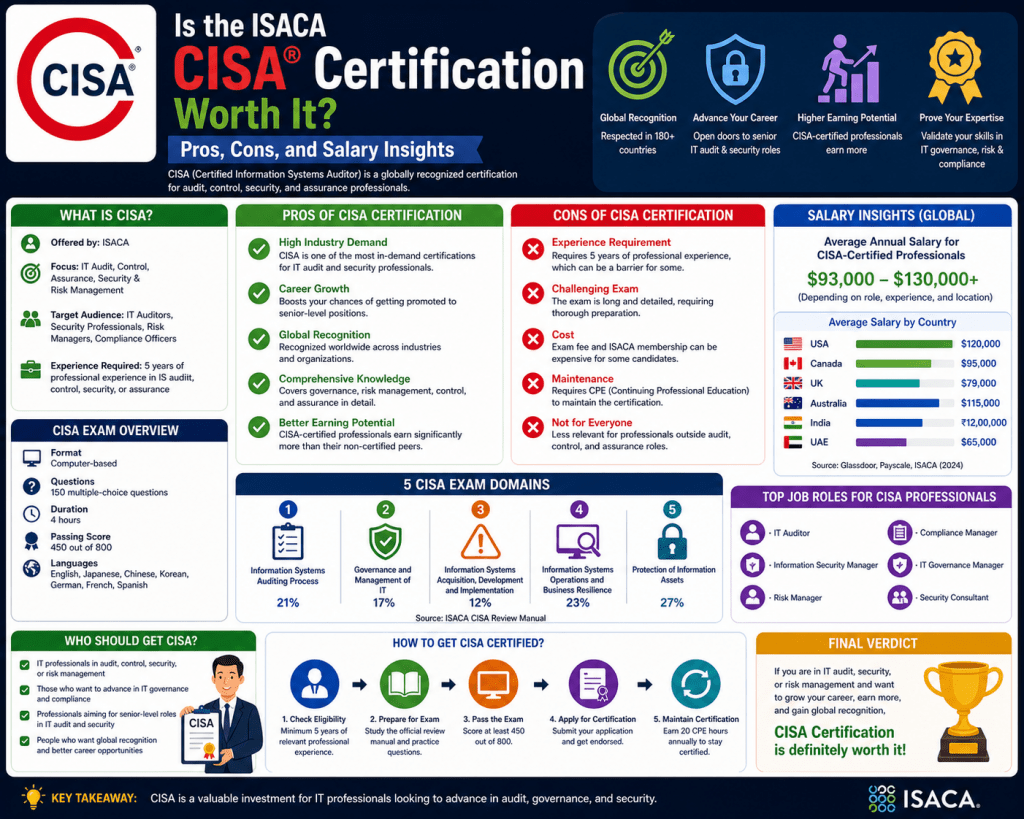
The Certified Information Systems Auditor certification is designed to validate the expertise of professionals in IT auditing. It is widely regarded as a benchmark for individuals who specialize in assessing information systems and managing risks. The certification demonstrates that a professional has the knowledge and skills required to evaluate security controls and ensure compliance.
This certification is particularly relevant in environments where data protection and regulatory compliance are critical. Organizations rely on certified professionals to ensure that their systems are secure and that risks are being managed effectively. The certification also enhances credibility, making individuals more competitive in the job market.
The scope of the certification goes beyond technical knowledge. It includes understanding business processes, governance frameworks, and risk management strategies. This broader perspective allows professionals to align security practices with organizational goals.
Core Domains of Knowledge
The certification is structured around several key domains that define the field of IT auditing. Each domain focuses on a specific area, ensuring that professionals develop a comprehensive understanding of information systems and their management.
The auditing process domain covers the fundamentals of planning, executing, and reporting audits. Professionals learn how to gather evidence, evaluate controls, and present findings in a structured manner. This domain forms the foundation of effective auditing practices.
The governance domain focuses on aligning IT strategies with business objectives. It involves establishing policies, frameworks, and oversight mechanisms that ensure accountability and transparency. Strong governance is essential for maintaining the integrity of information systems.
The system development domain examines how systems are acquired, developed, and implemented. It emphasizes the importance of integrating security measures during the development phase to prevent vulnerabilities from being introduced.
The operations and resilience domain addresses the management of day-to-day activities and the ability to respond to disruptions. This includes incident management, disaster recovery, and business continuity planning. Organizations must be prepared to handle unexpected events without significant impact.
The protection of the information assets domain focuses on safeguarding data through various security measures. This includes encryption, access control, and monitoring systems. Protecting sensitive information is a top priority for organizations in the digital age.
Exam Structure and Level of Difficulty
The certification exam is designed to test a candidate’s understanding of all core domains. It includes a large number of questions that must be completed within a fixed time frame. The exam assesses both theoretical knowledge and practical application.
Candidates are required to analyze scenarios and determine appropriate actions based on their understanding of concepts. This approach ensures that certified professionals can apply their knowledge in real-world situations. The exam is known for its difficulty, as it requires a deep understanding of multiple topics.
Preparation for the exam involves extensive study and practice. Candidates often spend several months reviewing materials, practicing questions, and gaining practical experience. The effort required reflects the value of the certification in the professional world.
Experience Requirements and Eligibility Criteria
A key aspect of the certification is the requirement for professional experience. Candidates must have several years of relevant work experience in IT auditing, control, or security. This ensures that certified individuals have practical knowledge in addition to theoretical understanding.
The experience requirement helps maintain the credibility of the certification. It ensures that those who hold the credential are capable of applying their knowledge effectively in real-world situations. While this requirement may seem challenging, it reinforces the value of the certification.
Some provisions allow candidates to reduce the experience requirement based on educational qualifications. This makes the certification more accessible while still maintaining high standards.
Ethical Standards and Professional Integrity
Ethics play a central role in IT auditing. Professionals are expected to maintain high standards of integrity, objectivity, and confidentiality. These principles are essential for building trust and ensuring the reliability of audit results.
Auditors often have access to sensitive information, making it important to handle data responsibly. They must conduct their work without bias and provide accurate assessments. Any compromise in ethical standards can undermine the credibility of the audit process.
Professional integrity also involves maintaining independence. Auditors must evaluate systems objectively without being influenced by external pressures. This ensures that their findings are based on evidence and not personal interests.
Ongoing Learning and Certification Maintenance
Maintaining the certification requires continuous learning and professional development. Certified individuals must stay updated with industry trends and emerging threats. This involves completing a certain number of learning hours each year.
Continuous learning helps professionals adapt to changes in technology and security practices. It also provides opportunities to expand knowledge and develop new skills. This ongoing process ensures that certified individuals remain effective in their roles.
In addition to learning requirements, maintaining the certification involves adhering to professional standards and fulfilling administrative obligations. These requirements reinforce the value of the certification and ensure its relevance over time.
The Importance of Certified Professionals in Organizations
Organizations value certified professionals because they bring expertise and credibility. These individuals help identify risks, improve controls, and ensure compliance with regulations. Their work contributes to building a secure and reliable environment.
Certified professionals also enhance an organization’s reputation. Their presence signals a commitment to maintaining high standards and protecting sensitive information. This can provide a competitive advantage in industries where security is a key concern.
As the demand for skilled IT auditors continues to grow, the importance of professional certifications becomes more evident. Organizations are seeking individuals who can navigate complex systems and provide assurance that security measures are effective.
Analyzing the Practical Benefits of the CISA Certification
The value of the Certified Information Systems Auditor certification becomes more evident when examining how it applies in real working environments. Organizations today operate in highly complex digital ecosystems where data flows across multiple platforms, networks, and cloud systems. This complexity increases the likelihood of security gaps, making it essential to have professionals who can systematically evaluate and control risks. The certification equips individuals with the ability to approach systems from an auditing perspective, focusing on identifying weaknesses before they turn into major issues.
One of the most practical benefits of this certification is its emphasis on structured thinking. Certified professionals are trained to analyze systems in a methodical way, ensuring that no critical component is overlooked. This structured approach is particularly valuable in large organizations where systems are interconnected, and a single vulnerability can have widespread consequences. By applying consistent auditing techniques, professionals can provide reliable insights that support decision-making.
Another important benefit is the ability to understand both technical and business perspectives. Many security issues arise because of a disconnect between technical teams and management. Certified individuals can bridge this gap by translating technical findings into business risks. This makes it easier for organizations to prioritize actions and allocate resources effectively.
How the Certification Enhances Risk Management Skills
Risk management is a central component of modern business operations, and the certification plays a significant role in strengthening this capability. Professionals learn how to identify potential threats, assess their impact, and implement strategies to reduce risks. This process involves not only technical analysis but also an understanding of organizational priorities.
Effective risk management requires the ability to evaluate both internal and external factors. Internal factors include system configurations, employee practices, and operational processes. External factors involve threats such as cyberattacks, regulatory changes, and technological advancements. Certified professionals are trained to consider all these elements when assessing risks.
The certification also emphasizes the importance of continuous monitoring. Risks are not static; they evolve as systems and technologies change. Professionals must regularly review and update their assessments to ensure that new vulnerabilities are addressed. This proactive approach helps organizations stay ahead of potential threats rather than reacting to incidents after they occur.
Strengthening Governance and Control Frameworks
Governance is a critical aspect of managing information systems, and the certification provides a strong foundation in this area. Governance involves establishing policies, procedures, and oversight mechanisms that guide how systems are managed. It ensures that IT operations align with organizational goals and comply with regulatory requirements.
Certified professionals play a key role in evaluating governance frameworks. They assess whether policies are clearly defined, whether responsibilities are properly assigned, and whether controls are effective. This evaluation helps organizations identify gaps and implement improvements that enhance accountability and transparency.
Control frameworks are another important focus area. These frameworks define the measures that are put in place to protect systems and data. Controls can include access restrictions, monitoring systems, and incident response procedures. Professionals must ensure that these controls are not only implemented but also functioning as intended.
By strengthening governance and control frameworks, organizations can create a more secure and reliable environment. This reduces the likelihood of security incidents and improves overall operational efficiency.
Improving Audit Effectiveness and Accuracy
The certification provides professionals with the tools and techniques needed to conduct thorough and accurate audits. Effective auditing requires a combination of technical knowledge, analytical skills, and attention to detail. Certified individuals are trained to approach audits in a systematic manner, ensuring that all relevant factors are considered.
One of the key aspects of effective auditing is evidence collection. Professionals must gather sufficient and appropriate evidence to support their findings. This involves reviewing system logs, analyzing configurations, and interviewing personnel. The ability to collect and evaluate evidence is essential for producing reliable audit reports.
Another important aspect is reporting. Audit findings must be communicated clearly and concisely to stakeholders. Certified professionals learn how to present their findings in a way that highlights key risks and provides actionable recommendations. This ensures that organizations can take appropriate steps to address identified issues.
Accuracy is critical in auditing, as incorrect findings can lead to poor decision-making. The certification emphasizes the importance of objectivity and thoroughness, helping professionals maintain high standards in their work.
Adapting to Evolving Technology Environments
Technology is constantly evolving, and organizations must adapt to new tools and platforms. This evolution presents both opportunities and challenges. While new technologies can improve efficiency, they can also introduce new risks. The certification prepares professionals to navigate these changes by providing a strong foundation in auditing principles.
Cloud computing is one of the most significant developments in recent years. Many organizations have moved their operations to cloud-based platforms, which require different security approaches compared to traditional systems. Certified professionals must understand how to evaluate cloud environments and ensure that they are properly secured.
Another important area is the use of automation and artificial intelligence. These technologies can improve efficiency but also create new vulnerabilities if not managed properly. Professionals must assess how these systems are implemented and whether appropriate controls are in place.
By staying informed about technological advancements, certified individuals can ensure that their auditing practices remain relevant and effective. This adaptability is essential in a rapidly changing digital landscape.
The Role of Communication in Auditing Success
Communication is a critical skill for professionals in auditing roles. The ability to convey complex information clearly and understandably is essential for effective decision-making. Certified individuals are trained to communicate their findings in a way that is accessible to both technical and non-technical audiences.
Audit reports must provide a clear overview of identified risks and recommended actions. This requires careful structuring of information and the use of simple language. Stakeholders must be able to understand the implications of the findings and take appropriate action.
In addition to written communication, professionals must also engage in discussions with various teams. This includes explaining findings, answering questions, and providing guidance on implementing improvements. Strong communication skills help build trust and ensure that recommendations are taken seriously.
Effective communication also involves listening. Professionals must understand the perspectives of different stakeholders and consider their input when making recommendations. This collaborative approach leads to better outcomes and stronger relationships within the organization.
Balancing Technical Knowledge and Business Insight
One of the unique aspects of the certification is its focus on both technical and business knowledge. Professionals must understand how systems operate while also considering how they support organizational objectives. This balance is essential for effective auditing and risk management.
Technical knowledge allows professionals to identify vulnerabilities and evaluate controls. However, understanding the business context is equally important. Professionals must consider how risks impact operations, financial performance, and reputation. This broader perspective helps prioritize actions and allocate resources effectively.
Balancing these two aspects requires continuous learning and experience. Professionals must stay updated with technological developments while also gaining insights into business processes. This combination of skills makes certified individuals valuable assets to organizations.
Challenges Faced by Certified Professionals in Real Work Environments
While the certification provides a strong foundation, professionals may face challenges when applying their knowledge in real-world situations. One common challenge is dealing with complex systems that involve multiple technologies and processes. Evaluating such systems requires a deep understanding and careful analysis.
Another challenge is resistance to change. Organizations may be reluctant to implement recommendations, especially if they require significant changes to existing processes. Professionals must navigate these situations by providing clear explanations and demonstrating the benefits of proposed actions.
Time constraints can also be a challenge. Audits must often be completed within limited timeframes, requiring efficient planning and execution. Professionals must prioritize tasks and focus on the most critical areas to ensure that audits are effective.
Despite these challenges, the certification prepares individuals to handle complex situations and adapt to different environments. The skills developed through the certification process help professionals overcome obstacles and deliver meaningful results.
Long-Term Skill Development Through the Certification
The certification is not just about obtaining a credential; it is also about developing skills that can be applied throughout a career. The knowledge gained during the preparation process provides a strong foundation for professional growth.
Critical thinking is one of the key skills developed through the certification. Professionals learn how to analyze situations, identify patterns, and make informed decisions. This skill is valuable in a wide range of roles and industries.
Problem-solving is another important skill. Professionals must identify issues, evaluate possible solutions, and implement effective strategies. This requires a combination of technical knowledge and practical experience.
The certification also encourages continuous improvement. Professionals are required to stay updated with industry developments and expand their knowledge. This ongoing learning process helps individuals remain competitive and adapt to changing environments.
The Expanding Demand for Skilled Auditors
The demand for skilled auditors continues to grow as organizations face increasing security challenges. Data protection, regulatory compliance, and risk management have become top priorities, creating a need for professionals who can address these areas effectively.
Organizations are looking for individuals who can ensure that their systems are secure and that risks are being managed properly. Certified professionals are well-positioned to meet this demand, as they have the knowledge and skills required to perform these tasks.
The growing importance of auditing is also reflected in the increasing number of opportunities available to professionals in this field. From corporate environments to government agencies, there is a wide range of roles that require auditing expertise.
As the digital landscape continues to evolve, the need for skilled auditors is expected to remain strong. Professionals who invest in developing their skills and gaining experience are likely to find ample opportunities for growth and advancement.
Determining Whether the CISA Certification Aligns With Career Goals
Choosing to pursue a professional certification requires careful consideration of long-term career objectives. The Certified Information Systems Auditor certification is highly specialized, and its value depends on how well it aligns with an individual’s intended career path. Professionals who aim to work in auditing, governance, or risk management are more likely to benefit from this certification compared to those focused purely on technical implementation roles.
The certification is designed for individuals who want to evaluate systems rather than build them. This distinction is important because it shapes the type of work professionals will perform daily. Instead of configuring networks or developing applications, certified individuals focus on assessing controls, identifying risks, and ensuring compliance with standards. This shift in responsibility requires a different mindset that emphasizes analysis and oversight.
Career alignment also involves understanding industry expectations. Many organizations consider this certification a strong indicator of competence in auditing roles. Professionals who hold the credential are often trusted with greater responsibilities, including leading audits and advising management on risk-related decisions. This makes it particularly valuable for individuals seeking to move into leadership positions within the field.
Identifying the Ideal Candidates for the Certification
The certification is best suited for professionals who already have some experience in IT, security, or auditing. Individuals who have worked with systems, managed networks, or participated in compliance activities are more likely to find the material relevant and easier to understand. This background provides a foundation that can be built upon through the certification process.
Mid-level professionals often gain the most benefit from pursuing the certification. At this stage in their careers, they typically have enough experience to meet eligibility requirements and are looking for opportunities to advance. The certification can help them transition into roles with greater responsibility and influence.
Professionals working in related areas such as internal auditing, risk management, or project management may also find the certification valuable. It enhances their ability to evaluate systems and understand the broader implications of security and governance. This can lead to more effective decision-making and improved performance in their roles.
However, individuals who are just starting their careers may need to focus on gaining practical experience before pursuing the certification. Building a strong foundation in IT or security is essential for understanding the concepts covered in the certification.
Understanding the Limitations of the Certification
While the certification offers many advantages, it is important to recognize its limitations. One of the main limitations is its focus on auditing rather than technical implementation. Professionals who prefer hands-on technical work may find that the certification does not align with their interests or career goals.
Another limitation is the time and effort required to obtain and maintain the certification. Candidates must invest significant time in studying and preparing for the exam. After obtaining the certification, they must continue to meet ongoing learning requirements to maintain their status. This level of commitment may not be suitable for everyone.
The certification also requires a certain level of professional experience, which can be a barrier for some individuals. Those who do not yet meet the experience requirements may need to wait before they can fully benefit from the certification. This delay can be frustrating for individuals who are eager to advance their careers.
Despite these limitations, the certification remains a valuable option for professionals who are committed to building a career in auditing and risk management. Understanding these limitations helps individuals make informed decisions about whether the certification is right for them.
Comparing Long-Term Benefits With Short-Term Effort
Pursuing the certification involves balancing short-term challenges with long-term benefits. The preparation process can be demanding, requiring consistent study and dedication. Candidates must manage their time effectively to balance work, personal responsibilities, and exam preparation.
In the short term, the effort required may seem overwhelming. However, the long-term benefits can be substantial. The certification can lead to increased earning potential, improved job opportunities, and greater career stability. It also provides a sense of accomplishment and professional recognition.
The knowledge gained during the preparation process is valuable in itself. Candidates develop a deeper understanding of auditing principles, risk management, and governance. These skills can be applied directly to their work, improving performance and effectiveness.
Evaluating this trade-off is an important step in deciding whether to pursue the certification. Individuals must consider their current situation, career goals, and willingness to invest time and effort.
The Role of Continuous Professional Development
Continuous learning is an essential aspect of maintaining relevance in the field of IT auditing. Technology and security practices are constantly evolving, and professionals must stay updated to remain effective. The certification emphasizes the importance of ongoing education and skill development.
Professionals are required to engage in activities that enhance their knowledge and expertise. This may include attending training sessions, participating in industry events, or studying new developments in technology. Continuous learning ensures that professionals can adapt to changes and address emerging challenges.
This requirement also encourages professionals to stay connected with the broader community. Engaging with peers and sharing knowledge helps build a network of expertise that benefits both individuals and organizations. Collaboration and knowledge sharing are important for addressing complex security issues.
The commitment to continuous development reinforces the value of the certification. It ensures that certified individuals remain competent in handling new challenges.
Impact on Organizational Security and Stability
Certified professionals play a significant role in improving organizational security and stability. Their ability to identify vulnerabilities and recommend improvements helps organizations reduce risks and prevent incidents. This proactive approach is essential in a landscape where threats are constantly evolving.
Organizations benefit from having professionals who can evaluate systems objectively and provide reliable insights. These insights support decision-making and help prioritize security initiatives. By addressing risks before they escalate, organizations can avoid costly incidents and maintain operational continuity.
The presence of certified professionals also contributes to a culture of accountability and responsibility. Employees are more likely to follow security policies when they understand their importance and see them being enforced. This cultural shift enhances overall security and reduces the likelihood of human error.
In addition, certified professionals help organizations meet regulatory requirements. Compliance with standards is essential for avoiding penalties and maintaining trust with stakeholders. Professionals ensure that systems and processes align with these requirements, reducing the risk of non-compliance.
Adapting to Industry Changes and Emerging Threats
The IT landscape is constantly changing, with new technologies and threats emerging regularly. Professionals must be able to adapt to these changes to remain effective. The certification provides a strong foundation that supports adaptability and resilience.
Emerging threats such as advanced cyberattacks and data breaches require a proactive approach to security. Professionals must stay informed about these threats and develop strategies to address them. This involves continuous learning and the ability to apply new knowledge in practical situations.
Technological advancements also present opportunities for improving security. Tools such as automation and advanced analytics can enhance auditing processes and provide deeper insights. Professionals must understand how to leverage these tools effectively while managing associated risks.
Adaptability is a key skill that enables professionals to navigate a dynamic environment. The certification supports this by emphasizing principles that remain relevant even as technologies change.
Balancing Certification With Practical Experience
While the certification provides valuable knowledge, practical experience is equally important. Professionals must be able to apply their knowledge in real-world situations to achieve meaningful results. Experience helps bridge the gap between theory and practice.
Working on real projects allows professionals to develop a deeper understanding of systems and processes. They learn how to handle challenges, interact with stakeholders, and implement solutions. This experience complements the knowledge gained through the certification.
Balancing certification with practical experience requires careful planning. Professionals should seek opportunities to apply their skills in their current roles or through additional projects. This approach enhances learning and prepares individuals for more advanced responsibilities.
Employers often value a combination of certification and experience. Professionals who demonstrate both are more likely to be considered for leadership roles and complex assignments.
Career Growth and Advancement Opportunities
The certification can catalyze career growth and advancement. It demonstrates a commitment to professional development and a willingness to invest in acquiring new skills. This can make individuals more attractive to employers and increase their chances of promotion.
Professionals who hold the certification often have access to a wider range of opportunities. They may be considered for roles that require specialized knowledge in auditing and risk management. These roles often come with increased responsibilities and higher levels of influence.
Career advancement is not limited to a single organization. The certification is recognized across industries, allowing professionals to explore opportunities in different sectors. This flexibility provides greater control over career paths and the ability to pursue diverse experiences.
As professionals gain experience and continue to develop their skills, they may move into leadership positions. These roles involve guiding teams, making strategic decisions, and shaping organizational policies. The certification provides a strong foundation for these responsibilities.
Weighing the Overall Value of the Certification
Determining the overall value of the certification requires a comprehensive evaluation of its benefits and challenges. It is not a one-size-fits-all solution, and its relevance depends on individual circumstances and career goals.
For professionals in auditing, risk management, and governance, the certification offers significant advantages. It provides the knowledge, skills, and recognition needed to excel in these fields. The long-term benefits often outweigh the initial effort required to obtain the certification.
For those in purely technical roles, the certification may be less relevant. Other certifications that focus on technical skills may be more appropriate for their career paths. Understanding these differences is essential for making an informed decision.
Ultimately, the value of the certification lies in how it is used. Professionals who actively apply their knowledge, continue learning, and seek growth opportunities are more likely to achieve success. The certification serves as a tool that supports these efforts and enhances overall career development.
Conclusion
The decision to pursue the Certified Information Systems Auditor certification ultimately depends on how well it aligns with an individual’s career direction, level of experience, and long-term professional goals. In an era where data breaches are increasingly common and often preventable, organizations are placing greater importance on structured auditing, governance, and risk management. This shift has created a strong demand for professionals who can evaluate systems effectively and ensure that security controls are properly implemented. The certification stands out as a recognized benchmark for those who want to specialize in this area and contribute to organizational stability.
Throughout the discussion, it becomes clear that the certification is not simply about passing an exam or adding a credential to a resume. It represents a deeper understanding of how information systems operate within a business context. Professionals who pursue it gain the ability to identify vulnerabilities, assess risks, and recommend improvements that align with organizational objectives. This combination of technical awareness and business insight is what makes the certification particularly valuable in modern work environments.
At the same time, the certification requires a considerable level of commitment. Candidates must invest time and effort into studying a wide range of topics, and they must also meet experience requirements to fully qualify. Even after achieving the credential, there is an ongoing responsibility to maintain it through continuous learning and professional development. This level of dedication may not be suitable for everyone, especially those who prefer roles that are more focused on hands-on technical tasks rather than evaluation and oversight.
Another important factor to consider is the type of career path the certification supports. It is best suited for individuals who are interested in auditing, governance, compliance, and risk management. These roles involve analyzing systems, reviewing controls, and ensuring that organizations follow established standards. For professionals who enjoy structured analysis and strategic thinking, the certification can open doors to advanced roles and leadership opportunities. However, those who are more interested in technical implementation or development may find other certifications more aligned with their goals.
The long-term benefits of the certification can be significant. It can enhance professional credibility, improve job prospects, and increase earning potential. Organizations value certified professionals because they bring a disciplined approach to managing risks and ensuring compliance. Their work helps prevent security incidents, protect sensitive data, and maintain trust with stakeholders. In a competitive job market, having a recognized certification can make a meaningful difference in career progression.
It is also important to recognize that the certification is not a guarantee of success. Like any professional credential, its value depends on how it is applied. Individuals who actively use their knowledge, continue to develop their skills, and seek opportunities to grow are more likely to see positive outcomes. The certification should be viewed as a tool that supports professional development rather than a final achievement.
In conclusion, the Certified Information Systems Auditor certification is a strong choice for professionals who are committed to building a career in auditing and risk management. It offers a structured framework for understanding complex systems and provides the skills needed to address modern security challenges. While it requires effort and dedication, the potential rewards in terms of career growth and professional recognition make it a worthwhile consideration for the right individuals.