
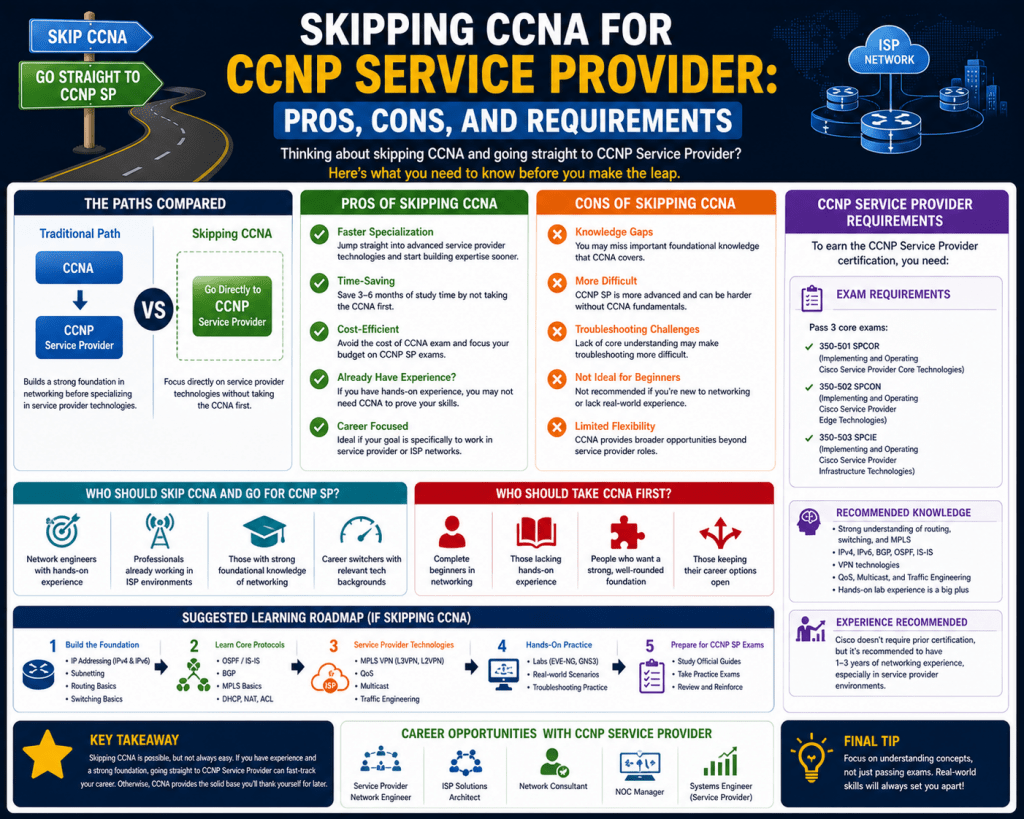
The structure of networking certifications has changed significantly over the years, reflecting the growing complexity and diversity of the IT industry. In the past, certification paths were strict and sequential, requiring candidates to progress step by step from beginner-level credentials to more advanced certifications. This approach ensured that all professionals developed a consistent foundation before moving into specialized or complex areas of networking.
As technology evolved, so did the expectations placed on IT professionals. Organizations began to recognize that individuals enter the networking field through different paths. Some gain experience through academic study, while others build skills through hands-on work in real-world environments. Because of this, rigid certification requirements started to feel limiting for experienced professionals who already possessed strong technical knowledge.
Modern certification frameworks have adapted to these changes by introducing more flexibility. Candidates are no longer required to follow a fixed progression. Instead, they can choose certifications that align with their current skills and career goals. This shift has made it possible for experienced professionals to pursue advanced certifications without first completing entry-level exams.
However, this flexibility also places greater responsibility on candidates. Without a structured path, individuals must carefully evaluate their readiness before attempting higher-level certifications. The decision to skip foundational certifications is no longer restricted by policy, but it must be guided by knowledge, experience, and career objectives.
The Purpose and Value of Entry-Level Certifications
Entry-level certifications play a crucial role in building a strong foundation in networking. They are designed to introduce core concepts and provide a structured learning path for individuals who are new to the field. These certifications cover essential topics such as network fundamentals, IP addressing, routing basics, switching concepts, and basic security practices.
One of the key benefits of entry-level certifications is that they ensure consistency in knowledge. By following a standardized curriculum, candidates develop a clear understanding of how networks operate. This includes both theoretical concepts and practical skills, allowing individuals to perform basic tasks such as configuring devices, troubleshooting connectivity issues, and managing small networks.
Entry-level certifications also emphasize best practices and proper methodologies. This is important because networking involves critical infrastructure, where mistakes can lead to significant disruptions. Learning standardized approaches helps ensure that professionals can design and manage networks in a reliable and secure manner.
For beginners, entry-level certifications provide a clear starting point. They offer a roadmap that guides individuals through the essential topics needed to build a successful career in networking. This structured approach reduces confusion and helps candidates focus on what matters most during the early stages of their development.
Even for experienced professionals, revisiting foundational concepts can be valuable. Over time, it is possible to forget or overlook basic principles, especially when working in specialized roles. Entry-level certifications provide an opportunity to refresh this knowledge and ensure that it remains strong and relevant.
Understanding the Expectations of Professional-Level Certifications
Professional-level certifications are designed for individuals who already have a solid understanding of networking fundamentals. These certifications focus on advanced topics that require deeper knowledge and practical experience. Candidates are expected to demonstrate their ability to work with complex network systems and solve challenging problems.
The scope of professional certifications includes advanced routing and switching, network design, automation, scalability, and troubleshooting in large environments. These topics go beyond basic configurations and require a strong ability to analyze and optimize network performance.
Unlike entry-level certifications, professional certifications often involve multiple exams. Candidates must typically pass a core exam that covers general advanced concepts, as well as a concentration exam that focuses on a specific area of expertise. This structure allows professionals to specialize in areas such as enterprise networking, security, or service provider environments.
The expectations for professional certifications are significantly higher. Candidates must not only understand concepts but also apply them in real-world scenarios. This requires hands-on experience, critical thinking, and the ability to adapt to different situations. Preparation for these exams is often more demanding, as it involves mastering complex topics and developing practical skills.
Key Differences Between Foundational and Advanced Certifications
The main difference between foundational and advanced certifications lies in the depth and complexity of the knowledge required. Entry-level certifications focus on introducing core concepts and ensuring that candidates can perform basic tasks. Professional certifications, on the other hand, require a deeper understanding and the ability to manage complex systems.
For example, entry-level certifications may introduce routing protocols such as OSPF and BGP at a basic level. Candidates learn how these protocols work and how to configure them in simple environments. In contrast, professional certifications require a detailed understanding of these protocols, including advanced configurations, optimization techniques, and troubleshooting in large-scale networks.
Another key difference is the level of responsibility associated with each certification. Entry-level certifications prepare individuals for roles that involve basic support and maintenance. Professional certifications are aimed at roles that require planning, designing, and managing complex network infrastructures.
The transition from foundational to advanced certifications represents a significant step in a professional’s career. It requires not only technical knowledge but also practical experience and problem-solving skills. This is why it is important to carefully consider whether skipping foundational certifications is the right choice.
Why Skipping Entry-Level Certifications Is Becoming Popular
The option to skip entry-level certifications has become increasingly popular among experienced professionals. One of the main reasons for this is the potential to save time. Preparing for certification exams requires a significant investment of effort, and professionals who already possess foundational knowledge may prefer to focus on advanced topics that are more relevant to their current roles.
Cost savings are another important factor. Certification exams can be expensive, especially when multiple exams are required. By skipping entry-level certifications, candidates can reduce their overall expenses and focus their resources on achieving higher-level credentials.
Skipping foundational certifications can also accelerate career progression. Professional-level certifications are often associated with more advanced roles and higher salaries. For individuals who already have experience in networking, obtaining an advanced certification can help them move forward more quickly in their careers.
The flexibility offered by modern certification paths allows individuals to tailor their learning journey to their specific needs. This is particularly beneficial for professionals who have gained skills through hands-on experience and do not require a structured introduction to basic concepts.
The Importance of Real-World Experience
Real-world experience is one of the most important factors in determining whether it is appropriate to skip entry-level certifications. Many professionals develop their skills through practical work rather than formal study. This hands-on experience can provide a deeper understanding of networking concepts and prepare individuals for advanced certifications.
Working in a networking role exposes individuals to real challenges, such as configuring devices, troubleshooting issues, and maintaining network performance. Over time, this experience builds confidence and expertise, allowing professionals to handle complex tasks effectively.
However, practical experience is not always comprehensive. While individuals may be highly skilled in certain areas, they may lack exposure to other topics that are covered in certification exams. This can create gaps in knowledge that need to be addressed before attempting advanced certifications. Candidates need to evaluate their experience carefully. They should identify their strengths and weaknesses and determine whether they have the necessary knowledge to succeed at the professional level. This self-assessment is essential for making an informed decision.
Recognizing and Addressing Knowledge Gaps
One of the main risks of skipping entry-level certifications is the possibility of knowledge gaps. Entry-level certifications are designed to provide a comprehensive overview of networking concepts, ensuring that candidates have a well-rounded understanding of the field. Without this structured learning, certain topics may be overlooked.
Knowledge gaps can create challenges during exam preparation and performance. Candidates may encounter unfamiliar concepts or struggle to apply their knowledge in different scenarios. This can make it more difficult to succeed in advanced certifications.
To address this issue, individuals who choose to skip entry-level certifications must take a proactive approach to learning. This includes reviewing key topics, practicing in lab environments, and using study materials to fill in any gaps. Continuous learning is essential for staying current in the field and maintaining a strong skill set.
By identifying and addressing knowledge gaps, candidates can improve their readiness for advanced certifications and increase their chances of success.
Building a Strong Foundation for Long-Term Success
A strong foundation in networking fundamentals is essential for long-term success in the IT industry. Even the most advanced technologies are built on basic principles, and a lack of understanding in these areas can limit a professional’s ability to grow and adapt.
Fundamental concepts such as IP addressing, subnetting, and protocol behavior are used in nearly every aspect of networking. Professionals who have a solid understanding of these concepts are better equipped to handle complex tasks and solve problems effectively.
Reinforcing foundational knowledge is important at every stage of a career. Even experienced professionals can benefit from revisiting basic concepts and ensuring that their understanding remains strong. This helps maintain confidence and adaptability in a rapidly changing industry.
For individuals considering skipping entry-level certifications, it is important to ensure that their foundation is solid. This provides the necessary support for tackling advanced certifications and achieving long-term career goals.
Analyzing the Advantages of Skipping Entry-Level Certifications
The option to skip entry-level certifications has become increasingly attractive among experienced networking professionals. One of the primary reasons is efficiency. Professionals who already have a strong grasp of networking fundamentals often feel that revisiting entry-level material does not provide significant value. Instead, they prefer to invest their time in learning advanced topics that are directly relevant to their current roles and responsibilities.
Time is a critical resource in the technology field. Networking professionals are often balancing demanding job roles with continuous learning requirements. Preparing for certifications requires consistent effort, and eliminating an entry-level step can significantly reduce the overall time needed to achieve a higher-level credential. This allows individuals to focus on gaining deeper expertise in areas such as advanced routing, network design, and infrastructure management.
Another important advantage is cost reduction. Certification exams can be expensive, particularly when multiple exams are required along the certification path. By skipping the entry-level certification, candidates can reduce the total financial investment. This is especially beneficial for individuals who are funding their own professional development without external support.
Career acceleration is also a key factor. Advanced certifications are often linked to senior roles and increased earning potential. For professionals who already have relevant experience, obtaining an advanced certification can validate their expertise and help them progress more quickly in their careers. This can lead to opportunities in leadership roles, specialized technical positions, and complex project environments.
The flexibility offered by modern certification systems also supports this approach. Professionals are no longer required to follow a rigid sequence, allowing them to tailor their certification journey according to their skills and career goals. This flexibility is particularly valuable in a field where experience and practical knowledge often carry as much weight as formal qualifications.
Understanding the Risks and Limitations of Skipping Foundational Certifications
Despite the advantages, skipping foundational certifications carries certain risks that must be carefully considered. One of the most significant risks is the lack of structured learning. Entry-level certifications provide a comprehensive and organized introduction to networking concepts. Without this structure, candidates may struggle to ensure that they have covered all essential topics.
Another limitation is the increased complexity of advanced certifications. Professional-level exams are designed to test deep understanding and practical application. Candidates who lack a strong foundation may find it difficult to keep up with the complexity of the material. This can lead to frustration during the preparation process and may impact performance during the exam.
Knowledge gaps are another concern. Even experienced professionals may have areas where their understanding is incomplete. Entry-level certifications are designed to cover a wide range of topics, ensuring a well-rounded knowledge base. Skipping this step may result in missing important concepts that are essential for advanced learning.
Confidence can also be affected. Candidates who are unsure about their foundational knowledge may feel less confident when tackling advanced topics. This can create additional pressure during exam preparation and increase the likelihood of mistakes.
It is important to recognize that skipping foundational certifications is not a shortcut. It requires a higher level of self-awareness and discipline. Candidates must take responsibility for identifying their weaknesses and addressing them through independent study and practice.
Assessing Professional Experience and Technical Readiness
Before deciding to skip an entry-level certification, it is essential to evaluate professional experience and technical readiness. This involves a detailed assessment of both practical skills and theoretical knowledge. A strong candidate for advanced certifications should have a solid understanding of networking fundamentals and the ability to apply that knowledge in real-world scenarios.
Experience in network engineering roles is a key indicator of readiness. Professionals who have spent several years working with network infrastructure are likely to have encountered a variety of challenges. This exposure helps build problem-solving skills and a deeper understanding of how networks operate in practice.
Technical readiness also includes familiarity with core networking concepts. These include IP addressing, subnetting, routing protocols, switching mechanisms, and basic security principles. These concepts form the foundation for all advanced networking topics, and a lack of understanding in these areas can create significant challenges.
Another important factor is the ability to work independently. Skipping foundational certifications often requires a self-directed approach to learning. Candidates must be able to identify gaps in their knowledge, find appropriate resources, and develop a structured study plan. This level of independence is essential for success in advanced certifications.
It is also important to consider the ability to adapt to new technologies. The networking field is constantly evolving, and professionals must be able to learn and apply new concepts quickly. This adaptability is a strong indicator of readiness for advanced certifications.
Essential Skills Needed to Skip Entry-Level Certifications
Skipping foundational certifications requires a specific set of skills that demonstrate readiness for advanced learning. One of the most important skills is a strong understanding of routing protocols. Professionals should be comfortable working with protocols such as OSPF and BGP, including configuration, optimization, and troubleshooting.
Proficiency in subnetting and IP addressing is also essential. These skills are fundamental to network design and troubleshooting. Professionals who are confident in these areas are better equipped to handle complex networking scenarios.
Experience with wide area networks and service provider technologies is another important requirement. This includes familiarity with concepts such as MPLS, virtual private networks, and traffic engineering. These technologies are commonly used in large-scale networks and are a key focus of advanced certifications.
Troubleshooting skills are critical for success. Advanced certifications often involve complex problem-solving tasks that require a systematic approach. Professionals must be able to analyze network issues, identify root causes, and implement effective solutions.
In addition to technical skills, critical thinking and attention to detail are important. These skills help professionals approach challenges with precision and confidence. They also contribute to better decision-making in complex scenarios.
The Importance of Specialization in Networking Careers
Specialization has become a defining feature of modern networking careers. As technologies continue to evolve, professionals are increasingly expected to develop expertise in specific areas. This trend is reflected in the structure of advanced certifications, which allow candidates to focus on particular domains.
Specialization offers several benefits. It enables professionals to develop deep knowledge in a specific area, making them more valuable to employers. It also helps individuals stand out in a competitive job market, where specialized skills are often in high demand.
For professionals considering skipping foundational certifications, specialization can provide a clear direction. By focusing on a specific area, candidates can align their learning with their career goals and build expertise that is directly relevant to their roles.
However, specialization should not come at the expense of foundational knowledge. A strong understanding of core networking principles is essential for mastering advanced topics. Without this foundation, it can be difficult to fully grasp specialized concepts.
Balancing specialization with a solid foundation is key to long-term success. Professionals must ensure that they have the necessary knowledge to support their specialized skills.
Balancing Hands-On Experience with Theoretical Knowledge
A successful approach to advanced certifications requires a balance between hands-on experience and theoretical knowledge. Practical experience provides valuable insights into real-world scenarios, while theoretical knowledge ensures a comprehensive understanding of networking concepts.
Professionals who rely solely on practical experience may find that they lack exposure to certain topics. On the other hand, those who focus only on theory may struggle to apply their knowledge in practical situations. Achieving a balance between these two aspects is essential for success.
One effective way to achieve this balance is through lab practice. Setting up lab environments allows candidates to experiment with different configurations and scenarios. This helps reinforce theoretical concepts and build practical skills.
Continuous learning is also important. Networking technologies are constantly evolving, and professionals must stay updated with new developments. This involves reviewing study materials, exploring new technologies, and practicing regularly.
By combining hands-on experience with theoretical knowledge, candidates can develop a well-rounded skill set that supports success in advanced certifications.
Common Pitfalls When Skipping Foundational Certifications
Skipping foundational certifications can lead to several common pitfalls if not approached carefully. One of the most common mistakes is underestimating the difficulty of advanced certifications. Candidates may assume that their experience is sufficient, only to find that the exam requires a deeper level of knowledge.
Another mistake is neglecting foundational concepts. Even experienced professionals may overlook basic principles, assuming that they are already familiar with them. This can create gaps in understanding that become evident during exam preparation.
Poor study planning is another issue. Without a structured learning path, candidates may struggle to organize their study efforts effectively. This can result in incomplete coverage of important topics and inefficient use of time.
Overconfidence can also be a problem. While confidence is important, it must be balanced with a realistic assessment of one’s abilities. Candidates who overestimate their readiness may find themselves unprepared for the challenges of advanced certifications.
Avoiding these pitfalls requires careful planning, self-assessment, and a commitment to continuous learning.
Creating a Structured Study Plan for Advanced Certifications
Developing a structured study plan is essential for success when skipping foundational certifications. The first step is to understand the exam objectives. Candidates should review the syllabus carefully and identify the topics that require the most attention.
A study plan should include a clear schedule that outlines the topics to be covered and the time allocated for each area. This helps ensure that all relevant topics are addressed and prevents last-minute cramming.
Practice is a key component of any study plan. This includes hands-on lab work and practice exams. Lab work helps build practical skills, while practice exams provide insight into the format and difficulty of the actual test.
Time management is also important. Candidates should allocate sufficient time for study and avoid rushing through the material. Consistent and focused study sessions are more effective than irregular or rushed preparation.
Seeking feedback and support can also enhance the learning process. Engaging with other professionals and participating in discussions can provide new perspectives and help clarify complex topics.
Career Opportunities After Advancing Without Entry-Level Certification
Professionals who successfully obtain advanced certifications without completing entry-level certifications can access a wide range of career opportunities. These roles often involve greater responsibility and require a higher level of expertise.
Common roles include network engineer, systems engineer, and network analyst. These positions involve tasks such as designing network architectures, implementing advanced configurations, and troubleshooting complex issues.
Leadership roles may also become accessible. Experienced professionals with advanced certifications may move into positions such as team lead or technical manager. These roles involve overseeing projects, guiding teams, and making strategic decisions.
Advanced certifications can also open opportunities in consulting and specialized services. Professionals may work with organizations to design and optimize network infrastructures, providing expert guidance and solutions.
The ability to achieve advanced certifications without following a traditional path demonstrates a high level of competence and dedication. This can enhance a professional’s reputation and increase their value in the job market.
Adapting to Continuous Changes in Networking Technology
The networking industry is constantly evolving, driven by new technologies and changing business requirements. Professionals must be able to adapt to these changes and continuously update their skills.
Advanced certifications play an important role in this process by providing structured learning paths that focus on current technologies and best practices. By pursuing these certifications, professionals can stay relevant and competitive in the job market.
Skipping foundational certifications can be part of this adaptation, allowing experienced professionals to focus on the skills that are most relevant to their current roles. However, it is important to ensure that this decision is based on a thorough understanding of one’s abilities and career goals.
Adapting to change also requires a commitment to lifelong learning. Networking professionals must be willing to explore new technologies, experiment with different approaches, and continuously improve their skills. This mindset is essential for long-term success in the field.
Determining Who Should Skip Foundational Certifications
The decision to skip an entry-level certification depends largely on an individual’s background, experience, and career direction. Not every networking professional benefits from bypassing foundational learning, and in many cases, doing so can create unnecessary challenges. Identifying whether this path is suitable requires a careful and honest evaluation of current capabilities.
Professionals who are well-suited to skip foundational certifications typically have several years of hands-on experience in networking roles. They are already comfortable working with network infrastructure, configuring devices, and troubleshooting issues in real environments. Their daily responsibilities often involve tasks that go beyond basic networking concepts, indicating that they have already internalized foundational knowledge through practical exposure.
In contrast, individuals who are new to networking or who have limited experience are generally not good candidates for skipping entry-level certifications. Without a solid understanding of core principles, advanced topics can quickly become overwhelming. Foundational certifications provide the structure and clarity needed to build confidence and competence in the field.
Career goals also play an important role in this decision. Professionals aiming for highly specialized or senior roles may benefit from moving directly to advanced certifications if they already meet the required skill level. However, those who are still exploring different areas of networking may find that starting with a foundational certification offers a clearer path forward.
Recognizing the Value of Structured Learning Paths
Structured learning paths have long been a cornerstone of professional development in networking. They provide a logical progression from basic concepts to advanced topics, ensuring that each stage builds upon the previous one. This approach helps learners develop a comprehensive understanding of the field and reduces the likelihood of gaps in knowledge.
Entry-level certifications are a key part of this structure. They introduce essential concepts in a systematic way, making it easier for individuals to grasp complex ideas later on. By following a structured path, candidates can develop both confidence and competence, which are critical for long-term success.
Skipping this structure can be challenging, particularly for those who are not accustomed to self-directed learning. Without a clear roadmap, it can be difficult to determine which topics to study and how to prioritize them. This can lead to inefficient learning and incomplete preparation.
However, experienced professionals who are comfortable with independent learning may find that they can create their own structured approach. By carefully reviewing exam objectives and developing a detailed study plan, they can replicate the benefits of a formal learning path while focusing on areas that are most relevant to their needs.
The Impact of Industry Experience on Certification Decisions
Industry experience is one of the most important factors in deciding whether to skip foundational certifications. Professionals who have spent several years working in networking environments often develop a deep understanding of how systems operate. This experience can serve as a strong foundation for pursuing advanced certifications.
Working in real-world environments exposes professionals to a wide range of challenges, from configuring network devices to resolving complex issues. This hands-on experience helps build problem-solving skills and reinforces theoretical knowledge. Over time, professionals become more confident in their abilities and better prepared to handle advanced topics.
Experience also provides context for learning. Understanding how concepts are applied in practice makes it easier to grasp more complex ideas. For example, professionals who have worked with routing protocols in real environments are better equipped to understand advanced configurations and optimization techniques.
However, it is important to recognize that not all experience is equal. Some roles may involve repetitive tasks that do not cover the full range of networking concepts. In such cases, additional study may be required to fill in the gaps before attempting advanced certifications.
Exploring Career Paths After Advanced Certification
Obtaining an advanced certification without completing an entry-level certification can open up a wide range of career opportunities. These opportunities often involve more complex responsibilities and require a higher level of expertise.
One common career path is that of a network engineer. In this role, professionals are responsible for designing, implementing, and maintaining network infrastructures. They work with a variety of technologies and must be able to troubleshoot issues efficiently.
Another potential path is systems engineering, which involves integrating networking with other aspects of IT infrastructure. This role requires a broad understanding of both networking and system operations, making it well-suited for professionals with advanced certifications.
Network analysts focus on monitoring and optimizing network performance. They analyze data to identify potential issues and recommend improvements. This role requires strong analytical skills and a deep understanding of network behavior.
Advanced certifications can also lead to leadership roles, such as team lead or technical manager. In these positions, professionals are responsible for guiding teams, managing projects, and making strategic decisions. Strong communication and leadership skills are essential for success in these roles.
Specialized roles in areas such as service provider networks, cloud infrastructure, and network security are also available. These positions often require advanced knowledge and offer opportunities to work on large-scale and complex systems.
Building Confidence Without Entry-Level Certification
Confidence plays a crucial role in the certification journey. Professionals who choose to skip foundational certifications must rely on their existing knowledge and experience to navigate advanced topics. Building and maintaining confidence requires a combination of preparation, practice, and self-awareness.
One way to build confidence is through consistent study and practice. By dedicating time to reviewing concepts and working through practical scenarios, candidates can reinforce their understanding and improve their skills. This helps reduce uncertainty and increases readiness for the exam.
Another important factor is familiarity with exam formats. Practicing with sample questions and simulated exams can help candidates understand what to expect and reduce anxiety. This preparation allows them to approach the exam with a clear strategy.
Seeking feedback from peers or mentors can also enhance confidence. Discussing concepts and sharing knowledge with others provides new perspectives and helps clarify difficult topics. This collaborative approach can make the learning process more effective and engaging.
Confidence should be based on preparation rather than assumption. Professionals who take the time to thoroughly prepare are more likely to perform well and achieve their certification goals.
Strategies for Bridging Knowledge Gaps
For professionals who skip foundational certifications, addressing knowledge gaps is essential. These gaps can arise from limited exposure to certain topics or from differences between practical experience and exam content.
One effective strategy is a targeted study. Candidates should review the exam objectives and identify areas where their knowledge is lacking. Focusing on these topics helps ensure a more balanced understanding of the material.
Practical labs are another valuable tool. Setting up lab environments allows candidates to experiment with configurations and scenarios that they may not encounter in their daily work. This hands-on approach reinforces learning and builds confidence.
Reading technical documentation and studying real-world case studies can also help bridge gaps. These resources provide detailed explanations and examples that enhance understanding of complex concepts.
Consistency is key when addressing knowledge gaps. Regular study sessions and continuous practice help reinforce learning and prevent information from being forgotten.
The Role of Discipline and Self-Motivation
Skipping foundational certifications requires a high level of discipline and self-motivation. Without a structured learning path, candidates must take full responsibility for their preparation. This includes setting goals, managing time effectively, and staying committed to the learning process.
Discipline is essential for maintaining a consistent study routine. Candidates must allocate time for study and practice, even when faced with competing priorities. This requires careful planning and a strong commitment to achieving certification goals.
Self-motivation is equally important. The certification journey can be challenging, and maintaining motivation is key to overcoming obstacles. Setting clear objectives and tracking progress can help keep candidates focused and engaged.
Developing a positive mindset also contributes to success. Viewing challenges as opportunities to learn and grow helps maintain motivation and resilience. This mindset is particularly important when tackling advanced topics that may be difficult at first.
Long-Term Benefits of Skipping Foundational Certifications
For professionals who are well-prepared, skipping foundational certifications can offer several long-term benefits. One of the most significant benefits is faster career progression. By obtaining advanced certifications earlier, professionals can position themselves for higher-level roles and increased responsibilities.
Another benefit is the ability to focus on relevant skills. Instead of spending time on basic concepts, professionals can concentrate on advanced topics that align with their career goals. This targeted approach can lead to deeper expertise and greater job satisfaction.
Skipping foundational certifications can also demonstrate confidence and capability. It shows that a professional is willing to take on challenges and pursue advanced goals. This can enhance their reputation and make them more attractive to employers.
However, these benefits are only realized when the decision is made carefully. Professionals must ensure that they have the necessary knowledge and skills to succeed. Otherwise, the risks may outweigh the advantages.
Adapting Learning Strategies for Advanced Certifications
Advanced certifications require a different approach to learning compared to entry-level certifications. Candidates must move beyond memorization and focus on understanding concepts at a deeper level. This involves analyzing scenarios, applying knowledge, and solving complex problems.
One effective strategy is scenario-based learning. This approach involves studying real-world situations and determining how to apply networking concepts to solve problems. It helps develop critical thinking and prepares candidates for the types of questions they may encounter in exams.
Another important strategy is active learning. This includes engaging with the material through hands-on practice, discussions, and experimentation. Active learning helps reinforce concepts and improve retention.
Time management is also crucial. Candidates must balance study with other responsibilities and ensure that they allocate sufficient time for preparation. Creating a study schedule and setting milestones can help maintain progress.
Flexibility is important as well. If a particular approach is not effective, candidates should be willing to adjust their strategy. This adaptability helps ensure that learning remains efficient and effective.
Maintaining Relevance in a Competitive Industry
The networking industry is highly competitive, and professionals must continuously update their skills to remain relevant. Advanced certifications play an important role in this process by validating expertise and demonstrating commitment to professional development.
Skipping foundational certifications can be part of a strategy to stay competitive. By focusing on advanced skills, professionals can position themselves as experts in their field. This can lead to opportunities in specialized roles and high-impact projects.
Continuous learning is essential for maintaining relevance. Networking technologies are constantly evolving, and professionals must stay informed about new developments. This includes exploring emerging technologies, learning new tools, and adapting to changing industry trends.
Building a strong professional network can also enhance career prospects. Engaging with other professionals, sharing knowledge, and participating in discussions helps expand opportunities and stay informed about industry developments.
Ultimately, maintaining relevance requires a combination of technical expertise, adaptability, and a commitment to lifelong learning. Professionals who embrace these principles are better equipped to succeed in a dynamic and competitive environment.
Conclusion
Choosing whether to skip an entry-level certification and move directly to an advanced credential is a decision that depends on individual experience, knowledge, and career goals. The flexibility in modern certification paths has created opportunities for professionals to tailor their learning journey, but it has also introduced the need for careful self-evaluation and disciplined preparation. While the option to bypass foundational learning can save time and reduce costs, it is not a universally suitable approach.
For experienced professionals who already possess strong networking fundamentals and hands-on expertise, moving directly to an advanced certification can be a strategic step. It allows them to focus on complex topics, validate their existing skills, and accelerate their career progression. In environments where advanced knowledge is required, this approach can provide a competitive advantage and open doors to higher-level roles and responsibilities.
At the same time, foundational certifications continue to hold significant value. They provide a structured and comprehensive understanding of core networking concepts, ensuring that professionals have a solid base to build upon. For individuals who are new to the field or who lack confidence in their fundamentals, starting with an entry-level certification remains a practical and effective choice.
The key to making the right decision lies in honest self-assessment. Professionals must evaluate their strengths, identify any gaps in their knowledge, and determine whether they are prepared to handle the demands of advanced certification exams. Skipping foundational learning requires a strong commitment to independent study, continuous practice, and ongoing skill development.
In a rapidly evolving industry, success is not determined solely by the certifications earned but by the ability to apply knowledge effectively and adapt to change. Whether following a traditional path or an accelerated one, the ultimate goal is to build expertise, maintain relevance, and achieve long-term career growth in networking.