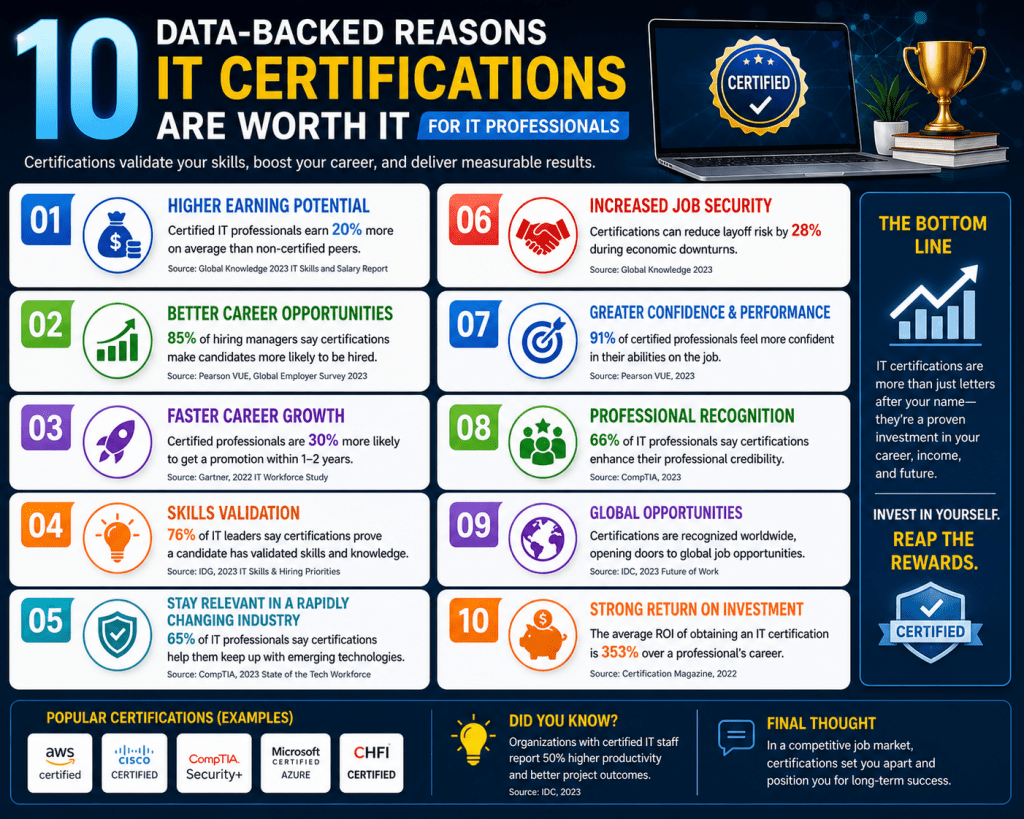
Information technology continues to evolve at a rapid pace, reshaping how organizations operate, compete, and innovate. As new tools, platforms, and security challenges emerge, the demand for skilled IT professionals continues to grow. Experience alone is no longer enough to ensure consistent performance across teams. Organizations increasingly rely on structured learning and standardized validation to maintain quality and reliability, which is where IT certifications play a critical role.
IT certifications serve as formal recognition of an individual’s technical abilities, providing a measurable way to assess knowledge and skills. Unlike informal training or self-taught expertise, certifications are designed around industry standards and best practices. This ensures that professionals are not only familiar with specific technologies but also understand how to apply them effectively in real-world environments. For organizations, this creates a dependable framework for evaluating and developing talent.
Creating a Standardized Knowledge Base Across IT Teams
One of the key advantages of IT certifications is their ability to establish a common baseline of knowledge across teams. In many organizations, IT departments consist of individuals with diverse educational backgrounds and varying levels of experience. Certifications help standardize skill sets, ensuring that team members share a consistent understanding of critical concepts such as networking, security, and system administration. This consistency improves collaboration and reduces the likelihood of miscommunication or errors.
Another important aspect of certifications is their alignment with current industry demands. Certification programs are regularly updated to reflect changes in technology, making them a reliable source of up-to-date knowledge. This is particularly valuable in areas like cybersecurity and cloud computing, where outdated practices can lead to serious risks. By encouraging employees to pursue certifications, organizations can ensure that their teams stay current with evolving trends and technologies.
Supporting Continuous Learning and Career Progression
The structured learning paths associated with certifications contribute to long-term workforce development. Entry-level certifications introduce foundational concepts, making them ideal for individuals who are new to the field. As professionals gain experience, they can progress to intermediate and advanced certifications that focus on specialized skills and complex problem-solving. This progression creates a clear career pathway, helping employees understand how to grow within their roles while contributing more effectively to the organization.
This continuous learning approach also encourages employees to stay engaged with their work. When individuals see clear growth opportunities, they are more likely to invest time and effort into developing their skills. This not only benefits the individual but also strengthens the organization as a whole by creating a more capable and motivated workforce.
Enhancing Operational Efficiency and Performance
From a business perspective, IT certifications are closely tied to operational efficiency. Certified professionals are trained to follow best practices, which leads to more streamlined processes and fewer errors. They are also better equipped to troubleshoot issues quickly, minimizing downtime and maintaining system stability. In environments where even minor disruptions can have significant consequences, this level of efficiency is essential.
Improved efficiency also extends to resource management. Certified professionals are more likely to implement optimized solutions, reducing unnecessary costs and improving overall system performance. This contributes to better utilization of technology investments and supports long-term business growth.
Strengthening Security and Risk Management
Security is one of the most critical concerns for modern organizations, and IT certifications play a vital role in addressing this challenge. With the increasing frequency and sophistication of cyber threats, businesses must ensure that their teams are prepared to protect sensitive data and critical systems. Certifications focused on security teach professionals how to identify vulnerabilities, implement protective measures, and respond to incidents effectively.
This proactive approach to security reduces the risk of breaches and helps organizations maintain compliance with regulatory requirements. Certified professionals are trained to follow established frameworks and guidelines, ensuring that security practices are consistent and effective across the organization.
Improving Employee Retention and Workplace Culture
IT certifications also have a significant impact on employee satisfaction and retention. Professionals in the technology field often seek opportunities to advance their careers and expand their skill sets. Organizations that support certification programs demonstrate a commitment to employee development, which can lead to higher levels of job satisfaction.
When employees feel valued and supported, they are more likely to remain with the organization. This reduces turnover and the associated costs of hiring and training new staff. Additionally, a culture that emphasizes learning and growth fosters collaboration, innovation, and overall team cohesion.
Building Trust and Credibility in the Market
Certifications not only benefit internal operations but also enhance an organization’s external reputation. Clients and partners are more likely to trust companies that employ certified professionals, especially when dealing with complex or sensitive projects. This trust can lead to stronger business relationships and increased opportunities.
In competitive industries, having a certified workforce can serve as a key differentiator. It signals a commitment to quality, expertise, and professionalism, which can influence decision-making among potential clients and stakeholders.
Maximizing Return on Technology Investments
The financial impact of IT certifications extends beyond initial training costs. While certification programs require investment, the long-term benefits often outweigh these expenses. Certified professionals are better equipped to make informed decisions, implement efficient solutions, and avoid costly mistakes.
By improving productivity, reducing downtime, and enhancing system performance, certifications contribute to a higher return on investment. Organizations can achieve more value from their technology infrastructure, ensuring that resources are used effectively and strategically.
Adapting to Rapid Technological Change
The ability to adapt to change is essential in the technology sector, and IT certifications support this adaptability. As new technologies emerge, certification programs evolve to include updated content and practices. This ensures that professionals remain relevant and capable of handling modern challenges.
Certified professionals are often more comfortable learning new tools and approaches, making them valuable assets in dynamic environments. Their ability to quickly adapt enables organizations to stay competitive and respond effectively to industry shifts.
Encouraging Accountability and Professional Standards
Certifications encourage a sense of accountability among IT professionals. Earning a credential requires dedication and effort, which often translates into a stronger commitment to maintaining high standards in the workplace. Certified individuals are more likely to take ownership of their responsibilities and strive for excellence in their roles.
This focus on professionalism benefits the entire organization. It creates a culture where quality and consistency are prioritized, leading to better outcomes and stronger team performance.
Driving Collaboration and Innovation
Collaboration is another area positively influenced by IT certifications. When team members share a common understanding of tools and methodologies, they can work together more effectively. This is particularly important in large organizations where projects involve multiple teams and departments.
Certifications also promote innovation by exposing professionals to new ideas and technologies. As employees expand their knowledge, they are more likely to identify opportunities for improvement and develop creative solutions. This continuous flow of ideas supports long-term growth and competitiveness.
Integrating Certifications into Organizational Strategy
Organizations that integrate certifications into their strategic planning often experience significant improvements in performance and resilience. By aligning certification goals with business objectives, companies can ensure that their training efforts directly support organizational priorities.
This alignment helps create a more focused and effective workforce. Employees understand how their skills contribute to the organization’s success, which increases motivation and productivity. At the same time, leadership can make more informed decisions about training investments and resource allocation.
Scaling Certification Programs for Long-Term Success
The scalability of certification programs makes them suitable for organizations of all sizes. Small businesses can use certifications to build a strong foundation, while larger enterprises can leverage them to maintain consistency across diverse teams.
As organizations grow, certification programs can be expanded to address new challenges and opportunities. This flexibility ensures that workforce development remains aligned with evolving business needs, supporting sustainable growth over time.
Preparing for the Future of Technology
As digital transformation continues to accelerate, the importance of IT certifications is expected to grow. Organizations must navigate increasingly complex technology environments, where the margin for error is small, and the stakes are high. Certified professionals bring a level of confidence and competence that is essential for success in these conditions.
By investing in certifications, organizations position themselves to handle future challenges more effectively. They build teams that are not only skilled but also adaptable, innovative, and prepared for the demands of a rapidly changing industry.
Understanding the Core Categories of IT Certifications
IT certifications cover a wide range of disciplines, reflecting the diverse responsibilities within modern technology teams. To build a capable and balanced workforce, organizations must understand how these certifications are grouped and how each category contributes to overall performance. Broadly, IT certifications fall into three major areas: technical skills, management and support, and development and programming. Each category serves a distinct purpose, yet they often overlap in real-world environments where collaboration and cross-functional knowledge are essential.
Technical certifications focus on the foundational and advanced skills required to design, maintain, and secure IT systems. Management and support certifications emphasize service delivery, operational efficiency, and leadership capabilities. Development and programming certifications validate the ability to create, maintain, and optimize software applications. Together, these categories form a comprehensive framework for building well-rounded IT teams.
Understanding these categories allows organizations to align certification efforts with business goals, ensuring that employees gain the skills needed to support both current operations and future growth.
Technical Certifications and Their Role in Infrastructure Excellence
Technical certifications form the backbone of IT expertise. They are designed to validate the skills required to manage hardware, software, networks, and cloud environments. These certifications are essential for ensuring that systems run efficiently, securely, and reliably.
Networking certifications focus on the design, configuration, and troubleshooting of communication systems. Professionals with networking credentials understand how data flows across systems, how to maintain connectivity, and how to resolve issues that may disrupt operations. Strong networking skills are critical because nearly every business function depends on reliable communication between systems and users.
Cybersecurity certifications address one of the most pressing challenges in modern IT environments. These certifications teach professionals how to protect systems from threats, identify vulnerabilities, and respond to incidents. As cyber risks continue to evolve, organizations rely on certified professionals to implement security measures that safeguard sensitive information and maintain operational continuity.
Cloud computing certifications have gained significant importance as organizations shift from traditional infrastructure to cloud-based solutions. These certifications validate expertise in deploying, managing, and optimizing cloud environments. Professionals with cloud certifications can help organizations scale their operations, reduce costs, and improve system performance by leveraging modern technologies.
Technical certifications also extend to areas such as system administration, virtualization, and storage management. These skills ensure that the IT infrastructure remains stable and efficient, supporting the needs of both employees and customers. By investing in technical certifications, organizations can build a strong foundation that supports all other aspects of their IT operations.
The Growing Importance of Cybersecurity Certifications
Cybersecurity has become a central focus for organizations of all sizes. With increasing threats and stricter regulations, the need for skilled security professionals has never been greater. Certifications in this field provide structured training on how to protect systems, detect threats, and respond effectively to security incidents.
Security certifications cover a wide range of topics, including risk management, encryption, identity management, and network security. These certifications ensure that professionals understand both the technical and strategic aspects of security, enabling them to develop comprehensive protection strategies.
Organizations benefit from cybersecurity certifications by reducing the likelihood of breaches and minimizing the impact of potential incidents. Certified professionals are trained to follow best practices, ensuring that security measures are consistently applied across the organization. This not only protects data but also helps maintain trust with clients and stakeholders.
Another important aspect of cybersecurity certifications is their role in compliance. Many industries require organizations to adhere to specific regulations, and certified professionals are equipped to implement the necessary controls and processes. This reduces the risk of non-compliance and associated penalties.
Cloud Certifications and Modern IT Transformation
Cloud computing has transformed how organizations manage their IT infrastructure. Instead of relying on physical hardware, businesses can now use scalable, on-demand resources to support their operations. Cloud certifications validate the skills needed to design, deploy, and manage these environments effectively.
Professionals with cloud certifications understand how to build secure and efficient architectures, optimize costs, and ensure high availability. They are also familiar with tools and practices that support automation, monitoring, and performance management. This expertise is essential for organizations looking to modernize their IT systems and remain competitive.
Cloud certifications also support innovation by enabling organizations to experiment with new technologies and services. Certified professionals can quickly deploy and test solutions, reducing the time required to bring new ideas to market. This agility is a key advantage in fast-paced industries.
As cloud adoption continues to grow, the demand for certified professionals in this area is expected to increase. Organizations that invest in cloud certifications can position themselves for long-term success by building teams that are capable of managing modern, scalable infrastructure.
Management and Support Certifications for Operational Efficiency
While technical skills are essential, effective IT operations also require strong management and support capabilities. Certifications in this category focus on service delivery, process improvement, and leadership, ensuring that IT teams can operate efficiently and meet business needs.
IT service management certifications emphasize the alignment of IT services with organizational goals. These certifications teach professionals how to design and manage processes that improve service quality, reduce costs, and enhance customer satisfaction. By implementing structured frameworks, organizations can achieve greater consistency and efficiency in their operations.
Project management certifications are equally important, especially in environments where multiple initiatives are running simultaneously. These certifications provide the skills needed to plan, execute, and monitor projects effectively. Professionals with project management credentials can coordinate resources, manage risks, and ensure that projects are completed on time and within budget.
Support certifications focus on the day-to-day operations of IT teams. These certifications validate skills in troubleshooting, customer service, and system maintenance. Support professionals play a critical role in maintaining system stability and ensuring that users can perform their tasks without disruption.
Together, management and support certifications help organizations create a structured and efficient IT environment. They ensure that technical expertise is complemented by strong processes and effective communication.
The Role of IT Service Management Certifications
IT service management certifications are designed to improve how organizations deliver and manage IT services. These certifications focus on creating processes that align IT operations with business objectives, ensuring that technology supports overall organizational goals.
Professionals with service management certifications understand how to design workflows, manage incidents, and continuously improve service quality. They are trained to analyze performance metrics and identify areas for improvement, leading to more efficient and reliable operations.
These certifications also emphasize the importance of customer satisfaction. By focusing on user needs and expectations, organizations can deliver services that meet or exceed requirements. This enhances the overall user experience and strengthens relationships with internal and external stakeholders.
Project Management Certifications and IT Leadership
Project management certifications play a vital role in ensuring the success of IT initiatives. These certifications provide a structured approach to managing projects, covering areas such as planning, execution, risk management, and communication.
Professionals with project management credentials are equipped to handle complex المشاريع that involve multiple teams and resources. They can coordinate efforts, resolve conflicts, and ensure that objectives are met within defined constraints.
Effective project management is essential for organizations that rely on technology to drive growth and innovation. By investing in these certifications, businesses can improve their ability to deliver مشاريع on time and achieve desired outcomes.
Development and Programming Certifications in Software Innovation
Development and programming certifications focus on the creation and maintenance of software applications. These certifications validate expertise in coding languages, frameworks, and development methodologies, ensuring that professionals can build high-quality applications.
Programming certifications cover a wide range of languages and technologies, allowing professionals to specialize in areas that align with organizational needs. These certifications ensure that developers understand best practices for writing efficient, maintainable code.
Web development certifications focus on building and maintaining websites and web applications. These certifications cover both front-end and back-end technologies, ensuring that developers can create user-friendly and functional solutions.
Database certifications validate skills in managing and optimizing data systems. As data becomes increasingly important for decision-making, professionals with database expertise play a critical role in ensuring data integrity and accessibility.
Development certifications also emphasize collaboration and version control, which are essential for modern software development. By following structured methodologies, developers can work together more effectively and deliver high-quality solutions.
Vendor-Specific Certifications and Specialized Expertise
Vendor-specific certifications focus on particular technologies or platforms. These certifications provide in-depth knowledge of specific tools, making them ideal for organizations that rely heavily on certain systems.
Professionals with vendor-specific certifications can optimize the use of these technologies, ensuring that systems are configured and managed effectively. This level of expertise can lead to improved performance and reduced costs.
However, vendor-specific certifications may limit flexibility, as they are tied to particular platforms. Organizations must consider their long-term technology strategy when investing in these certifications.
Vendor-Neutral Certifications and Broad Skill Development
Vendor-neutral certifications provide a broader perspective, covering concepts that apply across multiple technologies. These certifications are valuable for building foundational knowledge and ensuring flexibility in changing environments.
Professionals with vendor-neutral certifications can adapt to different systems and tools, making them versatile members of IT teams. This adaptability is particularly important for organizations that use a mix of technologies.
By combining vendor-specific and vendor-neutral certifications, organizations can achieve a balance between depth and flexibility. This approach ensures that teams have both specialized expertise and the ability to adapt to new challenges.
Aligning Certification Categories with Organizational Needs
Choosing the right mix of certifications requires a clear understanding of organizational priorities. Different roles within an IT team require different skill sets, and certifications should be selected accordingly.
For example, organizations focused on infrastructure stability may prioritize technical certifications, while those undergoing digital transformation may invest more in cloud and development certifications. Similarly, businesses with complex المشاريع may emphasize project management and service management credentials.
By aligning certification categories with specific roles and objectives, organizations can maximize the impact of their training efforts. This ensures that employees gain relevant skills that contribute directly to business success.
Building a Balanced and Future-Ready IT Workforce
A well-rounded IT team requires a combination of technical, managerial, and development skills. Certifications provide a structured way to develop these capabilities, ensuring that teams can handle a wide range of challenges.
Organizations that invest in diverse certification categories are better equipped to adapt to changing technology landscapes. They can respond to new opportunities, address emerging risks, and maintain a competitive edge.
By understanding the different categories of IT certifications and their respective benefits, businesses can create effective training strategies that support long-term growth and innovation.
Developing an Effective IT Certification Strategy for Long-Term Success
Building a successful IT certification strategy requires more than simply selecting popular credentials. Organizations need a structured approach that aligns learning initiatives with business goals, workforce capabilities, and future technology trends. A well-designed strategy ensures that certifications are not just individual achievements but meaningful contributors to organizational performance and growth.
The first step in creating an effective certification strategy is understanding the broader role that certifications play within the organization. Certifications should support operational efficiency, strengthen security, enhance innovation, and improve overall service delivery. When these objectives are clearly defined, it becomes easier to identify which certifications will provide the most value.
A strategic approach also ensures that certification efforts are consistent across teams. Without proper planning, organizations may end up with uneven skill distribution, where some areas are highly developed while others remain weak. A balanced strategy addresses this issue by aligning certifications with specific roles and responsibilities.
Evaluating Business Objectives and Technology Priorities
Every organization operates within a unique technological environment, and certification strategies must reflect this reality. The process begins with identifying key business objectives and determining how technology supports those goals. Whether the focus is on improving cybersecurity, expanding cloud capabilities, or enhancing customer experience, certifications should directly contribute to these priorities.
Understanding technology priorities helps organizations allocate resources effectively. For example, a company undergoing digital transformation may prioritize cloud and automation certifications, while another focused on data protection may invest more heavily in security credentials. This alignment ensures that training efforts produce measurable outcomes rather than generic improvements.
It is also important to consider future goals when evaluating priorities. Technology evolves rapidly, and organizations must anticipate upcoming trends to remain competitive. Certifications that address emerging technologies can help prepare teams for future challenges, reducing the need for reactive training later.
Conducting a Comprehensive Skills Gap Analysis
A skills gap analysis is a critical component of any certification strategy. This process involves assessing the current capabilities of the IT team and identifying areas where additional expertise is needed. By understanding existing strengths and weaknesses, organizations can make informed decisions about which certifications to prioritize.
The analysis should include a detailed review of roles, responsibilities, and performance metrics. Managers can evaluate how effectively teams are handling their tasks and where improvements are necessary. Feedback from employees is also valuable, as it provides insights into the challenges they face and the skills they wish to develop.
Once gaps are identified, certifications can be selected to address these specific needs. This targeted approach ensures that training efforts are relevant and impactful. It also prevents unnecessary spending on certifications that do not contribute to organizational goals.
Aligning Certifications with Career Pathways
Certification strategies are most effective when they are integrated into clear career development pathways. Employees need to understand how certifications relate to their roles and how they can use them to advance within the organization. This clarity motivates individuals to pursue certifications and invest in their professional growth.
Career pathways should outline progression from entry-level to advanced roles, with corresponding certifications at each stage. For example, new employees may begin with foundational certifications, while experienced professionals pursue specialized or expert-level credentials. This structured approach creates a sense of direction and purpose.
Aligning certifications with career growth also benefits the organization by ensuring a steady pipeline of skilled professionals. As employees advance, they take on greater responsibilities, reducing the need for external hiring and strengthening internal capabilities.
Encouraging Employee Participation and Engagement
Employee engagement is a key factor in the success of certification programs. Organizations must create an environment where learning is encouraged and supported. This includes providing access to training resources, allocating time for study, and recognizing achievements.
Involving employees in the decision-making process can significantly improve engagement. When individuals have a say in choosing certifications, they are more likely to feel invested in the outcome. This collaborative approach ensures that certifications align with both organizational needs and personal interests.
Recognition and incentives also play an important role. Acknowledging employees who achieve certifications reinforces the value of learning and motivates others to participate. This can be done through promotions, salary adjustments, or public recognition within the organization.
Balancing Specialization and Versatility in Skill Development
An effective certification strategy must strike a balance between specialization and versatility. Specialized certifications provide deep expertise in specific areas, enabling professionals to handle complex tasks with confidence. However, focusing solely on specialization can limit flexibility.
Versatile certifications, on the other hand, provide a broad understanding of multiple technologies and concepts. These certifications enable professionals to adapt to different roles and challenges, making them valuable assets in dynamic environments.
Organizations should aim to develop a mix of both skill types. This ensures that teams have the depth required for specialized tasks while maintaining the flexibility to respond to changing demands. A balanced approach also promotes collaboration, as team members can understand and support each other’s work.
Implementing Structured Learning and Training Programs
Successful certification strategies require well-organized training programs. Simply encouraging employees to pursue certifications is not enough; organizations must provide the necessary support to help them succeed. This includes access to study materials, practice environments, and mentorship opportunities.
Structured learning programs should be designed to accommodate different learning styles and schedules. Some employees may prefer self-paced study, while others benefit from guided instruction. Offering a variety of options ensures that all team members can participate effectively.
Mentorship is another valuable component of training programs. Experienced professionals can guide less experienced colleagues, sharing knowledge and providing practical insights. This not only improves learning outcomes but also strengthens team relationships.
Measuring the Impact of Certification Programs
To ensure the effectiveness of certification strategies, organizations must establish metrics for measuring success. These metrics can include exam pass rates, improvements in performance, reduction in system downtime, and enhanced security outcomes.
Regular evaluation allows organizations to identify what is working and what needs improvement. For example, if certain certifications do not lead to measurable benefits, adjustments can be made to the training approach or certification selection.
Performance reviews can also incorporate certification achievements, linking them to career progression and organizational contributions. This reinforces the importance of certifications and ensures that they remain aligned with business objectives.
Managing Costs and Maximizing Return on Investment
While certifications require financial investment, they should be viewed as long-term assets rather than short-term expenses. Organizations must carefully manage costs while ensuring that they receive maximum value from their training programs.
Cost management involves selecting certifications that align with strategic goals and avoiding unnecessary or redundant training. Bulk training programs and internal knowledge sharing can also help reduce expenses.
The return on investment from certifications can be measured in several ways, including increased productivity, reduced errors, and improved system performance. Certified professionals are better equipped to optimize resources and implement efficient solutions, leading to cost savings over time.
Ensuring Continuous Learning and Certification Renewal
Technology is constantly evolving, and certifications must be maintained to remain relevant. Many certifications require periodic renewal, which involves additional training or exams. Organizations must plan for these requirements and ensure that employees continue to update their skills.
Continuous learning should be embedded in the organizational culture. Certifications are not one-time achievements but part of an ongoing process of skill development. Encouraging employees to pursue advanced certifications and explore new areas ensures that teams remain competitive.
Regular training sessions, workshops, and knowledge-sharing initiatives can support continuous learning. These activities keep employees engaged and help them stay informed about the latest developments in their field.
Integrating Certifications with Broader Talent Development Strategies
Certifications should not exist in isolation but as part of a broader talent development framework. Organizations can combine certifications with other learning initiatives, such as hands-on projects, cross-training, and leadership development programs.
This integrated approach ensures that employees gain both theoretical knowledge and practical experience. It also creates opportunities for collaboration and innovation, as team members apply their skills in real-world scenarios.
Leadership development is particularly important for advanced professionals. Certifications can prepare individuals for technical roles, but leadership skills are essential for managing teams and driving strategic initiatives. Combining technical certifications with leadership training creates well-rounded professionals.
Adapting Certification Strategies to Organizational Growth
As organizations grow, their certification needs evolve. New technologies, markets, and challenges require different skill sets, and certification strategies must adapt accordingly. Regular reviews of training programs ensure that they remain aligned with changing requirements.
Scalability is an important consideration. Certification programs should be flexible enough to accommodate growth without becoming overly complex or difficult to manage. Standardized processes and clear guidelines can help maintain consistency as the organization expands.
Adapting to growth also involves preparing for future roles. As new positions emerge, certifications can help employees transition into these roles, ensuring that the organization has the talent needed to support its expansion.
Building a Culture of Learning and Innovation
A successful certification strategy goes beyond individual achievements and contributes to a broader culture of learning. Organizations that prioritize continuous development create environments where employees are encouraged to explore new ideas and improve their skills.
This culture fosters innovation, as employees feel empowered to experiment and propose new solutions. Certifications provide the foundation for this innovation by equipping professionals with the knowledge needed to implement their ideas effectively.
Collaboration plays a key role in this process. Teams that share knowledge and support each other’s learning efforts are more likely to achieve success. Certification programs can catalyze collaboration, bringing employees together around common goals.
Preparing for Future Technology Challenges
The future of technology presents both opportunities and challenges. Emerging fields such as artificial intelligence, automation, and advanced analytics are reshaping the IT landscape. Organizations must prepare their teams to להתמודד with these changes and leverage new technologies effectively.
Certifications focused on emerging technologies provide a pathway for building these capabilities. By investing in forward-looking training, organizations can stay ahead of industry trends and maintain a competitive advantage.
Preparation also involves developing adaptability. Certified professionals are often more comfortable learning new skills and adjusting to change. This adaptability is essential for navigating the uncertainties of future technology environments.
Sustaining Long-Term Success Through Strategic Certification Planning
Long-term success requires a commitment to continuous improvement and strategic planning. Certification strategies must be regularly reviewed and updated to reflect changing business needs and technological advancements.
Organizations that sustain their certification efforts over time are better positioned to handle challenges and seize opportunities. They build teams that are not only skilled but also resilient and forward-thinking.
By maintaining a clear focus on alignment, engagement, and adaptability, businesses can ensure that their certification programs continue to deliver value. This approach supports both individual growth and organizational success, creating a strong foundation for the future.
Conclusion
IT certifications have evolved from optional credentials into essential components of modern workforce development. As organizations continue to rely on technology to drive operations, innovation, and growth, the need for validated, up-to-date skills becomes increasingly important. Certifications provide a structured and reliable way to ensure that IT professionals possess the knowledge required to manage complex systems, address emerging challenges, and contribute meaningfully to business success.
One of the most significant advantages of IT certifications is their ability to create alignment between individual capabilities and organizational needs. When employees pursue certifications that are directly tied to business objectives, the benefits extend far beyond personal achievement. Teams become more efficient, processes improve, and systems operate with greater reliability. This alignment ensures that training investments are not wasted but instead translate into measurable improvements in performance and productivity.
Certifications also play a crucial role in reducing uncertainty within IT environments. Technology systems are often interconnected and highly sensitive to errors, making consistency and accuracy essential. Certified professionals bring a level of standardization to their work, following established best practices and methodologies. This reduces the risk of misconfigurations, security vulnerabilities, and operational disruptions, ultimately contributing to a more stable and secure infrastructure.
Another important aspect of IT certifications is their contribution to long-term workforce sustainability. Organizations that prioritize continuous learning are better equipped to adapt to change, and certifications provide a clear pathway for ongoing development. Employees are encouraged to expand their skills, explore new technologies, and stay current with industry trends. This not only enhances individual performance but also ensures that the organization remains competitive in a rapidly evolving landscape.
The impact of certifications extends beyond technical capabilities. They also influence workplace culture by promoting a mindset of growth and improvement. When learning becomes an integral part of the organizational environment, employees are more likely to take initiative, share knowledge, and collaborate effectively. This culture of continuous development fosters innovation, as individuals feel empowered to experiment with new ideas and approaches.
From a leadership perspective, IT certifications provide valuable insights into team capabilities. Managers can use certifications as benchmarks to assess skill levels, identify gaps, and plan future training initiatives. This data-driven approach to workforce development enables more informed decision-making, ensuring that resources are allocated where they are needed most. It also helps organizations build balanced teams with complementary skills, reducing reliance on external expertise.
Employee retention is another area where certifications have a meaningful impact. Professionals in the IT field often seek opportunities for growth and advancement, and organizations that support certification efforts are more likely to retain their talent. When employees see a clear path for career progression and feel supported in their development, they are more inclined to remain committed to the organization. This stability reduces turnover costs and preserves valuable institutional knowledge.
The financial benefits of IT certifications should not be overlooked. While there is an initial investment in training and exams, the return on that investment becomes evident over time. Certified professionals are better equipped to optimize systems, reduce downtime, and implement efficient solutions. These improvements lead to cost savings, increased productivity, and a stronger overall performance. In many cases, the value generated by certified employees far exceeds the cost of certification programs.
Certifications also enhance an organization’s reputation in the marketplace. Clients, partners, and stakeholders often associate certified teams with higher levels of expertise and reliability. This perception can influence business opportunities, particularly in industries where trust and technical competence are critical. By maintaining a certified workforce, organizations can differentiate themselves and build stronger relationships with their customers.
Adaptability is another key benefit of IT certifications. As technology continues to evolve, organizations must be able to respond quickly to new developments. Certified professionals are accustomed to learning and applying new concepts, making them more flexible and resilient in the face of change. This adaptability is essential for navigating the uncertainties of the digital age and ensuring long-term success.
The role of certifications in supporting innovation is equally important. By exposing professionals to new tools, methodologies, and perspectives, certification programs encourage creative thinking and problem-solving. Employees who continuously update their skills are more likely to identify opportunities for improvement and develop solutions that drive progress. This innovative mindset is a valuable asset for any organization seeking to stay ahead of the competition.
It is also important to recognize that certifications are most effective when they are part of a broader strategy. They should complement other forms of learning, such as hands-on experience, mentorship, and collaborative projects. This integrated approach ensures that knowledge is not only acquired but also applied in practical situations. Organizations that combine certifications with real-world experience create well-rounded professionals who can handle complex challenges with confidence.
Consistency in certification efforts is another factor that contributes to long-term success. Organizations that maintain ongoing training programs and encourage regular skill updates are better positioned to keep pace with technological advancements. This consistency ensures that teams remain capable and prepared, even as new challenges arise.
As the technology landscape continues to expand, the importance of IT certifications will only grow. Emerging fields such as artificial intelligence, automation, and advanced data analytics are creating new demands for specialized skills. Certifications provide a structured way to meet these demands, enabling organizations to build expertise in areas that are critical for future growth.
Ultimately, IT certifications represent a powerful tool for both individuals and organizations. They validate skills, support continuous learning, and align workforce capabilities with business objectives. By investing in certifications and integrating them into a comprehensive development strategy, organizations can build resilient, skilled, and forward-thinking IT teams.
The long-term impact of this investment is reflected in improved performance, stronger security, and greater adaptability. Organizations that embrace certifications as part of their growth strategy are better equipped to navigate the complexities of modern technology and seize new opportunities as they arise.