Human communication has always involved the need to share information in a way that ensures it reaches the intended recipient without being lost, distorted, or intercepted. From simple coded messages in early education to advanced digital communication systems, the methods have evolved significantly. In the modern digital world, especially in wireless communication, the focus is not only on delivering data but also on maintaining its integrity and reliability despite environmental challenges.
Wireless communication introduces complexities that are not present in wired systems. Signals must travel through open air, encountering obstacles, interference, and unpredictable conditions. These challenges require innovative techniques to ensure that transmitted data remains intact. One such technique is Direct Sequence Spread Spectrum, commonly known as DSSS data encoding. This method represents a major advancement in how data is transmitted securely and reliably over wireless channels.
DSSS is not just a standalone concept but part of a broader category known as spread spectrum communication. To fully understand DSSS, it is important to explore the principles behind spread spectrum and how it addresses the limitations of traditional signal transmission methods.
The Basics of Radio Frequency and Signal Behavior
Wireless communication relies on radio waves, which are a form of electromagnetic radiation. These waves travel through space and carry information from a transmitter to a receiver. The behavior of these waves is heavily influenced by their frequency, which determines how they interact with the environment.
Low-frequency radio waves have longer wavelengths, allowing them to travel greater distances and penetrate obstacles such as walls, buildings, and even terrain. However, these waves have limited capacity for carrying large amounts of data. High-frequency waves, on the other hand, can carry more data due to their shorter wavelengths and higher bandwidth. The trade-off is that they are more easily affected by environmental factors such as rain, physical barriers, and atmospheric conditions.
This trade-off creates a challenge for engineers. Using low frequencies ensures better coverage and penetration but limits data capacity. Using high frequencies allows for faster data transmission but increases vulnerability to interference and signal loss. Finding a balance between these two extremes is essential for effective wireless communication.
Introduction to Spread Spectrum Technology
Spread spectrum technology was developed as a solution to the limitations of traditional communication. Instead of transmitting data over a single frequency channel, spread spectrum distributes the signal across a wider range of frequencies. This approach provides several advantages, including improved resistance to interference, better signal reliability, and enhanced overall performance.
The core idea behind spread spectrum is to break the data into smaller pieces and transmit those pieces across multiple frequencies or across a wide bandwidth. By doing so, the system reduces the impact of interference on any single part of the signal. Even if some frequencies are affected by noise or obstruction, the remaining frequencies can still carry enough information to reconstruct the original data.
This method is particularly useful in environments where interference is common. In urban areas, for example, multiple devices and signals compete for the same frequency space. Spread spectrum helps mitigate these challenges by ensuring that the signal is not confined to a narrow band that could easily be disrupted.
How Spread Spectrum Improves Reliability
The reliability of a communication system depends on its ability to deliver data accurately under varying conditions. Spread spectrum enhances reliability by introducing redundancy and diversity into the transmission process. By spreading the signal across a wide frequency range, the system ensures that the loss of a small portion of the spectrum does not result in complete data loss.
This concept can be compared to sending multiple copies of a message through different paths. If one path is blocked, the message can still reach its destination through other paths. In spread spectrum communication, the different frequencies act as these paths, providing multiple opportunities for the data to be received successfully.
Another important aspect of spread spectrum is its ability to reduce the impact of noise. Noise is any unwanted signal that interferes with the desired transmission. In a narrowband system, noise affecting the specific frequency used for transmission can significantly degrade the signal. In a spread-spectrum system, the effect of noise is distributed across the entire bandwidth, reducing its overall impact.
What Makes DSSS Unique Among Spread Spectrum Techniques
Direct Sequence Spread Spectrum is one of the primary techniques used within the spread spectrum family. Unlike other methods that change frequencies during transmission, DSSS uses the entire frequency band simultaneously. This approach provides a consistent and continuous transmission, which can improve performance in certain scenarios.
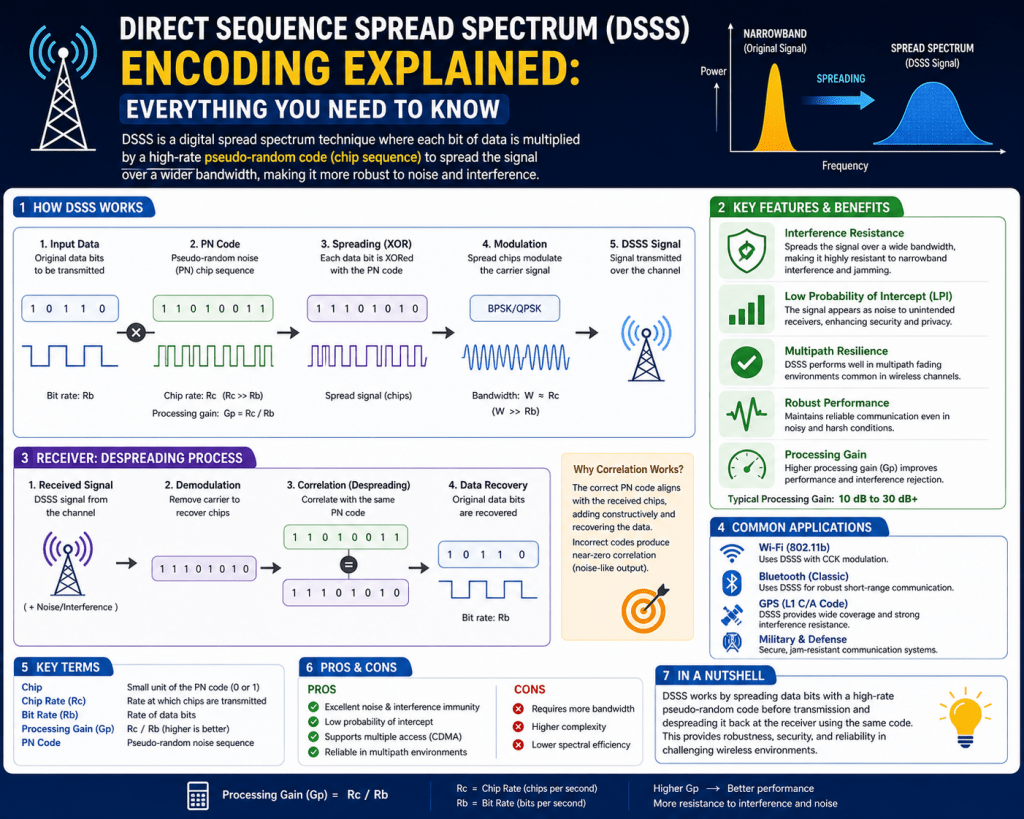
The defining characteristic of DSSS is its use of a pseudo-random noise sequence to encode the data before transmission. This sequence is combined with the original data to create a new signal that is spread across a wider bandwidth. The result is a signal that appears random and noise-like but contains structured information that can be decoded by a receiver using the same sequence.
This process distinguishes DSSS from other techniques because it does not rely on switching frequencies. Instead, it achieves spreading by modifying the data itself. This allows for more efficient use of the available spectrum and can lead to improved signal stability.
The Role of Pseudo-Random Noise in DSSS
Pseudo-random noise plays a central role in DSSS encoding. Despite its name, this noise is not truly random. It is generated using a deterministic algorithm that produces a sequence of bits that appear random but can be reproduced exactly by both the transmitter and the receiver.
This sequence is used to transform the original data into a spread signal. Each bit of the original data is combined with the pseudo-random sequence, resulting in a series of smaller units known as chips. These chips represent the encoded version of the data and are transmitted over the air.
The use of pseudo-random noise provides several benefits. It spreads the signal across a wider bandwidth, making it more resistant to interference. It also makes the signal less recognizable, as it resembles background noise to unintended receivers. This adds a layer of complexity that enhances the overall robustness of the communication system.
Understanding Chips and Data Expansion
In DSSS encoding, the concept of chips is fundamental. A chip is a smaller unit of data derived from the original bit through the encoding process. Each bit of the original data is represented by multiple chips, effectively expanding the data before transmission.
This expansion increases the amount of information transmitted, but it also introduces redundancy. Redundancy is a key factor in improving reliability, as it allows the receiver to recover the original data even if some chips are lost or corrupted during transmission.
For example, if one bit is represented by several chips, the receiver does not need to receive all of them to determine the original value. By analyzing the pattern of the received chips, the system can reconstruct the original bit with a high degree of accuracy. This makes DSSS particularly effective in environments where signal degradation is common.
Correlation and Signal Recovery
The process of recovering the original data from a DSSS signal relies on correlation. Correlation is a mathematical technique used to compare two sequences and determine how closely they match. In the context of DSSS, the receiver uses correlation to compare the incoming signal with the known pseudo-random sequence.
If the received signal matches the expected sequence, the system can confidently extract the original data. If the match is weak, the system can identify the signal as noise or interference. This ability to distinguish between valid data and noise is a key advantage of DSSS.
Correlation also allows the receiver to filter out unwanted signals. Since only the correctly encoded signal will match the pseudo-random sequence, other signals that do not follow the same pattern are effectively ignored. This improves the overall quality of the received data and reduces the impact of interference.
Bandwidth Trade-Offs in DSSS Systems
One of the trade-offs associated with DSSS is the increased bandwidth required for transmission. Because each bit is expanded into multiple chips, the overall bandwidth of the signal is significantly larger than that of the original data.
While this may seem like a disadvantage, it is a deliberate design choice that provides several benefits. The increased bandwidth allows the signal to be spread over a wider range of frequencies, improving its resistance to interference and noise. It also enhances the system’s ability to recover data in challenging conditions.
In many applications, the benefits of increased reliability and robustness outweigh the cost of additional bandwidth. This is especially true in environments where maintaining a stable connection is more important than maximizing data throughput.
Why DSSS Signals Resemble Noise
One of the most intriguing aspects of DSSS is that the encoded signal appears as noise to anyone who does not know the encoding sequence. This is a direct result of the pseudo-random noise used in the encoding process.
To an unintended receiver, the signal does not have any recognizable structure. It blends into the background noise, making it difficult to detect or interpret. This characteristic provides a level of privacy, as it reduces the likelihood of unauthorized interception.
However, it is important to note that DSSS is not a form of encryption. While it makes the signal harder to detect, it does not prevent someone with the correct knowledge and tools from decoding it. For true security, additional encryption methods are required.
Applications of DSSS in Wireless Communication
DSSS has been widely used in various wireless communication systems due to its reliability and resilience. It has been a foundational technology in early wireless networking standards and continues to influence modern communication techniques.
The ability of DSSS to maintain data integrity in the presence of interference makes it suitable for environments with high levels of signal congestion. It is also useful in situations where consistent performance is required despite changing conditions.
By combining spread spectrum principles with advanced encoding techniques, DSSS provides a robust solution for wireless communication challenges. Its use of pseudo-random noise, data expansion, and correlation-based decoding creates a system that is both reliable and adaptable.
The Importance of DSSS in Modern Networking
As wireless communication continues to evolve, the principles behind DSSS remain highly relevant. Modern systems may incorporate more advanced technologies, but the core idea of spreading a signal to improve reliability is still widely used.
DSSS represents an important step in the development of wireless communication. It demonstrates how mathematical and engineering concepts can be applied to overcome physical limitations and create more effective communication systems.
Understanding DSSS provides valuable insight into how wireless networks operate and how they achieve reliable performance in complex environments. It also highlights the importance of innovation in addressing the challenges of modern communication.
Deep Dive into DSSS Encoding Mechanics and Signal Processing
Direct Sequence Spread Spectrum relies on a carefully structured encoding process that transforms simple binary data into a robust and noise-resistant signal. While the foundational concept focuses on spreading data across a wide bandwidth, the actual implementation involves multiple layers of signal processing, synchronization, and mathematical operations. Understanding these mechanics reveals why DSSS is so effective in wireless communication environments where interference and signal degradation are common.
At its core, DSSS encoding begins with a binary data stream. This data, consisting of ones and zeros, is not transmitted directly. Instead, it is combined with a pseudo-random sequence that reshapes the signal into a spread format. This transformation increases the signal’s bandwidth while embedding redundancy that allows the receiver to recover the original information even in adverse conditions.
The encoding process operates at a much higher rate than the original data transmission. This higher rate is defined by the chip rate, which determines how many smaller units are used to represent each bit. The relationship between bit rate and chip rate plays a crucial role in determining the performance and resilience of the system.
Understanding Chip Sequences and Their Role in DSSS
Chip sequences are the building blocks of DSSS encoding. Each bit of the original data is mapped to a sequence of smaller bits called chips. These chips are generated using a pseudo-random noise generator, which produces a deterministic sequence that appears random but is reproducible by both the transmitter and receiver.
The purpose of this mapping is to spread the energy of each data bit across a wider frequency range. By doing so, the system ensures that interference affecting a small portion of the spectrum does not disrupt the entire signal. This distribution of energy is a defining characteristic of spread spectrum communication.
The length of the chip sequence determines the level of redundancy introduced into the system. Longer sequences provide greater resilience but require more bandwidth. Shorter sequences are more bandwidth-efficient but offer less protection against interference. The choice of sequence length depends on the specific requirements of the communication system.
Chip sequences also influence the processing gain of the system. Processing gain is a measure of how much the signal-to-noise ratio improves as a result of spreading. A higher processing gain indicates better performance in noisy environments, as the system can more effectively distinguish the desired signal from background noise.
The Concept of Spreading and Despreading
Spreading is the process of combining the original data with the chip sequence to create the DSSS signal. This is typically done using mathematical operations such as exclusive OR or multiplication, depending on the representation of the data. The result is a signal that has a much higher data rate in terms of chips per second.
Despreading is the reverse process performed at the receiver. Using the same pseudo-random sequence, the receiver reconstructs the original data by correlating the incoming signal with the expected chip pattern. This operation effectively compresses the signal back to its original form, removing the spreading effect.
The success of despreading depends on precise synchronization between the transmitter and receiver. Both must use the same chip sequence and align their timing accurately. Even a slight mismatch can result in decoding errors, highlighting the importance of synchronization mechanisms in DSSS systems.
Synchronization in DSSS Communication
Synchronization ensures that the receiver can correctly interpret the incoming signal. In DSSS systems, synchronization involves aligning the timing of the chip sequence with the received signal. This process is critical because the correlation operation used in despreading relies on matching the exact sequence and timing of the chips.
There are two main aspects of synchronization: code synchronization and carrier synchronization. Code synchronization involves aligning the pseudo-random sequence used for encoding and decoding. Carrier synchronization ensures that the frequency and phase of the received signal match those expected by the receiver.
Achieving synchronization can be challenging, especially in environments with high levels of noise and interference. DSSS systems often use specialized algorithms and techniques to acquire and maintain synchronization. These methods continuously adjust the receiver’s parameters to match the incoming signal, ensuring accurate data recovery.
Barker Code and Its Importance in DSSS
One of the most well-known chip sequences used in DSSS systems is the Barker code. Barker sequences are short pseudo-random sequences with excellent correlation properties. These properties make them particularly effective for signal detection and synchronization.
In many wireless communication systems, an 11-bit Barker sequence is used. This sequence provides a balance between performance and complexity, offering sufficient redundancy while maintaining manageable bandwidth requirements. Each bit of the original data is expanded into 11 chips using this sequence.
The key advantage of Barker sequences lies in their autocorrelation characteristics. Autocorrelation measures how well a sequence matches itself when shifted in time. Barker sequences have a strong peak when aligned correctly and minimal correlation when misaligned. This makes it easier for the receiver to identify the correct timing and recover the original data.
The use of Barker codes also enhances the system’s ability to handle interference. Because the sequence is designed to minimize cross-correlation with other signals, it reduces the likelihood of interference from other transmissions affecting the decoding process.
Mathematical Representation of DSSS Encoding
DSSS encoding can be described mathematically as the multiplication of the data signal by the pseudo-random sequence. If the data is represented as a sequence of binary values and the chip sequence is represented similarly, the encoding process produces a new sequence that combines both.
This mathematical representation highlights the deterministic nature of DSSS. Although the resulting signal appears random, it is generated through a predictable process that can be reversed by the receiver. This reversibility is essential for accurate data recovery.
The mathematical framework also provides insight into how DSSS achieves noise resistance. When the signal is spread, the energy is distributed across a wide bandwidth. During despreading, the energy is concentrated back into the original signal, while noise remains spread out. This difference in energy distribution improves the signal-to-noise ratio.
Processing Gain and Its Impact on Performance
Processing gain is a critical parameter in DSSS systems. It represents the ratio of the spread bandwidth to the original data bandwidth. A higher processing gain indicates that the signal has been spread more extensively, resulting in greater resistance to interference.
The processing gain directly influences the system’s ability to recover data in noisy environments. By spreading the signal over a wide bandwidth, DSSS reduces the impact of narrowband interference. When the signal is despread, the desired data is reinforced, while the interference is diminished.
This characteristic makes DSSS particularly useful in environments with high levels of electromagnetic interference. It allows the system to maintain reliable communication even when other signals are present in the same frequency range.
Error Resilience and Redundancy in DSSS
One of the most significant advantages of DSSS is its built-in redundancy. By representing each data bit with multiple chips, the system introduces multiple opportunities to recover the original information. Even if some chips are lost or corrupted, the remaining chips can still provide enough information for accurate reconstruction.
This redundancy acts as a form of error correction. While DSSS does not replace dedicated error correction codes, it complements them by improving the overall robustness of the transmission. The receiver can use correlation techniques to determine the most likely value of each bit based on the received chips.
The level of redundancy can be adjusted by changing the length of the chip sequence. Longer sequences provide more redundancy and better error resilience but require more bandwidth. This trade-off must be carefully managed to balance performance and efficiency.
Bandwidth Utilization and Spectrum Efficiency
DSSS requires a wider bandwidth than traditional narrowband communication systems. This increased bandwidth is necessary to accommodate the spread signal and the additional chips used for encoding. While this may seem inefficient, it is a deliberate design choice that prioritizes reliability over bandwidth conservation.
Spectrum efficiency is an important consideration in wireless communication. DSSS sacrifices some efficiency to achieve greater resilience and stability. In many applications, this trade-off is acceptable because maintaining a reliable connection is more important than maximizing data throughput.
The use of a wider bandwidth also reduces the power density of the signal. By spreading the energy over a larger frequency range, DSSS signals are less likely to interfere with other systems. This makes them suitable for environments where multiple devices share the same spectrum.
Interference Rejection and Noise Immunity
DSSS systems are highly effective at rejecting interference. Because the signal is spread across a wide bandwidth, interference affecting a narrow frequency range has a limited impact on the overall transmission. This characteristic is particularly valuable in environments with many competing signals.
Noise immunity is another key benefit of DSSS. The correlation process used in despreading allows the receiver to distinguish between the desired signal and random noise. Since the pseudo-random sequence is known, only signals that match this sequence are considered valid.
This ability to filter out noise improves the reliability of the communication system. It ensures that data can be transmitted accurately even in challenging conditions where other systems might fail.
Security Implications of DSSS Encoding
Although DSSS is not a form of encryption, it provides a level of signal obscurity. The noise-like appearance of the spread signal makes it difficult for unintended receivers to detect and interpret the transmission. Without knowledge of the pseudo-random sequence, the signal appears indistinguishable from background noise.
This characteristic enhances the security of DSSS systems by reducing the likelihood of interception. However, it is important to note that DSSS should not be relied upon as a sole security measure. Additional encryption techniques are required to protect sensitive data fully.
The combination of DSSS and encryption provides a robust solution for secure communication. DSSS ensures reliable transmission, while encryption protects the content of the data.
Real-World Implementation Considerations
Implementing DSSS in real-world systems involves several practical considerations. These include selecting appropriate chip sequences, managing synchronization, and optimizing bandwidth usage. Engineers must also consider the specific requirements of the application, such as data rate, range, and environmental conditions.
Hardware design plays a crucial role in DSSS implementation. Transmitters and receivers must be capable of generating and processing high-rate chip sequences. They must also support the algorithms required for synchronization and correlation.
Software algorithms are equally important. They control the encoding and decoding processes, manage synchronization, and handle error detection and correction. The integration of hardware and software components determines the overall performance of the DSSS system.
Adaptability of DSSS in Evolving Technologies
DSSS has proven to be a versatile and adaptable technology. While newer communication methods have been developed, the principles of DSSS continue to influence modern systems. Its ability to provide reliable communication in challenging environments ensures its ongoing relevance.
The concepts of spreading, redundancy, and correlation are fundamental to many advanced communication techniques. DSSS serves as a foundation for understanding these concepts and their applications in modern technology.
As wireless communication continues to evolve, DSSS remains an important part of the technological landscape. Its contributions to signal processing and communication theory have shaped the development of more advanced systems, ensuring its place in the history and future of wireless communication.
Advanced Concepts and Practical Applications of DSSS Data Encoding
Direct Sequence Spread Spectrum has established itself as one of the most resilient and reliable methods for wireless communication. While earlier discussions focused on its foundational principles and internal mechanics, a deeper exploration reveals how DSSS operates in real-world environments, how it scales across systems, and how it continues to influence modern communication technologies. Its strength lies not only in theory but in its adaptability to complex and unpredictable transmission conditions.
In practical scenarios, wireless communication rarely occurs in ideal conditions. Signals must navigate obstacles, compete with other transmissions, and endure interference from both natural and artificial sources. DSSS addresses these challenges by leveraging redundancy, signal spreading, and intelligent decoding mechanisms. These features allow it to maintain data integrity even when parts of the signal are degraded or lost.
One of the defining aspects of DSSS in real-world use is its ability to maintain consistent communication quality despite fluctuations in signal strength. As devices move or environmental conditions change, the signal may weaken or encounter interference. DSSS compensates for these variations by distributing data across a wide bandwidth, ensuring that even partial reception is sufficient for accurate reconstruction.
Multipath Propagation and DSSS Performance
Multipath propagation is a common phenomenon in wireless communication where signals take multiple paths to reach the receiver. These paths may include reflections from buildings, ground surfaces, and other obstacles. As a result, the receiver may receive multiple copies of the same signal at slightly different times.
In traditional communication systems, multipath propagation can cause interference, leading to signal distortion and data errors. DSSS, however, is inherently resistant to these effects. The spreading of the signal allows the receiver to distinguish between the different signal paths using correlation techniques.
By identifying the strongest and most relevant signal components, DSSS systems can effectively mitigate the impact of multipath interference. This capability improves signal clarity and reduces the likelihood of data corruption. It also enhances performance in environments such as urban areas, where reflections and obstacles are common.
Near-Far Problem and Power Control
In wireless networks, the near-far problem occurs when a receiver is exposed to signals from multiple transmitters at varying distances. A strong signal from a nearby transmitter can overpower weaker signals from distant transmitters, making it difficult for the receiver to detect and decode the weaker signals.
DSSS systems address this issue through power control mechanisms and signal processing techniques. By adjusting the transmission power of devices, the system ensures that signals arrive at the receiver with comparable strength. This balance allows the receiver to process multiple signals without one dominating the others.
The spreading process also contributes to mitigating the near-far problem. Since each signal is encoded with a unique pseudo-random sequence, the receiver can differentiate between them using correlation. This enables multiple users to share the same frequency band without significant interference.
Code Division Multiple Access and DSSS
One of the most important applications of DSSS is in Code Division Multiple Access, a technique that allows multiple users to share the same communication channel simultaneously. In this approach, each user is assigned a unique pseudo-random code, which is used to encode their data.
All users transmit their signals over the same frequency band at the same time. At the receiver, the desired signal is extracted by correlating the incoming data with the corresponding code. Signals from other users appear as noise and are effectively filtered out.
This method significantly increases the capacity of the communication system. Instead of dividing the spectrum by frequency or time, it allows multiple transmissions to coexist within the same bandwidth. DSSS plays a critical role in enabling this functionality by providing the encoding and decoding mechanisms required for code-based separation.
Interoperability with Wireless Standards
DSSS has been a foundational technology in early wireless networking standards. Its ability to provide reliable communication in noisy environments made it an ideal choice for initial implementations of wireless local area networks. These systems relied on DSSS to ensure stable connectivity and consistent performance.
In these standards, specific chip sequences and encoding techniques were defined to ensure interoperability between devices. This standardization allowed equipment from different manufacturers to communicate effectively, promoting widespread adoption of wireless technology.
Channel width and bandwidth allocation were also influenced by DSSS requirements. The need to accommodate spread signals led to the use of wider channels, which became a defining characteristic of wireless networking systems. These design choices continue to influence modern wireless technologies.
Signal Detection and Acquisition Techniques
Before a DSSS receiver can decode a signal, it must first detect and acquire it. This process involves identifying the presence of a valid signal and aligning the receiver’s parameters with the incoming transmission. Signal acquisition is a critical step, as accurate decoding depends on precise synchronization.
Detection is achieved by scanning the frequency band for signals that match the expected characteristics of DSSS transmission. Once a potential signal is identified, the receiver begins the acquisition process by attempting to align its pseudo-random sequence with the incoming signal.
This alignment is achieved through correlation. The receiver tests different timing offsets until it finds a strong correlation peak, indicating that the sequences are aligned. Once alignment is achieved, the receiver can proceed with decoding the data.
Maintaining synchronization is equally important. As conditions change, the receiver must continuously adjust its parameters to stay aligned with the signal. This dynamic process ensures consistent performance even in the presence of movement or environmental changes.
Error Handling and Data Reconstruction
DSSS systems are designed to handle errors gracefully. The redundancy introduced by chip sequences allows the receiver to recover data even when some portions of the signal are lost or corrupted. This capability is essential for maintaining reliable communication in challenging environments.
Error handling in DSSS involves analyzing the received chips and determining the most likely value of the original data bit. This is typically done using correlation and decision algorithms that evaluate the pattern of received chips.
In addition to inherent redundancy, DSSS systems often incorporate additional error detection and correction techniques. These methods further enhance reliability by identifying and correcting errors that cannot be resolved through correlation alone.
The combination of redundancy and error correction ensures that DSSS systems can deliver accurate data even under adverse conditions. This makes them suitable for applications where reliability is critical.
Impact of DSSS on Wireless Channel Design
The use of DSSS has a significant impact on how wireless channels are designed and allocated. Because DSSS requires a wider bandwidth, channels must be carefully planned to avoid overlap and interference with other systems.
Channel spacing and allocation are influenced by the spread of the signal. Engineers must ensure that adjacent channels do not interfere with each other, which can be challenging in crowded frequency bands. Proper channel planning is essential for maintaining system performance.
The concept of channel width also plays a role in DSSS performance. Wider channels allow for more extensive spreading, which can improve resilience but also increases the likelihood of interference with other systems. Balancing these factors is a key aspect of wireless network design.
DSSS in High-Interference Environments
One of the strengths of DSSS is its ability to perform well in environments with high levels of interference. Industrial settings, urban areas, and crowded communication networks often present significant challenges for wireless systems.
In such environments, DSSS provides a robust solution by spreading the signal and using correlation to filter out interference. This allows the system to maintain reliable communication even when other signals are present.
The noise-like nature of DSSS signals also reduces the likelihood of interference with other systems. Since the signal is distributed across a wide bandwidth, its impact on any single frequency is minimized. This characteristic makes DSSS suitable for coexistence with other communication technologies.
Energy Distribution and Signal Power Characteristics
DSSS changes how signal energy is distributed across the frequency spectrum. Instead of concentrating power in a narrow band, it spreads the energy over a wide range of frequencies. This distribution reduces the power density of the signal.
Lower power density has several advantages. It reduces the likelihood of interference with other systems and makes the signal less detectable by unintended receivers. This contributes to both coexistence and security.
At the same time, the total energy of the signal remains sufficient for reliable communication. During despreading, the receiver concentrates the energy back into the original signal, improving the signal-to-noise ratio. This process ensures that the benefits of spreading are realized without compromising signal strength.
Comparison with Other Spread Spectrum Techniques
While DSSS is a prominent spread spectrum technique, it is not the only one. Other methods, such as frequency hopping, take a different approach by rapidly switching between frequencies during transmission.
The key difference lies in how the signal is spread. DSSS spreads the signal continuously across a wide bandwidth, while other methods distribute the signal over time by changing frequencies. Each approach has its advantages and trade-offs.
DSSS is particularly effective in environments with continuous interference, as it provides consistent spreading and redundancy. Other methods may be more suitable for avoiding specific types of interference. Understanding these differences helps in selecting the appropriate technique for a given application.
Scalability and Future Relevance of DSSS
DSSS has demonstrated strong scalability across different communication systems. Its principles can be adapted to various data rates, bandwidths, and application requirements. This flexibility has contributed to its longevity and continued relevance.
As communication technologies evolve, the concepts behind DSSS continue to influence new developments. Techniques such as advanced coding, adaptive modulation, and multiple access systems build upon the foundations established by spread spectrum communication.
The emphasis on reliability, resilience, and efficient use of the spectrum remains central to modern wireless design. DSSS provides a framework for achieving these goals, ensuring its continued importance in the field.
Integration with Modern Communication Systems
Modern wireless systems often integrate multiple techniques to achieve optimal performance. DSSS can be combined with other methods, such as advanced modulation schemes and error correction algorithms, to enhance overall system capabilities.
This integration allows for greater flexibility and adaptability. Systems can adjust their parameters based on environmental conditions, user requirements, and available resources. DSSS contributes to this adaptability by providing a reliable foundation for signal transmission.
The ability to integrate DSSS with other technologies ensures that it remains relevant in a rapidly changing landscape. Its principles continue to support innovation and development in wireless communication.
Challenges and Limitations of DSSS
Despite its advantages, DSSS is not without limitations. The requirement for increased bandwidth can be a constraint in environments where spectrum is limited. Efficient spectrum management is essential to address this challenge.
Synchronization complexity is another consideration. Maintaining accurate alignment between transmitter and receiver requires sophisticated algorithms and processing capabilities. This can increase system complexity and cost.
Additionally, while DSSS provides a level of signal obscurity, it does not offer complete security. Additional measures are needed to protect sensitive data from unauthorized access.
Understanding these limitations is important for effectively implementing DSSS and maximizing its benefits.
The Role of DSSS in Reliable Wireless Communication
DSSS represents a significant advancement in the field of wireless communication. Its ability to spread signals, introduce redundancy, and filter out interference makes it a powerful tool for ensuring reliable data transmission.
By addressing the challenges of noise, interference, and signal degradation, DSSS enables communication systems to operate effectively in a wide range of environments. Its influence extends beyond its original applications, shaping the development of modern wireless technologies.
The combination of theoretical principles and practical implementation makes DSSS a cornerstone of communication engineering. Its continued relevance highlights the importance of innovative approaches to overcoming the limitations of wireless transmission.
Conclusion
Direct Sequence Spread Spectrum represents a significant milestone in the evolution of wireless communication, bringing together principles of signal processing, mathematical modeling, and practical engineering to solve real-world transmission challenges. Throughout its development and application, DSSS has consistently demonstrated its value in enhancing reliability, improving resistance to interference, and enabling efficient use of the available frequency spectrum. Its importance lies not only in how it works but in why it works so effectively under conditions where traditional communication methods struggle.
At its core, DSSS transforms the way data is transmitted by shifting from a narrowband approach to a wideband strategy. Instead of relying on a single frequency channel that can easily be disrupted, DSSS distributes data across a broad range of frequencies using carefully designed chip sequences. This spreading process fundamentally changes the nature of the signal, making it more robust against environmental factors such as noise, physical obstructions, and competing transmissions. The result is a communication system that prioritizes consistency and reliability over raw efficiency.
One of the most defining characteristics of DSSS is its use of pseudo-random noise sequences. These sequences serve as the foundation for encoding and decoding, enabling both the transmitter and receiver to operate in synchronization. While the transmitted signal appears random and indistinguishable from noise to unintended observers, it remains fully interpretable to devices that share the same encoding pattern. This dual nature enhances both the resilience and the subtlety of the communication process, allowing signals to coexist within crowded frequency environments without causing significant disruption.
The concept of chips and data expansion further reinforces the strength of DSSS. By representing each bit of data with multiple chips, the system introduces redundancy that acts as a safeguard against data loss. Even when parts of the signal are corrupted or lost during transmission, the remaining chips often contain enough information to reconstruct the original data accurately. This built-in redundancy reduces the need for retransmissions and improves overall communication efficiency in challenging conditions.
Another critical aspect of DSSS is its reliance on correlation for signal recovery. The ability of the receiver to compare incoming signals with known sequences and identify valid data plays a central role in filtering out noise and interference. This process allows DSSS systems to operate effectively even in environments with high levels of electromagnetic activity. The precision and reliability of correlation-based decoding highlight the sophistication of DSSS as a communication technique.
DSSS also addresses several common challenges in wireless communication, including multipath propagation and the near-far problem. By spreading the signal and using advanced decoding techniques, DSSS minimizes the impact of reflected signals and ensures that transmissions from multiple sources can be distinguished and processed accurately. These capabilities make DSSS particularly well-suited for complex environments such as urban areas, industrial settings, and densely populated communication networks.
The role of DSSS in enabling multiple access systems further underscores its importance. By allowing multiple users to share the same frequency band through unique encoding sequences, DSSS supports efficient spectrum utilization and increases the capacity of communication systems. This approach has had a lasting impact on the design of wireless networks, influencing the development of technologies that rely on shared resources and simultaneous transmissions.
Despite its many advantages, DSSS involves certain trade-offs that must be carefully managed. The increased bandwidth required for spreading the signal can be a limitation in environments where spectrum availability is restricted. Additionally, the need for precise synchronization between transmitter and receiver introduces complexity into system design. These challenges highlight the importance of balancing performance, efficiency, and practicality when implementing DSSS in real-world applications.
The adaptability of DSSS is one of its most enduring strengths. Its principles can be applied across a wide range of communication systems, from early wireless networks to more advanced and integrated technologies. By focusing on reliability and resilience, DSSS provides a foundation that can be enhanced with additional techniques such as advanced modulation, error correction, and dynamic resource allocation. This flexibility ensures that DSSS remains relevant even as communication technologies continue to evolve.
Another noteworthy aspect of DSSS is its contribution to signal coexistence. By spreading energy across a wide frequency range and reducing power density, DSSS minimizes its impact on other systems operating in the same spectrum. This characteristic is essential in modern communication environments, where multiple technologies must operate simultaneously without causing harmful interference. DSSS enables this coexistence by promoting efficient and respectful use of shared resources.
The noise-like nature of DSSS signals also introduces an element of subtlety to wireless communication. While not a substitute for encryption, this characteristic makes it more difficult for unintended receivers to detect and interpret transmissions. This added layer of complexity complements other security measures and contributes to the overall robustness of the communication system.
From a broader perspective, DSSS illustrates how theoretical concepts can be translated into practical solutions that address real-world challenges. The integration of mathematical techniques, signal processing algorithms, and engineering design principles demonstrates the interdisciplinary nature of modern communication systems. DSSS serves as an example of how innovation can overcome physical limitations and create more effective methods of transmitting information.
As wireless communication continues to expand and diversify, the foundational ideas behind DSSS remain highly relevant. The emphasis on spreading, redundancy, and intelligent decoding continues to influence the design of new technologies. Even as newer methods emerge, the principles established by DSSS provide valuable insights into how reliable communication can be achieved in complex and dynamic environments.
The enduring significance of DSSS lies in its ability to balance competing demands. It addresses the need for reliability in the presence of interference, the need for efficiency in the use of spectrum, and the need for adaptability in changing conditions. By combining these elements into a cohesive system, DSSS has earned its place as a cornerstone of wireless communication.
Understanding DSSS is not only about learning a specific technique but also about appreciating the broader strategies used to manage and optimize communication systems. It highlights the importance of thinking beyond simple transmission methods and considering how signals interact with their environment. This perspective is essential for anyone seeking to understand or work with modern communication technologies.
Through its innovative approach to signal spreading and recovery, DSSS has reshaped the way data is transmitted over wireless networks. Its contributions extend beyond its original applications, influencing the development of more advanced and sophisticated communication systems. The concepts it introduced continue to guide engineers and researchers in their efforts to improve connectivity and performance.
In the context of an increasingly connected world, the importance of reliable and efficient communication cannot be overstated. DSSS provides a framework for achieving these goals, offering a solution that is both practical and adaptable. Its legacy is evident in the continued evolution of wireless technologies, where the need for resilience and reliability remains as important as ever.
The study of DSSS reveals the depth and complexity of modern communication systems while also highlighting the elegance of well-designed solutions. By spreading signals, introducing redundancy, and leveraging mathematical precision, DSSS transforms the challenges of wireless communication into manageable and solvable problems.