
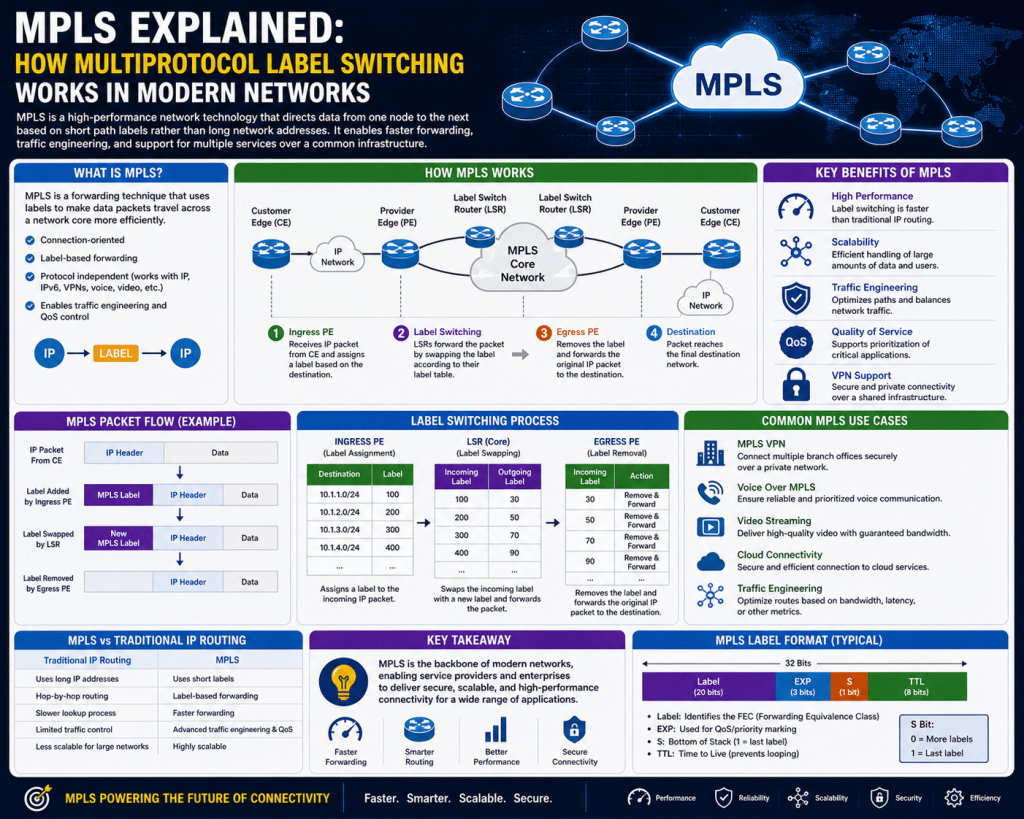
Multi-Protocol Label Switching, widely known as MPLS, is a foundational technology used in modern networking to improve the speed, control, and efficiency of data transmission across large and complex networks. It was developed to address the limitations of traditional routing methods, which often struggle to keep up with the growing demands of real-time applications and large-scale connectivity. As organizations increasingly rely on digital communication, cloud services, and distributed infrastructures, MPLS has become a critical component in ensuring consistent and reliable performance.
At a high level, MPLS operates by directing data packets along predetermined paths using labels rather than relying solely on IP addresses. This approach significantly reduces the time required for routing decisions, enabling faster and more efficient data forwarding. Unlike conventional routing, where each device must independently determine the next hop for a packet, MPLS allows for a more streamlined and predictable flow of traffic.
The importance of MPLS lies not only in its speed but also in its ability to provide greater control over how data moves through a network. This level of control is essential for organizations that require guaranteed performance for critical applications, such as voice communication, video conferencing, and enterprise resource systems. By prioritizing certain types of traffic, MPLS ensures that important data is delivered without delay or disruption.
The Core Concept Behind MPLS Technology
The fundamental idea behind MPLS is to simplify the process of packet forwarding by introducing labels that guide data through the network. These labels act as identifiers that determine the path a packet should follow, eliminating the need for repeated analysis of its destination address at each step.
When a packet enters an MPLS-enabled network, it is assigned a label by an ingress router. This label is then used by intermediate devices to forward the packet along a specific route. Each router along the path reads the label and makes a quick forwarding decision without inspecting the packet’s full header. This process continues until the packet reaches its destination, where the label is removed.
This method of forwarding is significantly more efficient than traditional routing because it reduces the computational workload on network devices. Instead of performing complex lookups in routing tables, routers can rely on simple label-based instructions. This not only speeds up data transmission but also improves the overall scalability of the network.
Another important aspect of MPLS is its protocol independence. It can work with various types of network protocols, making it a versatile solution for different environments. This flexibility allows organizations to integrate MPLS into their existing infrastructure without requiring major changes.
How Data Travels Through an MPLS Network
Understanding how data moves through an MPLS network helps clarify why this technology is so effective. The journey begins when a data packet enters the network through an ingress router. This router examines the packet’s destination and assigns it a label that corresponds to a predefined path.
Once labeled, the packet is forwarded through a series of label-switched routers. These devices are responsible for moving the packet along its designated path. At each step, the router reads the label and determines the next hop. In some cases, the label may be replaced with a new one to reflect changes in the routing path.
This process continues until the packet reaches the egress router, which removes the label and forwards the packet to its final destination using standard routing methods. The entire journey is designed to minimize delays and ensure that data is delivered efficiently.
One of the key advantages of this approach is its predictability. Because paths are predetermined, network administrators can ensure that data follows the most efficient route. This is particularly important in environments where consistent performance is required.
The use of labels also enables faster recovery from network failures. If a particular path becomes unavailable, MPLS can quickly reroute traffic along an alternative path without significant disruption. This capability enhances the reliability of the network and reduces downtime.
The Role of MPLS in Wide Area Networks
MPLS is commonly used in wide-area networks to connect multiple locations across large geographic distances. Organizations with offices in different cities or countries often need a reliable way to share data and communicate effectively. MPLS provides a solution by creating a private network that links these sites together.
In a typical MPLS deployment, each location connects to a service provider’s network. The provider uses MPLS to route traffic between sites, ensuring that data is delivered efficiently and securely. From the perspective of the organization, it appears as though all locations are part of a single, unified network.
This approach offers several advantages over traditional methods of connectivity. It eliminates the need for complex point-to-point connections, reducing both cost and administrative overhead. It also provides better performance by prioritizing critical traffic and minimizing delays.
Wide area networks that use MPLS are particularly well-suited for applications that require low latency and high reliability. Voice and video communication, for example, depend on consistent performance to deliver a good user experience. MPLS ensures that these applications receive the necessary resources to function effectively.
The ability to create a seamless network across multiple locations also improves collaboration and productivity. Employees can access resources and communicate with colleagues regardless of their physical location, enabling more efficient operations.
Comparing MPLS with Traditional Routing Methods
To fully appreciate the benefits of MPLS, it is helpful to compare it with traditional routing methods. In conventional networks, routers make forwarding decisions based on the destination IP address of each packet. This process involves examining the packet’s header and consulting a routing table to determine the best path.
While this approach is effective, it can become inefficient as networks grow in size and complexity. Each router must perform the same analysis for every packet, leading to increased processing time and potential delays. This can be particularly problematic in high-traffic environments.
MPLS addresses these challenges by introducing a more efficient method of forwarding. Using labels to guide packets along predetermined paths, it eliminates the need for repeated analysis at each hop. This results in faster data transmission and improved performance.
Another advantage of MPLS is its ability to support advanced features such as traffic engineering and quality of service. These capabilities allow network administrators to optimize the flow of data and ensure that critical applications receive the resources they need.
In contrast, traditional routing methods offer limited control over how traffic is handled. Packets typically follow the shortest available path, which may not always be the most efficient or reliable option. MPLS provides greater flexibility by allowing administrators to define specific paths for different types of traffic.
The Importance of Label Switched Paths
Label Switched Paths, often referred to as LSPs, are a key component of MPLS networks. These paths define the route that packets will take from their source to their destination. By establishing LSPs in advance, MPLS ensures that data follows a consistent and efficient path through the network.
LSPs are created based on various factors, including network topology, traffic requirements, and performance goals. Once established, they provide a predictable route for data transmission, reducing the likelihood of congestion and delays.
One of the main benefits of LSPs is their ability to support traffic engineering. Network administrators can design paths that optimize the use of available resources, ensuring that traffic is distributed evenly across the network. This helps prevent bottlenecks and improves overall performance.
LSPs also enhance the reliability of the network. If a particular path becomes unavailable, MPLS can quickly switch to an alternative path without disrupting data transmission. This ensures continuous connectivity and minimizes downtime.
The use of LSPs is particularly important in large-scale networks where efficient traffic management is essential. By providing a structured approach to routing, MPLS enables organizations to maintain high levels of performance and reliability.
MPLS and Network Scalability
Scalability is a critical consideration in modern networking, and MPLS is well-suited to meet this requirement. As organizations grow and their networks expand, the ability to handle increased traffic becomes essential. MPLS provides a scalable solution by simplifying the process of packet forwarding and reducing the workload on network devices.
The use of labels allows routers to process packets more efficiently, enabling them to handle higher volumes of traffic without compromising performance. This is particularly important in environments where large amounts of data must be transmitted quickly and reliably.
MPLS also supports the integration of new technologies and services. As organizations adopt cloud computing, virtualization, and other advanced solutions, their networking requirements continue to evolve. MPLS provides the flexibility needed to accommodate these changes without requiring significant modifications to the existing infrastructure.
Another aspect of scalability is the ability to add new locations to the network. MPLS simplifies this process by allowing new sites to be integrated into the existing network with minimal effort. This makes it easier for organizations to expand their operations and adapt to changing business needs.
The scalability of MPLS is one of the reasons it remains a popular choice for large enterprises and service providers. It provides a reliable and efficient foundation for building and managing complex networks.
MPLS as a Foundation for Reliable Communication
Reliable communication is essential for modern organizations, and MPLS plays a crucial role in achieving this goal. By providing a consistent and efficient method of data transmission, it ensures that applications and services can operate without interruption.
One of the key features of MPLS is its ability to prioritize traffic based on its importance. This is achieved through quality of service mechanisms, which allow network administrators to assign different levels of priority to different types of data. Critical applications, such as voice and video communication, can be given higher priority to ensure they receive the necessary resources.
This prioritization helps maintain the quality of real-time communication, reducing issues such as latency, jitter, and packet loss. As a result, users experience clearer calls, smoother video streams, and more responsive applications.
MPLS also enhances security by providing a private network environment. Data is transmitted through dedicated paths within the service provider’s network, reducing the risk of unauthorized access. While it is not a replacement for encryption, it adds a layer of protection.
The combination of performance, reliability, and security makes MPLS an essential technology for organizations that depend on seamless communication. It provides the infrastructure needed to support a wide range of applications and services, ensuring that data is delivered efficiently and consistently across the network.
Label Distribution and Forwarding Mechanisms in MPLS
A critical part of MPLS functionality is the process of label distribution. Labels are not randomly assigned; they are carefully generated and shared between network devices using specialized signaling protocols. These protocols ensure that all routers within an MPLS domain understand how to interpret and forward labeled packets.
When a packet enters the network, the ingress router classifies it based on predefined rules. This classification may consider destination address, application type, or quality requirements. Once classified, the router assigns a label that corresponds to a specific forwarding path. This path is known as a Label Switched Path and defines how the packet will traverse the network.
As the packet moves through intermediate routers, each device examines the label and performs a simple lookup to determine the next hop. Instead of analyzing the full IP header, the router only needs to reference a label forwarding table. This dramatically reduces processing time and improves throughput.
At each hop, the label may be swapped with a new one. This process, known as label swapping, ensures that the packet remains on the correct path even as it moves between different segments of the network. The final router removes the label entirely and forwards the packet using traditional IP routing methods.
This mechanism creates a highly efficient forwarding system that minimizes overhead and allows routers to focus on fast switching rather than complex decision-making.
The Role of Label Switch Routers in MPLS Networks
Label Switch Routers are fundamental components of the MPLS architecture. These devices are responsible for forwarding packets based on labels rather than IP addresses. Their primary function is to maintain high-speed packet forwarding by using simplified lookup tables.
There are different types of label switch routers within an MPLS network. Ingress routers handle incoming traffic and assign labels, while intermediate routers focus on forwarding labeled packets. Egress routers remove labels and deliver packets to their final destination.
Each label switch router maintains a Label Information Base, which stores mappings between incoming labels and outgoing interfaces. This database allows routers to quickly determine where a packet should be sent next without performing complex routing calculations.
The efficiency of label switch routers is one of the main reasons MPLS performs better than traditional routing in large-scale environments. By reducing processing complexity, these routers can handle significantly higher traffic volumes with lower latency.
Another important aspect of label switch routers is their ability to support traffic engineering. They can direct different types of traffic along different paths, ensuring that network resources are used efficiently and congestion is minimized.
Traffic Engineering and Intelligent Path Selection in MPLS
Traffic engineering is one of the most powerful capabilities of MPLS, allowing network administrators to control how data flows across the network. Instead of relying on automatic shortest-path routing, MPLS enables the creation of optimized paths based on performance requirements.
In traditional networks, traffic typically follows the shortest available route. While this approach is simple, it often leads to uneven traffic distribution and network congestion. MPLS solves this problem by allowing administrators to define explicit paths for different types of traffic.
These paths are established based on factors such as bandwidth availability, latency requirements, and application priority. Once defined, traffic is directed along these optimized routes, ensuring efficient use of network resources.
Traffic engineering also allows for load balancing across multiple paths. Instead of overloading a single route, MPLS distributes traffic across several Label Switched Paths. This reduces congestion and improves overall network performance.
Another advantage of traffic engineering is its ability to respond to network changes. If a link becomes congested or fails, MPLS can dynamically reroute traffic along alternative paths. This ensures continuous service availability and minimizes disruptions.
Quality of Service Implementation in MPLS Networks
Quality of Service plays a central role in MPLS-based networks, especially in environments where real-time communication is critical. MPLS supports QoS by allowing traffic to be classified and prioritized based on its importance.
Different types of traffic have different performance requirements. For example, voice communication requires low latency and minimal packet loss, while file transfers are less sensitive to delay. MPLS enables networks to differentiate between these traffic types and allocate resources accordingly.
Packets are marked with priority levels at the ingress point of the network. These markings are then translated into MPLS labels that carry information about how the packet should be treated. High-priority traffic is given preference in forwarding queues, ensuring faster delivery.
This prioritization is essential for applications such as voice over IP and video conferencing. Without QoS, these applications may experience jitter, delays, or dropped packets. MPLS helps maintain consistent performance by ensuring that critical traffic is always prioritized.
QoS also allows for bandwidth management across the network. Administrators can allocate specific portions of network capacity to different types of traffic, preventing any single application from consuming excessive resources.
MPLS VPNs and Secure Network Segmentation
One of the most widely used applications of MPLS is in creating virtual private networks. MPLS-based VPNs allow multiple organizations or departments to share the same physical infrastructure while maintaining logical separation between their traffic streams.
This is achieved by using labels to segregate traffic within the network. Each VPN is assigned a unique label structure that ensures data is only delivered to authorized destinations. This creates a secure and isolated communication environment.
Unlike traditional VPNs that rely heavily on encryption over public networks, MPLS VPNs operate within the service provider’s private infrastructure. This reduces exposure to external threats and improves performance by avoiding the overhead of encryption at every hop.
MPLS VPNs are commonly used in enterprise environments where multiple branches need to communicate securely. Each site connects to the provider’s network, and MPLS ensures that traffic is correctly isolated and routed between locations.
This approach simplifies network management because all VPNs are handled within a single MPLS framework. Administrators do not need to manage multiple independent connections, reducing complexity and operational overhead.
Scalability and Growth in MPLS-Based Networks
Scalability is one of the defining strengths of MPLS. As organizations expand, their networking requirements increase in both size and complexity. MPLS is designed to accommodate this growth without requiring major changes to the underlying infrastructure.
New sites can be added to an MPLS network with minimal configuration. Once connected to the service provider’s infrastructure, they become part of the existing label-based system. This allows organizations to scale their networks quickly and efficiently.
The use of labels also ensures that increased traffic does not significantly degrade performance. Because forwarding decisions are simplified, routers can handle larger volumes of data without additional processing overhead.
MPLS also supports the integration of new technologies such as cloud computing and virtualization. These technologies often require flexible and dynamic networking solutions, which MPLS provides through its adaptable architecture.
As networks grow, MPLS continues to maintain consistent performance by distributing traffic efficiently and avoiding bottlenecks. This makes it an ideal solution for organizations experiencing rapid expansion.
Resilience and Failover Mechanisms in MPLS Networks
Network reliability is a critical requirement for modern communication systems, and MPLS provides strong resilience features to ensure continuous operation. One of the key mechanisms supporting this reliability is fast rerouting.
If a link or node in the network fails, MPLS can quickly switch traffic to an alternative Label Switched Path. This process occurs automatically and minimizes service disruption. Because backup paths are often pre-established, failover happens almost instantaneously.
This capability is particularly important for real-time applications that cannot tolerate downtime. Voice and video services, for example, require uninterrupted connectivity to maintain quality.
MPLS also supports redundant network paths, ensuring that multiple routes exist between key locations. This redundancy enhances fault tolerance and reduces the impact of hardware or link failures.
Another aspect of resilience is the ability to isolate failures. Since MPLS networks use labels to control traffic flow, issues in one part of the network do not necessarily affect other areas. This isolation improves overall stability.
Integration of MPLS with Modern Networking Technologies
MPLS is not an isolated technology but rather a foundational layer that integrates with modern networking systems. It works alongside IP routing, cloud infrastructure, and software-defined networking to create flexible and efficient communication environments.
In modern architectures, MPLS often serves as the transport layer that connects distributed services. It provides the underlying infrastructure that supports high-performance applications and cloud-based systems.
Its compatibility with multiple protocols allows it to function in diverse environments without requiring major changes. This makes MPLS a long-lasting and adaptable solution for evolving network demands.
As networking continues to advance, MPLS remains relevant due to its ability to combine speed, reliability, and control. It continues to play a central role in shaping how data moves across global infrastructures, supporting the growing demand for high-performance connectivity in complex digital ecosystems.
Advanced Traffic Engineering and Load Distribution in MPLS
Traffic engineering in MPLS goes beyond simple routing decisions. It involves a dynamic and strategic approach to controlling how data flows across a network. This capability is essential in environments where different applications compete for limited bandwidth and resources.
One of the most important aspects of traffic engineering is constraint-based routing. Instead of choosing a path solely based on distance, MPLS considers multiple constraints such as bandwidth availability, delay sensitivity, and link reliability. This ensures that traffic is not only delivered but delivered in an optimized manner.
Load distribution plays a major role in maintaining network balance. MPLS networks often consist of multiple parallel paths between locations. Rather than sending all traffic through a single route, MPLS distributes data across several Label Switched Paths. This prevents congestion and ensures that no single link becomes overloaded.
This approach is particularly useful in large enterprise environments where thousands of users may be accessing applications simultaneously. By balancing traffic loads, MPLS ensures consistent performance across the entire network infrastructure.
Dynamic rerouting is another key feature of MPLS traffic engineering. When network conditions change, such as when a link becomes congested or fails, MPLS can quickly adjust routing decisions. Traffic is redirected to alternative paths without requiring manual intervention. This adaptability ensures continuous service availability and minimizes disruptions.
Traffic prioritization also contributes to load management. High-priority applications are assigned dedicated resources, while lower-priority traffic is routed through less critical paths. This ensures that essential services maintain performance even under heavy load conditions.
MPLS and Quality of Service Optimization Techniques
Quality of Service is one of the defining strengths of MPLS networks. It allows different types of traffic to be treated according to their specific requirements, ensuring that critical applications receive the necessary performance guarantees.
In MPLS environments, QoS begins at the edge of the network. When traffic enters the system, it is classified into different categories based on its sensitivity to delay, jitter, and packet loss. Each category is assigned a priority level, which is then mapped to MPLS labels.
Voice and video traffic typically receive the highest priority because they require real-time delivery. Even small delays can significantly impact the quality of these applications. MPLS ensures that such traffic is routed through the most efficient and least congested paths.
Data traffic, such as file transfers or background updates, is usually assigned a lower priority. While still important, these types of traffic are more tolerant of delays and can be scheduled during periods of lower network usage.
Queue management is another important aspect of QoS in MPLS. Routers maintain separate queues for different types of traffic. High-priority queues are processed first, ensuring that critical packets are forwarded without delay. This structured approach helps maintain predictable performance across the network.
Bandwidth allocation is also used to enforce QoS policies. Specific portions of network capacity can be reserved for different traffic classes. This prevents any single application from consuming excessive resources and ensures fair distribution across all services.
Resilience Engineering and Failover Mechanisms in MPLS
Network resilience is a critical requirement for modern communication systems, and MPLS provides several mechanisms to ensure continuous availability even in the presence of failures.
One of the most important resilience features is fast reroute capability. When a network failure occurs, MPLS can quickly switch traffic to an alternative Label Switched Path. This process happens in milliseconds, minimizing service disruption and maintaining connectivity.
Backup paths are often pre-established in MPLS networks. These redundant routes are kept ready to take over traffic in case of primary path failure. Because these paths are already defined, failover does not require complex recalculation, which significantly reduces recovery time.
Link protection and node protection are two additional mechanisms used to enhance resilience. Link protection ensures that traffic can bypass a failed connection, while node protection allows traffic to avoid an entire failed router. Together, these mechanisms provide comprehensive coverage against network failures.
Another important aspect of resilience is traffic restoration. After a failure is resolved, MPLS can automatically restore traffic to its original optimal path. This ensures that the network returns to its most efficient state without manual intervention.
Resilience in MPLS is not limited to failure recovery. It also includes proactive measures such as continuous monitoring of network conditions. By analyzing performance metrics in real time, MPLS can anticipate potential issues and adjust routing decisions before failures occur.
MPLS in Large-Scale Enterprise and Service Provider Networks
MPLS is widely used in both enterprise and service provider environments due to its ability to support large-scale, complex network infrastructures. In enterprise networks, MPLS connects multiple branch offices, data centers, and cloud services into a unified communication system.
This unified approach simplifies network management by providing a consistent framework for data transmission. Instead of managing multiple independent connections, organizations can rely on a single MPLS backbone to handle all communication between sites.
Service providers use MPLS to deliver network services to multiple customers over shared infrastructure. Each customer is assigned a separate logical network, ensuring traffic isolation and security. This allows providers to efficiently utilize their infrastructure while maintaining service separation.
Scalability is a major advantage in these environments. MPLS networks can grow to accommodate thousands of nodes without significant performance degradation. New sites can be added seamlessly, making it easy for organizations to expand their operations.
In addition, MPLS supports multiple service types over a single network. Voice, video, and data traffic can all be carried simultaneously, each with its own performance requirements. This convergence of services reduces infrastructure complexity and improves efficiency.
MPLS Integration with Cloud and Hybrid Network Environments
As organizations increasingly adopt cloud computing, MPLS plays a key role in connecting on-premises infrastructure with cloud-based services. It provides a reliable and consistent transport layer that ensures smooth communication between distributed environments.
In hybrid networks, MPLS connects local data centers with public and private cloud platforms. This allows organizations to extend their internal networks into cloud environments without sacrificing performance or control.
One of the main advantages of MPLS in cloud integration is its ability to provide predictable latency. Cloud applications often require consistent response times, especially for real-time services. MPLS ensures that data travels along optimized paths, reducing variability in performance.
Security is also enhanced through MPLS-based connectivity. By using private network paths, organizations can reduce exposure to public internet risks. While additional security measures may still be applied, MPLS provides a controlled transport environment that supports secure communication.
Another benefit is bandwidth management. Cloud applications can generate significant traffic, and MPLS allows organizations to allocate resources efficiently. This ensures that critical applications maintain performance even during periods of high demand.
Evolution of MPLS in Modern Networking Architectures
MPLS continues to evolve alongside modern networking technologies. While newer approaches such as software-defined networking and SD-WAN have emerged, MPLS remains a foundational technology due to its reliability and performance advantages.
In modern architectures, MPLS is often used in combination with other technologies. It serves as a stable backbone for transporting data, while newer systems handle dynamic routing and application-level optimization.
The evolution of MPLS has also led to improvements in automation and orchestration. Network management systems can now dynamically configure MPLS paths based on real-time conditions. This reduces manual configuration and improves responsiveness.
Another trend is the integration of MPLS with virtualized network functions. This allows network services to be deployed more flexibly, improving scalability and reducing hardware dependency.
Despite changes in networking technology, MPLS continues to play a critical role in ensuring reliable, high-performance communication. Its ability to combine speed, control, and scalability makes it a lasting component of modern network design.
Final Perspective on MPLS Network Behavior and Operational Value
Across modern networking environments, MPLS operates as a high-efficiency transport mechanism that bridges traditional routing with advanced traffic control. Its ability to simplify forwarding decisions while maintaining granular control over traffic behavior makes it uniquely suited for large-scale infrastructures.
The operational value of MPLS lies in its balance between performance and control. It reduces processing overhead while enabling complex traffic management strategies. This combination allows organizations to maintain high levels of reliability, scalability, and efficiency across their networks.
As digital ecosystems continue to grow, MPLS remains a key technology for ensuring that data flows smoothly across diverse environments, supporting the increasing demand for fast, stable, and predictable connectivity across global infrastructures.
900 words of conclusion
Conclusion: The Lasting Importance and Strategic Value of MPLS in Modern Networking
Multi-Protocol Label Switching has established itself as one of the most influential technologies in the evolution of modern networking. Across enterprise environments, service provider backbones, and hybrid cloud infrastructures, MPLS continues to serve as a foundational mechanism for ensuring fast, reliable, and predictable data delivery. Its design philosophy—separating control decisions from data forwarding and using labels instead of repeated IP lookups—has proven to be both efficient and scalable in environments where performance and stability are essential.
One of the most important takeaways about MPLS is that it fundamentally changes how data moves through a network. Traditional routing depends heavily on each router independently analyzing destination addresses and making hop-by-hop decisions. While functional, this method becomes increasingly inefficient as networks grow. MPLS replaces this repetitive decision-making process with predefined label-based paths, allowing traffic to move through the network with significantly reduced processing overhead. This shift is not just an incremental improvement; it represents a structural optimization of how networks operate at scale.
Another key reason MPLS remains widely used is its ability to deliver predictable performance. In modern digital environments, unpredictability is one of the biggest challenges. Applications such as voice communication, video conferencing, financial systems, and cloud-based services require consistent latency and minimal packet loss. MPLS addresses this need by enabling traffic engineering and quality of service mechanisms that prioritize critical data. Instead of treating all traffic equally, MPLS allows networks to make intelligent decisions about which data should be prioritized and how it should be routed.
This predictability extends beyond performance into operational stability. MPLS networks are designed to maintain service continuity even in the event of failures. Through mechanisms such as fast rerouting and pre-established backup paths, MPLS can quickly adapt to changing network conditions. This resilience ensures that disruptions are minimized and that communication remains uninterrupted. In environments where downtime can result in significant financial or operational impact, this capability is extremely valuable.
Scalability is another defining strength of MPLS. As organizations expand, they often face increasing complexity in connecting multiple locations, managing traffic, and maintaining performance. MPLS simplifies this challenge by providing a unified framework for connecting distributed sites. New locations can be integrated into the network without redesigning the entire infrastructure. This makes MPLS particularly suitable for global enterprises that require consistent connectivity across regions, data centers, and branch offices.
In addition to scalability, MPLS also supports network convergence. Modern organizations no longer rely on separate networks for voice, video, and data. Instead, all communication types are carried over a single infrastructure. MPLS enables this convergence by supporting multiple traffic classes within the same network while maintaining performance guarantees for each. This reduces infrastructure complexity and allows organizations to operate more efficiently.
Security and isolation are also important aspects of MPLS-based networks. While MPLS itself is not an encryption technology, it provides logical separation between different traffic streams through labeling and virtual routing structures. This creates isolated communication paths that reduce exposure and improve control. In service provider environments, this capability is especially important because multiple customers share the same physical infrastructure while requiring complete separation of their data.
From an operational perspective, MPLS simplifies network management by centralizing control over traffic behavior. Administrators can define routing policies, prioritize applications, and manage bandwidth allocation without needing to configure every individual router manually. This centralized approach reduces configuration complexity and helps maintain consistency across large-scale networks.
The long-term relevance of MPLS is also tied to its adaptability. While newer networking models such as software-defined networking and cloud-native architectures have emerged, MPLS continues to integrate effectively with them. Rather than being replaced, it often serves as a stable transport layer beneath more dynamic systems. This hybrid approach allows organizations to combine the reliability of MPLS with the flexibility of newer technologies.
In cloud and hybrid environments, MPLS plays a particularly important role. As organizations distribute workloads across on-premises infrastructure and cloud platforms, they require consistent and predictable connectivity between these environments. MPLS provides this consistency by offering controlled, optimized paths for data movement. This ensures that applications perform reliably regardless of where they are hosted.
Another significant aspect of MPLS is its contribution to user experience. End users may not directly interact with network infrastructure, but they experience its effects through application performance. Faster response times, smoother video calls, and more reliable access to services are all outcomes of efficient underlying network design. MPLS enhances these experiences by reducing latency, minimizing packet loss, and ensuring stable delivery of data.
Despite its many advantages, MPLS is not a static technology. It continues to evolve alongside modern networking demands. Improvements in automation, orchestration, and integration with virtualized systems have expanded its capabilities. Networks today are more dynamic than ever, and MPLS has adapted to support these changes without losing its core strengths.
It is also important to recognize that MPLS represents a balance between simplicity and control. On the one hand, it simplifies packet forwarding by using labels. On the other hand, it provides sophisticated tools for traffic engineering, prioritization, and optimization. This balance is what makes it suitable for both large enterprises and service providers who need both efficiency and precision.
Looking at its broader impact, MPLS has shaped how modern networks are designed and operated. It introduced concepts such as label switching, traffic engineering, and quality-based routing that have influenced many newer technologies. Even as networking continues to evolve, the principles established by MPLS remain relevant and widely applied.
Ultimately, MPLS remains a critical component of modern networking because it solves fundamental challenges that persist in large-scale communication systems. It ensures that data moves efficiently, reliably, and predictably across complex infrastructures. It supports the growing demand for real-time applications, cloud services, and global connectivity. And perhaps most importantly, it provides a stable foundation upon which modern digital systems can continue to grow and evolve.
As organizations continue to expand their digital ecosystems, the need for robust, scalable, and intelligent networking solutions will only increase. MPLS, with its proven architecture and enduring performance advantages, will continue to play a central role in meeting these demands, ensuring that modern communication systems remain fast, reliable, and adaptable in an ever-changing technological landscape.