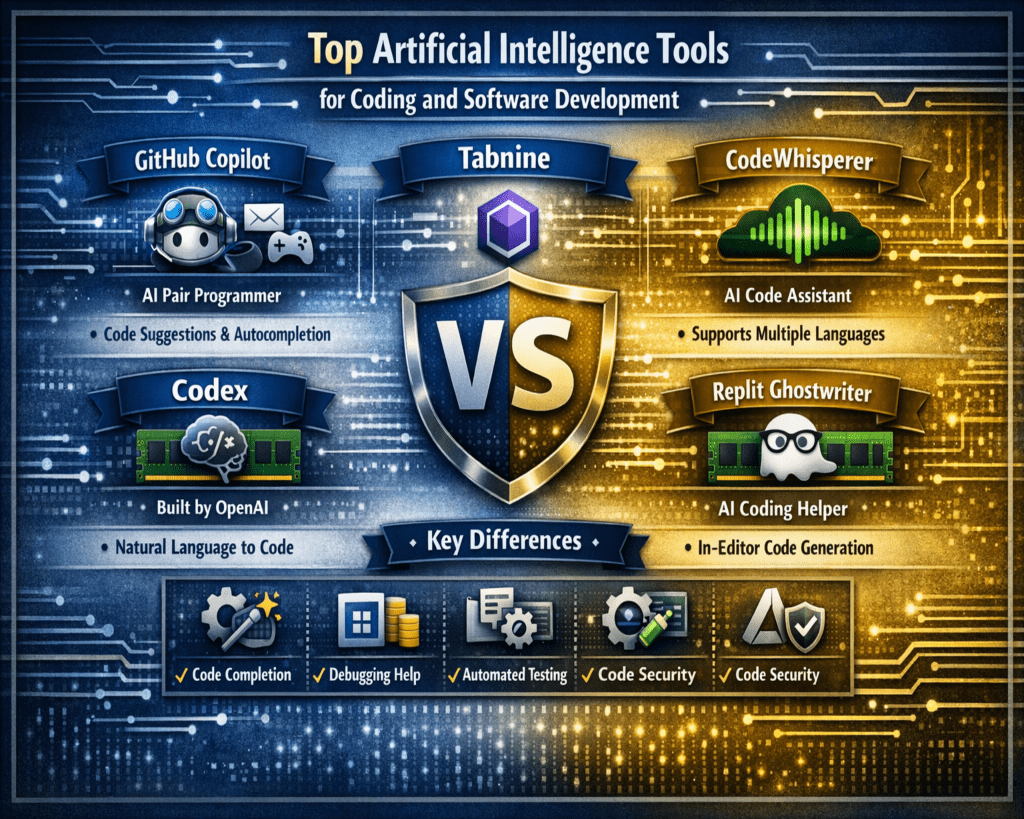
AI for coding refers to advanced software systems that assist developers in writing, analyzing, improving, and maintaining code using machine learning and large-scale language models. These systems are trained on vast repositories of programming knowledge, enabling them to recognize patterns across multiple languages, frameworks, and architectural styles. In practical use, AI coding tools function as intelligent assistants embedded within development environments or accessible through interactive interfaces. They help interpret natural language instructions and convert them into functional code structures, reducing the need for repetitive manual programming. Beyond simple code generation, these tools are capable of explaining logic, suggesting optimizations, and identifying structural weaknesses in real time. This makes them valuable in both learning environments and professional software engineering workflows. The concept of AI-assisted coding is not limited to automation alone; it represents a broader shift toward intelligent collaboration between humans and machines in the software creation process. Developers increasingly rely on these systems to accelerate tasks that previously required extensive manual effort, while still maintaining full control over design decisions and system architecture.
The Evolution of AI in Software Development Workflows
The integration of artificial intelligence into software development has evolved gradually, beginning with simple autocomplete systems and advancing into fully context-aware coding assistants. Early tools primarily focused on syntax prediction, offering basic suggestions based on previously typed characters. Modern AI systems, however, understand entire codebases, project structures, and programming intent. This allows them to provide far more accurate and contextually relevant recommendations. As development workflows have become more complex, AI tools have adapted to support multiple stages of the software lifecycle, including planning, coding, testing, debugging, and deployment support. This evolution has significantly changed how developers interact with their environments. Instead of manually navigating documentation or writing repetitive code structures, developers now receive real-time assistance that adapts to their coding style and project requirements. This shift has also encouraged more iterative development practices, where ideas can be quickly tested, refined, and implemented with minimal delay. As a result, development cycles have become more agile, responsive, and efficient across a wide range of industries.
How AI Is Reshaping Developer Productivity
One of the most significant impacts of AI in coding is the improvement of developer productivity. Software engineers often spend a considerable portion of their time on repetitive or low-complexity tasks such as writing boilerplate code, configuring project structures, or debugging minor issues. AI tools help reduce this burden by automating these repetitive activities, allowing developers to focus on higher-value problem-solving tasks. This shift leads to faster project completion times and more efficient use of engineering resources. Additionally, AI systems provide real-time suggestions that help developers avoid common mistakes, improving code quality without requiring additional review cycles. Productivity gains are not limited to speed alone; they also include improvements in consistency, readability, and maintainability of code. By standardizing repetitive elements of development, AI reduces variability across codebases, making it easier for teams to collaborate and scale projects. This enhanced productivity is particularly valuable in large-scale software environments where multiple teams work simultaneously on interconnected systems.
AI-Assisted Debugging and Error Detection in Codebases
Debugging has traditionally been one of the most time-intensive aspects of software development, requiring developers to trace errors through complex systems and identify root causes manually. AI-powered coding tools significantly improve this process by analyzing code behavior and detecting anomalies in real time. These systems can highlight potential errors, suggest fixes, and explain the underlying cause of issues in a way that is easy to understand. By doing so, they reduce the time required to resolve bugs and improve overall system stability. AI tools can also identify patterns that may lead to future errors, allowing developers to proactively address issues before they impact production environments. This predictive capability is particularly valuable in large-scale applications where small errors can propagate into significant system failures. Additionally, AI-assisted debugging enhances learning for less experienced developers by providing detailed explanations of why certain errors occur and how they can be resolved. This combination of automation and education makes debugging more efficient and accessible across different skill levels.
Automation of Repetitive Coding Tasks and Workflow Optimization
A major advantage of AI in software development is its ability to automate repetitive and structured coding tasks. Many programming activities follow predictable patterns, such as creating functions, defining classes, building API endpoints, and generating configuration files. AI systems can handle these tasks efficiently, producing consistent and standardized outputs based on project requirements. This automation reduces the cognitive load on developers and allows them to focus on more creative and strategic aspects of software design. Workflow optimization is another key benefit, as AI tools help streamline the transition between different stages of development. For example, they can automatically generate test cases based on existing code or suggest documentation structures that align with project architecture. Over time, this leads to more organized and maintainable codebases, as repetitive inconsistencies are minimized. Automation also improves collaboration within development teams by ensuring that all contributors follow similar coding patterns and standards, reducing friction during code reviews and integration processes.
Bridging Skill Gaps Across Developer Experience Levels
AI coding tools play an important role in supporting developers with varying levels of expertise. For beginners, these systems act as interactive learning assistants that provide explanations, examples, and suggestions in real time. This helps new developers understand programming concepts more quickly and develop better coding habits from the start. Instead of relying solely on static documentation, learners can interact with AI systems that respond dynamically to their queries and code inputs. For experienced developers, AI serves as a productivity enhancer that handles routine tasks and offers alternative approaches to problem-solving. This allows senior engineers to focus on system architecture, optimization, and innovation. The ability of AI to adapt to different skill levels makes it a versatile tool in both educational and professional environments. It also encourages continuous learning, as developers are regularly exposed to new coding patterns, techniques, and optimization strategies through AI-generated suggestions. This contributes to a more balanced and efficient development ecosystem where knowledge is continuously shared and reinforced.
The Rise of AI-Integrated Development Environments
Modern software development environments are increasingly being designed with built-in AI capabilities. These environments provide intelligent code completion, contextual suggestions, and automated error detection directly within the coding interface. This integration allows developers to receive real-time assistance without interrupting their workflow or switching between external tools. AI-integrated environments can analyze entire projects, understand dependencies, and provide recommendations based on the overall structure of the application. This creates a more cohesive development experience where assistance is continuously available at every stage of coding. As these systems become more advanced, they are also beginning to support higher-level tasks such as architecture planning and system design suggestions. This evolution is transforming development environments into intelligent platforms that actively contribute to decision-making rather than simply serving as passive coding spaces. The result is a more efficient and interactive development process that aligns closely with modern software engineering demands.
Context Awareness and Intelligent Code Understanding
One of the most powerful capabilities of modern AI coding systems is their ability to understand context within a codebase. Unlike traditional tools that analyze code line by line, AI systems can interpret entire files, project structures, and relationships between different components. This contextual understanding allows them to generate more accurate suggestions and identify issues that may not be visible at the surface level. For example, an AI system can recognize how a change in one module might affect other parts of the application and provide warnings or recommendations accordingly. This level of awareness improves both code quality and system reliability. It also reduces the likelihood of introducing bugs during development, as AI tools can anticipate potential conflicts or inefficiencies. Context-aware AI systems are particularly useful in large-scale projects where complexity makes manual analysis difficult. By providing a holistic view of the codebase, they help developers make more informed decisions and maintain better control over system behavior.
Early Limitations and Considerations in AI-Driven Coding
While AI for coding offers significant advantages, it also introduces certain limitations that must be considered. One important factor is that AI-generated code is not always fully optimized or error-free. Developers must still review outputs carefully to ensure correctness and alignment with project requirements. Another consideration is that over-reliance on AI can reduce the development of fundamental problem-solving skills if used without proper balance. Additionally, AI systems may occasionally produce outdated or inefficient coding patterns depending on their training data. Security concerns also arise when generated code is not properly validated, as vulnerabilities may be unintentionally introduced into applications. These limitations highlight the importance of maintaining human oversight in all AI-assisted development workflows. While AI can significantly enhance productivity and efficiency, it is most effective when combined with strong technical understanding and careful review processes.
Overview of Leading AI Tools for Coding in Modern Software Development
AI-powered coding tools have become essential components of modern software engineering environments. These systems are designed to assist developers in writing code, improving efficiency, reducing errors, and accelerating project delivery. Each tool offers a unique combination of features, integration capabilities, and specialized strengths. Some focus on real-time code completion, while others provide deeper reasoning, debugging support, or cloud-based optimization. The selection of the right AI coding tool depends on the type of project, programming language, and development environment being used. As software development becomes increasingly complex, these tools play a central role in improving productivity and maintaining code quality across teams of all sizes. Their growing adoption reflects a broader shift toward intelligent development ecosystems where human expertise is supported by machine-assisted reasoning and automation.
AI Tools Focused on Intelligent Code Generation and Autocomplete
One of the most widely used categories of AI coding tools is intelligent code generation systems. These tools are embedded directly into development environments and provide real-time suggestions as developers write code. They analyze context, syntax, and project structure to predict the next lines of code or complete entire functions automatically. This significantly reduces the time spent on writing repetitive structures and improves coding speed. These systems are particularly useful in large-scale projects where consistency and efficiency are important. They support multiple programming languages and adapt to individual coding styles over time, making them highly personalized. Developers benefit from reduced manual effort and improved accuracy in routine coding tasks. These tools are especially effective for generating boilerplate code, setting up APIs, and building standard application components. By handling predictable patterns, they allow developers to focus on logic design and system architecture.
AI Tools Designed for Debugging and Problem Resolution
Another important category of AI coding tools focuses on debugging and error detection. These systems analyze code in real time to identify issues, suggest fixes, and explain the underlying causes of errors. Unlike traditional debugging methods that require manual inspection, AI tools provide immediate feedback and context-aware solutions. This reduces the time needed to locate and resolve problems within complex codebases. These tools are capable of recognizing patterns associated with common programming errors and offering optimized corrections. They also help developers understand why an error occurred, which improves long-term learning and skill development. In large projects, where debugging can be extremely time-consuming, these AI systems provide significant efficiency improvements. They also help reduce production risks by identifying potential issues before deployment. This proactive approach to debugging improves software stability and reliability across development cycles.
AI Tools Focused on Secure and Enterprise-Grade Development
Security-focused AI coding tools are designed to support organizations that require strict compliance and data protection standards. These systems analyze code for vulnerabilities, insecure patterns, and potential risks before deployment. They are particularly useful in enterprise environments where security breaches can have significant consequences. These tools often include built-in compliance checks that align with industry standards and regulatory requirements. They help developers identify issues such as unsafe dependencies, weak authentication mechanisms, and improper data handling practices. By integrating security analysis directly into the coding process, these tools reduce the likelihood of vulnerabilities reaching production environments. They also encourage secure coding practices by providing real-time feedback during development. This approach ensures that security is not treated as a separate phase but as an integrated part of the development workflow.
AI Tools for Cloud-Centric and Scalable Application Development
Cloud-based development has become a dominant trend in modern software engineering, and AI coding tools are increasingly optimized for this environment. These tools assist developers in building scalable applications that run efficiently across distributed systems. They provide recommendations for cloud architecture, serverless functions, and resource optimization strategies. By analyzing application structure, they can suggest improvements that enhance performance and reduce operational costs. These tools are especially useful for teams working with large-scale infrastructure or microservices architectures. They help streamline deployment processes and ensure that applications are optimized for cloud environments from the beginning of development. This reduces the need for extensive post-deployment optimization and improves overall system efficiency. AI support in cloud development also helps developers manage complexity by simplifying configuration and infrastructure management tasks.
Comparing AI Coding Tools Based on Integration and Workflow Compatibility
Different AI coding tools vary significantly in how they integrate into development workflows. Some tools are designed to operate directly within code editors, providing seamless inline suggestions and real-time assistance. Others function as standalone platforms that support broader analysis and reasoning tasks. Integration plays a key role in determining how effectively a tool can be used in daily development activities. Tools that integrate directly into popular development environments tend to offer faster feedback and more intuitive usage. On the other hand, standalone tools often provide deeper analytical capabilities that go beyond simple code completion. Developers must consider how each tool fits into their existing workflow before adoption. The most effective tools are those that enhance productivity without requiring significant changes to established development practices. Workflow compatibility ensures smoother adoption and better long-term usage across teams.
Evaluating Code Quality Across Different AI Systems
Code quality is a critical factor when comparing AI coding tools. High-quality AI systems generate code that is not only functional but also clean, efficient, and maintainable. Some tools prioritize speed and responsiveness, producing quick suggestions that may require further refinement. Others focus on structured and well-optimized output that aligns with best practices. The variation in code quality often depends on the underlying model architecture and training data. Tools that emphasize reasoning and context awareness tend to produce more reliable results in complex scenarios. Developers must evaluate whether generated code meets project standards and performance requirements. Code quality also includes readability, consistency, and scalability, all of which are essential for long-term maintenance. AI systems that support refactoring and optimization contribute significantly to improving overall codebase quality.
Use Cases in Real-World Software Development Projects
AI coding tools are used across a wide range of real-world applications. In web development, they assist in building user interfaces, backend logic, and API integrations. In mobile application development, they help generate platform-specific code and optimize performance. In data science and machine learning projects, AI tools support model implementation, data processing, and algorithm optimization. These tools are also widely used in enterprise software systems where scalability, security, and performance are critical. Development teams rely on AI assistance to accelerate prototyping, reduce manual coding effort, and improve collaboration. In educational environments, AI tools are used to teach programming concepts and provide real-time feedback to learners. Their versatility makes them applicable across industries such as finance, healthcare, e-commerce, and cloud computing. This broad adoption demonstrates the growing importance of AI in modern software engineering practices.
AI Tools for Rapid Prototyping and Software Experimentation
Rapid prototyping is another area where AI coding tools provide significant value. Developers can quickly generate functional prototypes by describing desired features in natural language. This allows teams to test ideas and validate concepts before committing to full-scale development. AI tools reduce the time required to move from idea to implementation, enabling faster experimentation cycles. This is particularly useful in startups and innovation-driven environments where speed is essential. By automating the initial stages of development, AI systems help teams explore multiple design options and refine product direction more efficiently. Prototyping with AI also reduces the risk of investing time in non-viable solutions, as ideas can be tested and adjusted quickly based on feedback.
AI Tools Supporting Learning and Skill Development in Programming
AI coding tools are increasingly being used as educational resources for developers at all levels. Beginners benefit from step-by-step explanations, contextual examples, and interactive feedback that helps them understand programming concepts more effectively. These tools provide real-time guidance that accelerates the learning process and reduces dependency on traditional documentation. Intermediate developers use AI systems to explore advanced techniques and improve coding efficiency. Experienced developers benefit from exposure to alternative approaches and optimization strategies suggested by AI models. This continuous learning environment helps developers stay updated with evolving technologies and programming practices. AI tools also encourage experimentation, allowing learners to test different solutions and understand their outcomes in real time.
Limitations and Performance Considerations in AI Coding Tools
Despite their advantages, AI coding tools have limitations that must be considered. Performance may vary depending on the complexity of the task and the quality of input provided. In some cases, AI-generated code may require significant refinement before it is production-ready. These systems may also struggle with highly specialized or niche programming tasks where training data is limited. Additionally, performance can be affected by context size limitations, which may restrict understanding of very large codebases. Developers must remain aware of these constraints and apply human judgment when evaluating AI output. Proper usage involves balancing automation with manual oversight to ensure accuracy and reliability in software development.
Comparative Insights Across Different AI Coding Platforms
When comparing AI coding tools, several factors determine their effectiveness in real-world scenarios. These include integration depth, code quality, reasoning ability, security focus, and adaptability to different programming environments. Some tools excel in fast code generation, while others provide deeper analytical insights or stronger security features. The best choice often depends on project requirements and team preferences. Development teams may also use multiple AI tools simultaneously to take advantage of different strengths. This hybrid approach allows for more flexible and efficient workflows. Understanding the differences between tools helps developers make informed decisions that align with their technical goals and operational needs.
Understanding the Risks of AI-Driven Coding in Modern Development
AI for coding introduces significant advantages in speed, automation, and productivity, but it also brings a set of risks that developers and organizations must carefully manage. One of the most important concerns is the possibility of generating incorrect or incomplete code. While AI systems are trained on large datasets, they do not truly understand intent in the same way human developers do. This can lead to outputs that appear correct but fail under real-world conditions. In complex systems, even small inaccuracies can result in performance issues, logic errors, or system instability. Another important risk is overdependence on AI tools, where developers begin to rely heavily on automated suggestions without fully understanding the underlying logic. This can weaken problem-solving skills over time and reduce the ability to debug independently when AI assistance is not available. In fast-paced environments, this dependency can create long-term skill gaps within development teams.
Security Risks Associated with AI-Generated Code
Security is one of the most critical concerns when using AI in software development. AI-generated code may unintentionally include vulnerabilities such as insecure data handling, weak authentication practices, or outdated libraries. Since AI models generate code based on learned patterns, they may reproduce insecure practices present in training data. This can introduce hidden risks into production systems if not carefully reviewed. Additionally, AI systems may not always consider context-specific security requirements, especially in regulated industries where compliance standards are strict. Developers must therefore treat AI-generated output as a starting point rather than a final implementation. Proper security reviews, code audits, and testing processes remain essential to ensure safe deployment. Without these safeguards, organizations may unknowingly expose themselves to cyber threats or data breaches.
Over-Reliance on Automation and Its Impact on Developer Skills
While automation is one of the main advantages of AI coding tools, excessive reliance can negatively affect long-term developer growth. When developers consistently depend on AI to generate solutions, they may gradually lose familiarity with core programming principles. This can reduce their ability to think critically about system design and algorithm efficiency. In situations where AI tools provide incorrect suggestions or fail to cover edge cases, developers may struggle to identify and resolve issues independently. This challenge becomes more significant in complex systems where deep technical understanding is required. Maintaining a balance between automation and manual coding practice is essential for skill development. Developers must continue to engage in problem-solving activities that strengthen their foundational knowledge, ensuring they remain capable of working without AI assistance when necessary.
Code Quality and Maintainability Challenges in AI-Assisted Development
AI-generated code does not always follow consistent standards of structure, readability, or maintainability. In some cases, the code may be functional but difficult to understand or extend over time. This creates challenges in collaborative environments where multiple developers work on the same codebase. Poorly structured AI output can increase technical debt, making future updates more difficult and time-consuming. Additionally, different AI tools may produce varying coding styles, leading to inconsistency across projects. Developers must therefore enforce strict code review practices and standardization guidelines to ensure maintainability. Refactoring AI-generated code is often necessary to align it with long-term architectural goals. Without proper oversight, teams may face increased maintenance costs and reduced system efficiency over time.
Licensing and Intellectual Property Concerns in AI-Generated Code
Another important consideration in AI-assisted development is the potential for licensing and intellectual property issues. Since AI models are trained on large datasets that may include open-source code, there is a possibility that generated outputs resemble existing licensed material. This can create legal uncertainty if similar code is used in commercial applications without proper verification. Organizations must ensure that AI-generated code complies with internal policies and external licensing requirements. This includes reviewing dependencies, verifying originality, and ensuring proper attribution where necessary. Failure to address these concerns may result in legal disputes or compliance violations. As AI becomes more widely adopted, licensing transparency and code provenance will become increasingly important topics in software development governance.
Best Practices for Safe and Effective Use of AI in Coding
To maximize the benefits of AI coding tools while minimizing risks, developers must follow structured best practices. One of the most important principles is maintaining human oversight throughout the development process. AI should be used as an assistant rather than a replacement for developer judgment. Every piece of generated code should be reviewed, tested, and validated before deployment. Another best practice involves using AI for augmentation rather than full automation, meaning developers should rely on AI for suggestions and support rather than complete solutions. This ensures that developers remain actively engaged in the problem-solving process. It is also important to use AI tools that align with project requirements, especially in terms of security, privacy, and compliance. Regular code reviews and testing procedures help ensure that AI-generated output meets quality standards and does not introduce unexpected issues into production systems.
The Importance of Combining AI Assistance with Strong Programming Fundamentals
Strong programming fundamentals remain essential even in AI-assisted development environments. Developers who understand core concepts such as data structures, algorithms, system design, and debugging techniques are better equipped to evaluate AI-generated suggestions. This knowledge allows them to identify errors, optimize performance, and make informed architectural decisions. AI tools are most effective when used by developers who already possess a strong technical foundation. In such cases, AI serves as an enhancement tool rather than a dependency. Developers can quickly validate suggestions, refine outputs, and apply deeper reasoning to improve results. Without this foundation, there is a risk of blindly accepting incorrect or inefficient code, which can negatively impact software quality and system performance.
The Role of Human Review in AI-Assisted Development Workflows
Human review remains a critical component of any AI-assisted development process. Even the most advanced AI systems cannot fully replace human judgment, especially in complex or mission-critical applications. Code reviews help ensure that AI-generated output aligns with project goals, security requirements, and performance expectations. Peer review processes also encourage collaboration and knowledge sharing within development teams. By combining AI-generated suggestions with human evaluation, teams can achieve higher levels of accuracy and reliability. Testing is another essential step in validating AI-assisted code. Automated testing frameworks, combined with manual review, help identify issues that may not be immediately visible. This layered approach ensures that software remains stable and secure throughout its lifecycle.
The Future Evolution of AI in Software Engineering
The future of AI in coding is expected to move toward even deeper integration with development environments and system architecture. AI systems will likely become more context-aware, capable of understanding entire software ecosystems rather than isolated code snippets. This will enable them to provide more advanced recommendations related to architecture design, scalability, and performance optimization. Future systems may also support autonomous development tasks, where AI can implement features based on high-level requirements with minimal human intervention. However, human oversight will continue to play a central role in ensuring quality and ethical use. As AI models become more advanced, they are also expected to improve in areas such as security awareness, reasoning ability, and adaptability to complex systems. This evolution will further enhance the efficiency of software development while maintaining the need for skilled human engineers.
AI and the Shift Toward Intelligent Development Ecosystems
Software development is gradually shifting toward fully intelligent ecosystems where AI is embedded across every stage of the lifecycle. From planning and design to coding, testing, deployment, and maintenance, AI systems are becoming integrated into each phase. This creates a continuous feedback loop where development processes are constantly optimized based on real-time data and usage patterns. Intelligent ecosystems allow teams to respond more quickly to changes, reduce operational inefficiencies, and improve system reliability. Developers working within these environments benefit from enhanced visibility, automated insights, and predictive analytics that help guide decision-making. This shift represents a fundamental transformation in how software is built and maintained, moving away from manual processes toward adaptive, data-driven development models.
Balancing Automation and Human Creativity in Software Development
One of the most important considerations in the future of AI coding is maintaining a balance between automation and human creativity. While AI systems excel at efficiency and pattern recognition, human developers remain essential for innovation, abstract thinking, and creative problem-solving. Software development is not just a technical process but also a creative discipline that requires imagination and strategic thinking. AI can support this creativity by handling repetitive tasks and providing inspiration through suggestions, but it cannot fully replace human insight. The most successful development teams will be those that effectively combine machine efficiency with human creativity, using AI as a tool to enhance rather than replace human contribution.
Conclusion
Artificial intelligence has moved from being an experimental concept in software engineering to becoming a practical, widely adopted part of modern development workflows. Across industries, AI for coding is reshaping how software is designed, written, tested, and maintained. What once required extensive manual effort and deep time investment can now be accelerated through intelligent systems that understand patterns, suggest improvements, and automate repetitive tasks. This transformation is not simply about faster coding; it represents a structural shift in how development teams think about productivity, collaboration, and software quality.
One of the most important outcomes of AI integration in coding is the redefinition of developer efficiency. Instead of spending large portions of time on repetitive tasks such as writing boilerplate code or debugging simple errors, developers can now focus more on architecture, logic design, and innovation. This shift allows teams to produce higher-quality software in shorter timeframes while reducing operational strain. AI systems act as supportive assistants that enhance human capability rather than replacing it, creating a more balanced and efficient development environment.
At the same time, the evolution of AI coding tools has introduced a new standard for accessibility in programming. Developers at different skill levels can now interact with intelligent systems that guide them through complex logic, explain programming concepts, and offer real-time feedback. For beginners, this reduces the barrier to entry into software development by providing structured guidance and instant clarification. For experienced engineers, it offers an opportunity to delegate routine work and focus on higher-level problem-solving. This dual benefit has made AI a unifying tool across diverse development teams.
However, the rise of AI-assisted coding also brings important challenges that cannot be overlooked. Code generated by AI systems must always be reviewed and validated, as it may contain inefficiencies, inconsistencies, or potential security vulnerabilities. While these systems are highly advanced, they do not fully understand business context, system constraints, or long-term architectural goals in the same way human developers do. This means that human oversight remains essential in ensuring that AI-generated code meets quality, performance, and security standards.
Security considerations are particularly important in AI-driven development environments. As AI tools generate code based on learned patterns, they may unintentionally reproduce insecure practices or outdated implementations. This makes it necessary for developers and organizations to implement strict review processes, testing frameworks, and security validation steps. Without these safeguards, there is a risk that vulnerabilities could be introduced into production systems. Therefore, AI should be viewed as a supportive layer in the development process rather than a final authority on code correctness.
Another critical aspect of AI in coding is its impact on long-term skill development. While automation improves efficiency, excessive reliance on AI tools can reduce opportunities for developers to engage deeply with problem-solving tasks. Over time, this may weaken foundational programming skills if not balanced properly. Strong technical knowledge remains essential for understanding system behavior, debugging complex issues, and making informed design decisions. The most effective developers will be those who use AI to enhance their abilities while continuing to actively develop their core technical expertise.
Despite these challenges, the overall direction of AI in software development remains strongly positive. The continuous improvement of machine learning models is leading to more accurate, context-aware, and reliable coding assistance tools. These systems are becoming better at understanding entire codebases, recognizing dependencies, and providing meaningful suggestions that go beyond simple autocomplete functionality. As a result, AI is gradually evolving into a deeper collaborator within the software engineering process.
In the broader perspective, AI is also influencing how development teams are structured and how projects are managed. Workflows are becoming more dynamic and adaptive, with AI assisting in planning, documentation, testing, and deployment processes. This creates a more integrated development cycle where tasks are interconnected and continuously optimized. Teams are able to respond more quickly to changes, reduce inefficiencies, and maintain higher levels of consistency across projects.
Another important development is the increasing role of AI in improving software maintainability. Clean, readable, and well-structured code is essential for long-term project success. AI systems help enforce coding standards, suggest refactoring improvements, and reduce inconsistencies across large codebases. This leads to more maintainable systems that are easier to scale and update over time. In large organizations, this can significantly reduce technical debt and improve long-term productivity.
As AI continues to evolve, its role in coding is expected to expand even further. Future systems may be capable of understanding full software architectures, suggesting system-level improvements, and even generating entire application modules based on high-level requirements. While this level of automation will increase efficiency, it will also require even stronger emphasis on governance, oversight, and ethical use. The balance between automation and human decision-making will remain a central theme in the evolution of software engineering.
Ultimately, the future of coding will not be defined by AI replacing developers, but by AI augmenting human capability. The most successful development environments will be those that combine machine efficiency with human creativity, critical thinking, and design intuition. AI will handle repetitive and structured tasks, while developers will focus on innovation, strategy, and system design. This partnership creates a more powerful and scalable approach to software development than either could achieve independently.
As the technology continues to mature, organizations that adopt AI responsibly will gain significant advantages in speed, quality, and adaptability. However, success will depend on how well these tools are integrated into existing workflows and how effectively teams maintain control over the development process. AI is not a replacement for expertise but an extension of it, amplifying what skilled developers can achieve.
In the long term, AI for coding represents a fundamental shift toward more intelligent, efficient, and collaborative software engineering. It is shaping a future where development is faster, learning is continuous, and innovation is more accessible than ever before.