
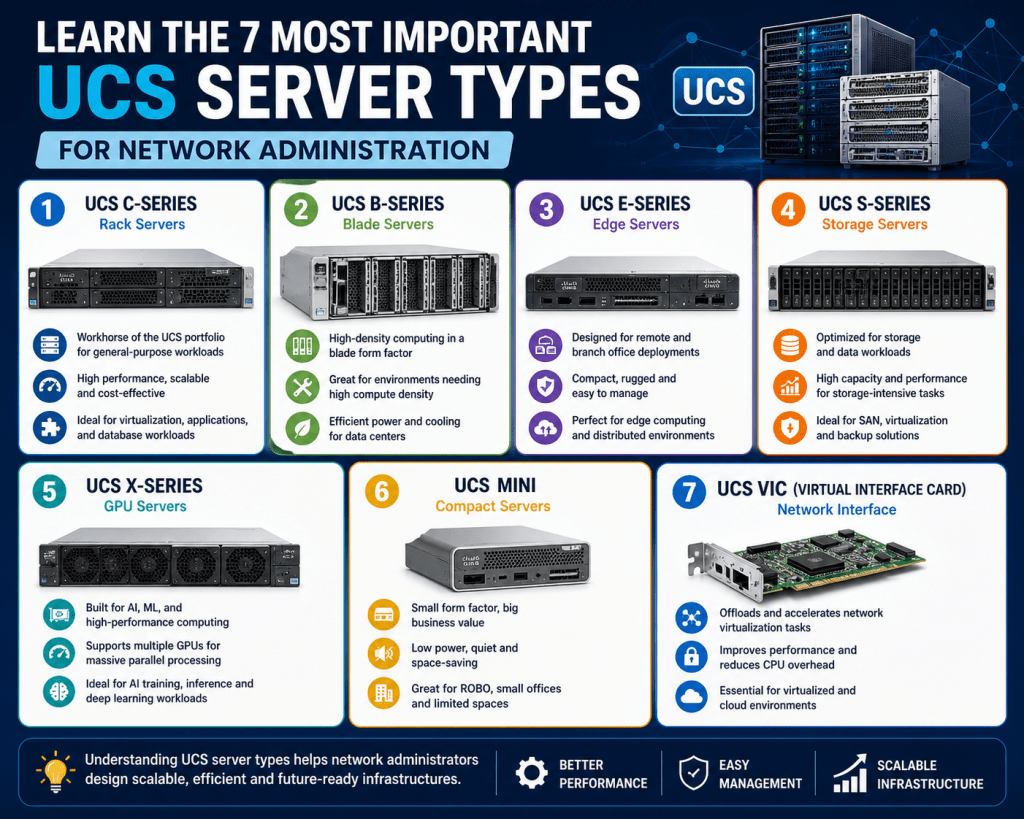
Cisco Unified Computing System represents a tightly integrated computing architecture designed to unify compute, networking, storage connectivity, and infrastructure management into a single operational framework. It is widely deployed in enterprise data centers where scalability, automation, and centralized control are essential for maintaining complex workloads. The UCS ecosystem is built to reduce fragmentation in traditional server environments, where compute nodes, switches, and storage systems were historically managed as separate entities. By integrating these components into a coordinated system, UCS enables more efficient provisioning, reduced configuration errors, and improved workload mobility across infrastructure layers. In modern IT environments, UCS servers are commonly used for virtualization platforms, enterprise applications, private cloud deployments, and data-intensive workloads that require consistent performance and high availability. The ecosystem includes blade servers, rack servers, and high-density storage platforms, each designed to serve specific operational needs while maintaining compatibility within a unified management structure. This flexibility allows organizations to scale computing resources based on workload demand without redesigning their entire infrastructure architecture.
Evolution of Cisco UCS Architecture in Enterprise Computing
The UCS architecture was introduced as a response to increasing complexity in traditional data center environments where server, network, and storage systems were deployed and managed independently. This separation often led to inefficiencies in provisioning, inconsistent configuration policies, and increased operational overhead. The UCS model addressed these challenges by introducing a converged infrastructure approach where compute resources are tightly integrated with networking and managed through a centralized control system. Over time, this architecture evolved to support higher levels of automation, improved hardware abstraction, and enhanced scalability for large enterprise environments. As workloads shifted toward virtualization and cloud-based computing models, UCS systems adapted by supporting more powerful processors, expanded memory configurations, and faster interconnect technologies. The evolution of UCS also introduced improved support for policy-driven infrastructure management, allowing administrators to define server behavior through templates rather than manual configuration. This transformation significantly reduced deployment times and enabled data centers to operate with greater agility and consistency.
Core Design Principles of UCS Infrastructure
The UCS architecture is built on several foundational design principles that define its operational efficiency and scalability. One of the most important principles is stateless computing, where server identity and configuration are decoupled from physical hardware. This allows compute nodes to be replaced or reassigned without requiring manual reconfiguration, significantly reducing downtime during maintenance or hardware replacement. Another key principle is centralized management, where all computing resources are controlled through a unified management system that governs hardware policies, network configurations, and operational profiles. This approach ensures consistency across large-scale deployments and reduces administrative complexity. UCS also emphasizes modular scalability, enabling organizations to expand infrastructure incrementally by adding compute nodes, chassis systems, or networking components without disrupting existing operations. Resource pooling is another critical principle, allowing compute, memory, and network resources to be dynamically allocated based on workload requirements. These principles collectively contribute to improved operational efficiency, reduced configuration errors, and enhanced system resilience in enterprise environments.
Blade Server Technology in UCS Environments
Blade server technology is a core component of UCS architecture and plays a significant role in enabling high-density computing within data center environments. A blade server is a compact computing unit that operates within a shared chassis system, which provides common resources such as power supply, cooling infrastructure, and network connectivity. This design eliminates the need for individual power supplies and network cabling for each server, resulting in improved space efficiency and reduced operational complexity. In UCS environments, blade servers are integrated with fabric interconnect systems that provide high-speed communication between compute nodes and external networks. This architecture supports rapid data transfer, centralized management, and consistent policy enforcement across all connected servers. Blade systems are particularly well-suited for virtualization clusters, application hosting environments, and workloads that require scalable compute density. The modular nature of blade architecture allows organizations to increase processing capacity by simply adding more blade units to existing chassis systems, making it a highly scalable solution for growing enterprise demands.
Cisco UCS B-Series Architecture and Operational Role
The UCS B-series represents the blade server component of the UCS ecosystem and is designed for high-density computing environments where performance, scalability, and centralized management are critical. B-series servers operate within chassis systems that provide shared infrastructure resources, allowing multiple compute nodes to function efficiently within a compact physical footprint. Each blade server operates as an independent compute unit while remaining fully integrated into the UCS management framework. This allows administrators to apply consistent configuration policies, monitor system performance, and manage workloads across multiple servers from a centralized interface. The B-series architecture is commonly deployed in virtualization environments, enterprise application hosting platforms, and cloud infrastructure systems where compute resources must be dynamically allocated based on demand. The design supports workload balancing across multiple blade servers, ensuring consistent performance even under heavy processing loads. Over time, the B-series lineup has evolved to include multiple generations of hardware, each introducing improvements in processing power, memory capacity, and input-output performance, making it suitable for increasingly demanding enterprise applications.
Cisco UCS B200 Blade Server Architecture and Capabilities
The UCS B200 blade server is one of the most widely used components within the UCS B-series lineup and is designed as a half-width blade system optimized for balanced compute performance and energy efficiency. It supports dual processor configurations, enabling parallel processing capabilities that are essential for virtualization workloads and enterprise applications. The architecture allows for significant memory scalability, making it suitable for applications that require large memory footprints, such as databases, analytics platforms, and virtual machine hosting environments. The B200 also supports advanced hardware acceleration options, including GPU integration, which enables it to handle computationally intensive workloads such as artificial intelligence processing, machine learning model training, and graphical rendering tasks. Storage flexibility is provided through support for both solid-state and traditional disk-based storage configurations, allowing administrators to optimize performance based on workload requirements. The integration with UCS fabric systems ensures high-speed network connectivity and centralized control over data traffic, enabling efficient communication between compute nodes and external systems. The B200 is widely deployed in environments that require reliable performance, scalable compute resources, and simplified infrastructure management.
Cisco UCS B480 Blade Server High-Density Computing Design
The UCS B480 blade server is designed for environments that require maximum compute density and high-performance processing capabilities within a blade chassis system. It supports multi-socket processor configurations, allowing significantly higher levels of parallel computation compared to smaller blade systems. This makes it suitable for large-scale virtualization environments, enterprise resource planning systems, and high-performance computing clusters where workload intensity is consistently high. The B480 architecture provides extensive memory capacity, enabling it to handle large datasets and support multiple simultaneous application instances without performance degradation. This high memory capability is particularly important in environments where in-memory computing and data-intensive processing are required. The server also supports multiple GPU configurations, allowing it to handle advanced computational tasks such as scientific simulations, predictive analytics, and artificial intelligence workloads. From a design perspective, the B480 maximizes compute density within a shared chassis environment, enabling organizations to scale processing power without increasing physical infrastructure footprint. Its integration with UCS centralized management systems ensures consistent configuration, monitoring, and lifecycle management across all deployed blade units, improving operational efficiency in large-scale enterprise environments.
UCS Chassis Systems and Fabric Integration Layer
In UCS environments, blade servers operate within chassis systems that provide shared infrastructure components such as power distribution, cooling systems, and network connectivity modules. These chassis systems are designed to support multiple blade servers simultaneously, enabling high-density computing within a compact physical structure. The integration of fabric interconnect technology is a key aspect of UCS architecture, as it provides a unified networking layer that connects compute nodes to external networks and storage systems. This fabric layer enables high-speed data transfer and simplifies network management by consolidating multiple network paths into a single coordinated system. The chassis and fabric integration also support centralized policy enforcement, allowing administrators to define network configurations, security policies, and operational parameters across all connected servers. This reduces complexity and ensures consistent behavior across the entire infrastructure. The combination of blade servers, chassis systems, and fabric interconnects forms a cohesive computing environment that is highly scalable, efficient, and optimized for enterprise workloads requiring centralized control and high-performance computing capabilities.
Role of Rack Servers in Cisco UCS Ecosystem
Rack servers form a critical part of the Cisco Unified Computing System, designed to provide flexible compute resources in environments where blade architecture may not be the primary requirement. Unlike blade systems that rely on shared chassis infrastructure, rack servers operate as independent units installed within standard 19-inch racks, making them highly adaptable for mixed infrastructure environments. Within the UCS ecosystem, rack servers are integrated into the same centralized management framework as blade systems, allowing consistent policy enforcement, monitoring, and provisioning across both architectures. This integration ensures that organizations can deploy heterogeneous infrastructure while maintaining operational uniformity. Rack servers are widely used in enterprise applications, virtualization environments, and workloads that require dedicated compute resources without the density constraints of blade systems. Their modular nature makes them suitable for incremental scaling, where organizations can expand compute capacity by adding individual servers rather than deploying entire chassis systems.
Cisco UCS C-Series Architecture Overview
The UCS C-series represents Cisco’s rack server portfolio within the Unified Computing System. These servers are designed to function either as standalone systems or as part of a fully integrated UCS deployment. This dual-mode capability allows organizations to adopt UCS infrastructure gradually, without requiring immediate migration of all compute resources into a unified system. C-series servers are built to support a wide range of workloads, including virtualization, database management, application hosting, and high-performance computing tasks. They are engineered with a focus on flexibility, offering multiple storage configurations, processor options, and memory scalability features that can be tailored to specific enterprise requirements. The architecture also supports direct integration with UCS fabric interconnect systems, enabling centralized management and policy-driven configuration similar to blade environments. This makes the C-series an important bridge between traditional rack-based computing and fully converged UCS infrastructure.
Cisco UCS C220 Rack Server Design and Operational Use
The UCS C220 rack server is a compact 1U form factor system designed for environments where space efficiency and balanced compute performance are essential. It is widely deployed in virtualization clusters, web hosting environments, and enterprise application infrastructures where moderate compute density is required without sacrificing performance. The architecture supports dual-processor configurations, allowing parallel processing capabilities that are essential for multi-threaded workloads. Memory scalability is a key feature of the C220, enabling support for large RAM capacities that can handle virtual machines, in-memory databases, and application caching systems.
The storage subsystem in the C220 is highly flexible, supporting both small-form-factor and large-form-factor drive configurations. This allows administrators to optimize storage based on performance or capacity requirements. The system also supports high-speed networking interfaces that enable efficient data transfer between servers and external systems. Integration with UCS management systems allows the C220 to be provisioned, monitored, and updated through centralized control interfaces, ensuring consistency across distributed deployments. The C220 is particularly well-suited for environments where rack density, energy efficiency, and workload versatility are key operational priorities.
Cisco UCS C240 Rack Server High-Capacity Architecture
The UCS C240 rack server is a larger 4U system designed for environments that require expanded storage capacity and higher computational flexibility. Compared to the C220, the C240 provides significantly greater storage expansion capabilities, supporting a larger number of drive bays and multiple storage configurations. This makes it particularly suitable for database systems, data analytics platforms, and storage-intensive applications where high-capacity local storage is essential.
The processor architecture in the C240 supports dual CPU configurations with high core counts, enabling it to handle compute-intensive workloads efficiently. Memory scalability is also significantly enhanced, allowing large memory footprints that support complex applications and virtualization environments. One of the defining features of the C240 architecture is its support for advanced storage technologies, including NVMe-based drives, which provide extremely low latency and high throughput performance for demanding applications.
The system also includes redundant power supplies and advanced cooling mechanisms to ensure reliability in high-density deployments. Integration with UCS management systems allows administrators to manage the C240 in the same way as blade systems, ensuring consistent operational policies across heterogeneous infrastructure. This makes the C240 a versatile solution for organizations that require both high compute performance and large-scale storage capacity within a single system.
Storage Optimization and Data Intensive Workloads in UCS C-Series
One of the primary strengths of UCS C-series servers is their ability to support data-intensive workloads through flexible storage configurations. These systems are designed to accommodate a wide range of storage technologies, including traditional hard drives, solid-state drives, and high-speed NVMe storage devices. This flexibility allows organizations to design storage architectures that align with workload requirements, whether they prioritize capacity, performance, or a combination of both.
In enterprise environments, C-series servers are often used for database hosting, where large volumes of structured data require efficient storage and retrieval mechanisms. They are also widely deployed in analytics platforms that process large datasets in real time, requiring high input-output performance and low-latency storage access. The integration of RAID controllers and advanced storage management features ensures data redundancy and fault tolerance, which are critical for maintaining system reliability in production environments. The ability to scale storage independently from compute resources also provides significant operational flexibility, allowing organizations to optimize infrastructure based on evolving business needs.
UCS S3260 Storage Server High-Density Design
The UCS S3260 storage server represents a specialized platform within the UCS ecosystem designed specifically for high-capacity storage environments. Unlike general-purpose compute servers, the S3260 is optimized for large-scale data storage and retrieval operations. It is commonly used in environments that require petabyte-scale storage capacity, such as big data analytics platforms, media storage systems, and large backup repositories.
The architecture of the S3260 supports extremely high storage density within a single system, allowing organizations to consolidate large volumes of data into a compact physical footprint. It is designed with dual server nodes, enabling redundancy and high availability within the same chassis. This dual-node architecture ensures that storage services remain operational even if one compute node experiences failure.
The system also supports high-speed network interfaces, enabling efficient data transfer between storage systems and external compute resources. This is particularly important in environments where large datasets must be accessed or processed in real time. The integration of flash-based storage and NVMe support further enhances performance, allowing the system to handle high-throughput workloads with low latency.
Unified Storage and Compute Integration in S3260 Systems
One of the defining characteristics of the S3260 platform is its ability to integrate storage and compute resources within a single system. This convergence allows organizations to deploy high-capacity storage solutions without requiring separate compute infrastructure for data management tasks. Each node within the S3260 system is capable of processing data locally, reducing the need for external compute resources and improving overall system efficiency.
The architecture also supports unified I/O operations, enabling both Ethernet and fiber channel connectivity options for integration with external storage networks and compute clusters. This flexibility allows the S3260 to function as both a standalone storage system and as part of a larger distributed infrastructure. Data replication, redundancy, and fault tolerance mechanisms are built into the system design, ensuring data integrity and availability across large-scale deployments.
Network Integration and Fabric Connectivity in Rack Systems
Cisco UCS rack servers are deeply integrated with fabric interconnect systems that provide centralized networking and communication management. This integration allows rack servers to operate within the same network architecture as blade systems, ensuring consistent data flow and policy enforcement across the entire infrastructure. Fabric connectivity enables high-speed communication between compute nodes, storage systems, and external networks, reducing latency and improving overall system performance.
The networking layer in UCS environments is designed to simplify configuration and management by consolidating multiple network interfaces into a unified fabric structure. This reduces the complexity associated with traditional networking environments where multiple switches and routing configurations must be managed independently. In rack server deployments, this fabric integration ensures that compute resources can scale without introducing additional network management overhead.
Hybrid Deployment Models Using UCS Rack Servers
UCS rack servers are commonly used in hybrid deployment models where organizations combine traditional infrastructure with converged systems. This approach allows enterprises to gradually transition toward unified computing environments without disrupting existing operations. Rack servers can operate independently while still being managed through UCS control systems, enabling seamless integration between legacy and modern infrastructure components.
In hybrid environments, rack servers often serve as bridge systems that support workloads not yet migrated to a fully converged infrastructure. This includes legacy applications, specialized compute workloads, and storage-intensive systems that require dedicated hardware configurations. The flexibility of UCS C-series architecture ensures that these systems can coexist within the same management framework as blade and storage systems, providing a unified operational model across diverse infrastructure environments.
Role of Specialized Storage Servers in UCS Architecture
Within the Cisco Unified Computing System ecosystem, storage-focused infrastructure plays a crucial role in supporting data-heavy workloads that extend beyond traditional compute requirements. As enterprise environments continue to generate large volumes of structured and unstructured data, dedicated storage systems become essential for maintaining performance, scalability, and data availability. UCS storage servers are designed to integrate seamlessly with compute and networking layers, creating a unified architecture where data movement is optimized across all infrastructure components. These systems are commonly deployed in environments that require high-capacity storage, fast data access, and resilient data protection mechanisms. The integration of storage systems into UCS architecture eliminates traditional silos between compute and storage, enabling organizations to manage data more efficiently while maintaining consistent operational control across distributed environments.
Cisco UCS S3260 Storage Platform Architecture
The UCS S3260 storage server is designed as a high-density storage platform that supports large-scale data consolidation within a single system. It is engineered for environments that require massive storage capacity combined with efficient data processing capabilities. The architecture of the S3260 allows organizations to store and manage large datasets without relying on multiple fragmented storage systems. This consolidation reduces infrastructure complexity and improves operational efficiency by centralizing storage management within a unified platform.
The system is built with a dual-node architecture, allowing two independent compute nodes to operate within the same chassis. This design provides built-in redundancy, ensuring that storage services remain available even in the event of node failure. Each node is capable of processing data independently, which enhances system resilience and supports load distribution across storage operations. The high-density storage configuration supports a large number of drive bays, enabling petabyte-scale storage deployments within a compact physical footprint. This makes the S3260 particularly suitable for industries that deal with large datasets, such as media production, scientific research, and enterprise data analytics.
High-Density Storage Optimization and Performance Scaling
The UCS S3260 platform is optimized for environments where storage density and performance must be balanced effectively. It supports a combination of hard disk drives, solid-state drives, and NVMe storage devices, allowing organizations to design tiered storage architectures based on performance requirements. High-capacity drives are typically used for archival and bulk data storage, while faster SSD and NVMe drives are used for high-performance workloads that require low-latency data access.
The system architecture also supports intelligent data distribution across storage tiers, ensuring that frequently accessed data is stored on faster media while less frequently accessed data is stored on high-capacity drives. This approach improves overall system performance while optimizing storage costs. The integration of high-speed networking interfaces enables rapid data transfer between storage systems and compute nodes, which is essential for real-time analytics and large-scale data processing applications. These performance optimization techniques make the S3260 a key component in modern data-driven enterprise environments.
Unified Storage and Compute Convergence in UCS Systems
One of the defining characteristics of Cisco UCS infrastructure is the convergence of storage and compute resources into a unified architecture. This convergence eliminates the traditional separation between storage arrays and compute servers, allowing both resources to be managed within a single operational framework. In the S3260 system, compute nodes are integrated directly into the storage chassis, enabling local data processing and reducing the need for external compute resources.
This architecture significantly reduces data latency by minimizing the distance between compute and storage layers. It also improves system efficiency by allowing data processing tasks to occur closer to the source of data storage. The unified I/O architecture supports multiple connectivity options, including Ethernet and fiber channel interfaces, enabling seamless integration with external storage networks and compute clusters. This flexibility allows the S3260 to function both as a standalone storage system and as part of a larger distributed infrastructure environment.
Cisco UCS Mini Infrastructure Design and Edge Deployment Strategy
The UCS Mini system is designed for environments where compact infrastructure solutions are required without compromising enterprise-level computing capabilities. It integrates blade servers, rack servers, networking components, and management systems into a single consolidated platform. This makes it particularly suitable for branch offices, remote locations, and edge computing environments where space and infrastructure complexity are limited.
The UCS Mini architecture provides a simplified deployment model that enables organizations to implement full-scale UCS functionality in smaller environments. It includes support for blade servers such as the B-series, as well as compatibility with rack servers from the C-series. This hybrid capability allows organizations to deploy a complete computing and networking solution within a single chassis system.
Edge Computing Requirements and UCS Mini Functionality
Edge computing environments require infrastructure that can process data locally without relying heavily on centralized data centers. The UCS Mini system addresses this requirement by providing localized compute and storage capabilities within a compact deployment model. This reduces latency by processing data closer to the source and improves application responsiveness in distributed environments.
Edge deployments often involve workloads such as retail systems, industrial automation, healthcare data processing, and remote branch office applications. These environments require a reliable computing infrastructure that can operate independently while still maintaining connectivity with central data centers. The UCS Mini system supports these requirements by providing integrated compute, storage, and networking capabilities within a unified platform. This allows organizations to deploy consistent infrastructure across both central and distributed locations.
Cisco UCS E-Series Architecture and Embedded Computing
The UCS E-series represents a specialized form of embedded computing designed for integration within network routing systems. Unlike traditional server architectures, E-series modules are embedded directly into Cisco routing platforms, enabling compute capabilities at the network edge. This architecture is designed to support distributed computing models where application processing occurs closer to end users or data sources.
The E-series modules are commonly deployed in Cisco routing systems where they provide localized compute resources for applications that require low latency and high availability. This includes applications such as branch office services, content delivery optimization, and real-time data processing. By embedding compute resources directly into networking infrastructure, the E-series eliminates the need for separate server deployments in remote locations, reducing infrastructure complexity and operational costs.
Distributed Application Processing in Network Integrated Servers
The integration of compute modules within networking devices allows for distributed application processing across network edges. This approach reduces the dependency on centralized data centers by enabling certain workloads to be processed locally within the network infrastructure. Applications that require real-time responsiveness benefit significantly from this architecture, as data does not need to traverse long network paths before being processed.
In E-series environments, compute resources operate directly within routing platforms, allowing them to access network data streams in real time. This enables applications such as traffic analysis, security inspection, and localized service delivery to operate more efficiently. The close integration between networking and compute resources also improves data handling efficiency by reducing the number of intermediate processing layers required for application execution.
Latency Optimization and Edge Processing Efficiency
One of the primary advantages of UCS E-series architecture is its ability to reduce latency by processing data at the network edge. Traditional computing models rely on centralized data centers where data must travel across networks before being processed and returned. This introduces latency that can impact application performance, particularly in real-time systems. By contrast, E-series systems process data locally within network devices, significantly reducing response times.
This architecture is particularly beneficial for applications that require immediate data processing, such as financial transaction systems, industrial monitoring systems, and remote analytics platforms. By minimizing data travel distance, organizations can achieve faster response times and improved application performance. This also reduces bandwidth consumption between edge locations and central data centers, improving overall network efficiency.
Hybrid Infrastructure Models Combining UCS Server Types
Modern enterprise environments often utilize hybrid infrastructure models that combine multiple UCS server types to optimize performance, scalability, and cost efficiency. In such environments, blade servers provide high-density compute resources, rack servers offer flexible and scalable processing capabilities, storage systems handle large data volumes, and edge systems provide localized computing power.
This combination allows organizations to design infrastructure architectures that align with specific workload requirements. High-performance applications may be deployed on blade systems, while storage-intensive applications are hosted on high-capacity rack or storage servers. Edge applications are handled by embedded compute modules that operate close to data sources. This distributed approach ensures that computing resources are utilized efficiently across the entire infrastructure.
Centralized Management Across Distributed UCS Infrastructure
Despite the diversity of UCS server types, all systems are managed through a centralized control framework that provides unified visibility and configuration capabilities. This management layer allows administrators to define policies, monitor performance, and manage hardware resources across blade, rack, storage, and edge systems. Centralized management reduces operational complexity and ensures consistency across large-scale deployments.
The unified management approach also supports automation capabilities that enable dynamic resource allocation based on workload demand. This allows infrastructure to adapt in real time to changing application requirements, improving efficiency and reducing manual intervention. The ability to manage heterogeneous infrastructure through a single system is one of the key strengths of the UCS ecosystem.
End-to-End Infrastructure Integration in UCS Environments
Cisco UCS architecture is designed to provide end-to-end integration across compute, storage, and networking layers. This integration enables organizations to build highly scalable and efficient data center environments that can support a wide range of workloads. By unifying infrastructure components under a single management framework, UCS reduces operational complexity and improves system reliability.
The combination of blade servers, rack servers, storage systems, and edge computing modules creates a flexible infrastructure model that can adapt to evolving business requirements. Each component plays a specific role within the overall architecture, contributing to a cohesive system that supports enterprise-grade performance and scalability.
Conclusion
Cisco Unified Computing System represents a significant shift in how modern enterprise infrastructure is designed, deployed, and managed, bringing compute, storage, and networking into a tightly integrated ecosystem that reduces operational fragmentation and increases overall efficiency. Across the different UCS server types, a clear pattern emerges where each architecture is optimized for a specific layer of enterprise computing, yet remains fully interoperable within a unified management framework. This convergence is what allows organizations to scale their infrastructure without introducing unnecessary complexity, while still maintaining flexibility across diverse workload requirements. Blade servers provide high-density compute power for virtualization and performance-intensive environments, rack servers deliver adaptable and scalable compute resources for general-purpose workloads, storage-focused systems enable massive data consolidation and high-throughput processing, and edge-integrated servers extend computing capabilities closer to where data is generated. Together, these layers form a cohesive infrastructure model that supports both traditional enterprise applications and modern cloud-oriented architectures.
The significance of UCS architecture becomes even more apparent when considering the operational challenges faced by large-scale IT environments. Traditional infrastructure models often require separate management systems for servers, storage arrays, and networking equipment, which leads to configuration inconsistencies, slower deployment cycles, and increased administrative overhead. UCS addresses these challenges by introducing a unified control plane that allows administrators to manage the entire infrastructure through centralized policies and templates. This approach not only reduces manual configuration but also enhances system reliability by ensuring consistent deployment standards across all components. As a result, organizations can achieve faster provisioning times, improved resource utilization, and more predictable system behavior even as infrastructure scales.
Another important aspect of UCS infrastructure is its emphasis on modular scalability. Instead of requiring large-scale infrastructure overhauls when capacity needs increase, UCS systems allow incremental expansion through the addition of blade servers, rack units, storage modules, or edge computing nodes. This modular approach aligns closely with modern enterprise requirements where workloads evolve rapidly, and demand elasticity is critical. It also enables organizations to align infrastructure investments more closely with actual usage patterns, reducing unnecessary capital expenditure while maintaining performance headroom for future growth. The ability to scale both vertically and horizontally within the same ecosystem is a key differentiator that makes UCS suitable for dynamic enterprise environments.
From a performance perspective, UCS server types are designed to handle a wide range of computational demands, from lightweight application hosting to large-scale data analytics and artificial intelligence workloads. Blade servers offer dense compute configurations that maximize processing power per rack unit, making them ideal for virtualization clusters and high-performance computing environments. Rack servers provide balanced compute and storage capabilities, making them suitable for general enterprise applications, databases, and mixed workloads. Storage-centric systems focus on delivering high-capacity, high-throughput data management capabilities, enabling organizations to store and process vast amounts of information efficiently. Edge computing modules extend this capability further by enabling localized processing, reducing latency,y and improving responsiveness for distributed applications. This layered approach ensures that each workload is matched with the most appropriate infrastructure type, optimizing both performance and resource efficiency.
The integration of networking within UCS architecture is another critical factor that contributes to its effectiveness. By embedding networking capabilities directly into the infrastructure through fabric interconnect systems, UCS eliminates many of the complexities associated with traditional network configurations. This integration allows for streamlined communication between compute nodes and storage systems, reducing latency and improving data flow efficiency. It also simplifies network management by centralizing configuration and policy enforcement, which reduces the risk of misconfigurations and enhances overall system stability. In large-scale environments where thousands of compute nodes may be deployed, this level of integration becomes essential for maintaining operational consistency.
Security and reliability are also deeply embedded in UCS design principles. The centralized management model allows for consistent security policy enforcement across all infrastructure components, reducing vulnerabilities caused by inconsistent configurations. Hardware-level integration ensures that compute, storage, and networking components operate within a controlled environment, minimizing exposure to external threats. Redundancy features across servers and storage systems further enhance reliability by ensuring continuous operation even in the event of hardware failures. This combination of security and resilience makes UCS suitable for mission-critical applications where downtime or data loss cannot be tolerated.
In addition to technical capabilities, UCS architecture also plays a strategic role in enabling digital transformation initiatives. As organizations transition toward cloud-based and hybrid computing models, the need for flexible, scalable, and centrally managed infrastructure becomes increasingly important. UCS provides a foundation for these transformations by supporting both on-premises and hybrid deployments within a unified operational model. This allows organizations to gradually migrate workloads to cloud environments while maintaining control over critical applications and data. The ability to integrate with virtualization platforms and cloud orchestration systems further enhances its role as a foundational infrastructure layer in modern IT ecosystems.
Looking at the broader enterprise landscape, UCS server types collectively represent a comprehensive approach to infrastructure design that prioritizes efficiency, scalability, and operational simplicity. Rather than treating compute, storage, and networking as separate domains, UCS integrates them into a cohesive system that operates as a single entity. This integration not only simplifies management but also improves performance by reducing overhead and optimizing resource allocation. It enables organizations to respond more effectively to changing business demands, support emerging technologies, and maintain competitive advantage in increasingly data-driven industries.
Ultimately, Cisco UCS servers are not just individual hardware components but part of a larger architectural philosophy that redefines how data centers operate. By combining modular design, centralized management, and integrated infrastructure components, UCS creates an environment where scalability and efficiency coexist without compromise. This makes it a foundational technology for enterprises seeking to build resilient, high-performance computing environments capable of supporting both current and future workloads.