
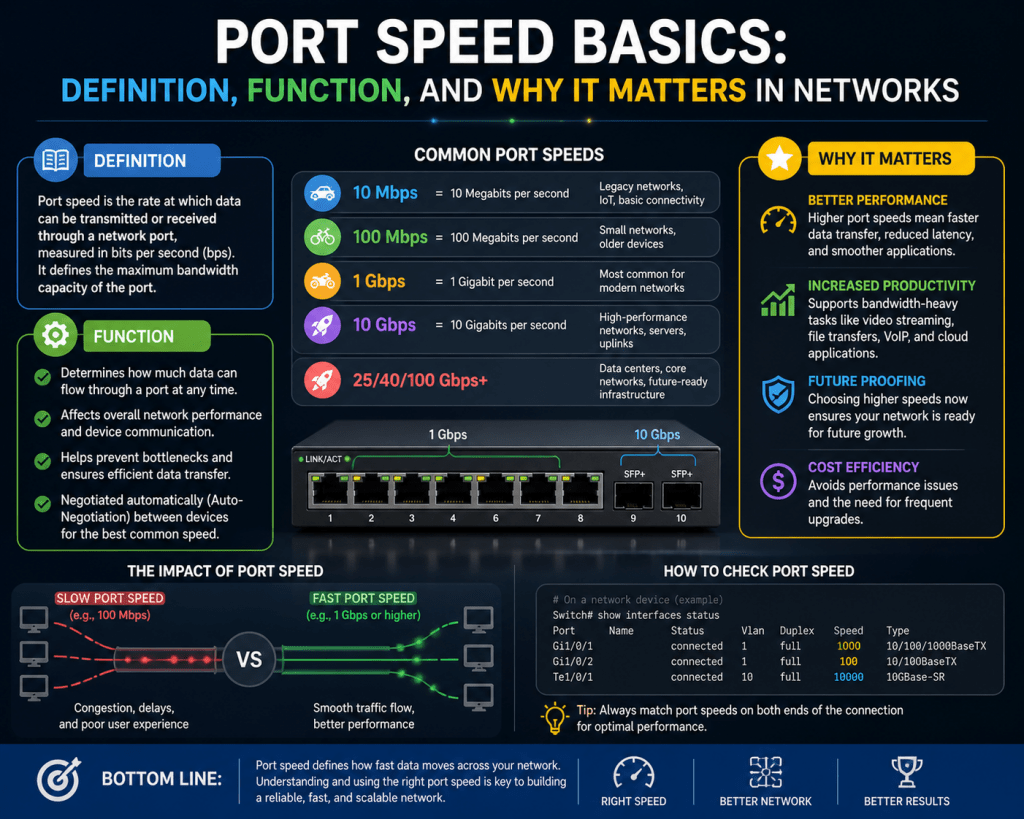
Port speed refers to the maximum rate at which data can be transmitted and received through a physical network interface such as an Ethernet port, switch port, or router interface. It is typically measured in bits per second (bps) and is commonly expressed in megabits per second (Mbps) or gigabits per second (Gbps). For example, a Gigabit Ethernet port supports up to 1000 Mbps under ideal conditions, establishing a ceiling for data transfer between connected devices. This value does not represent actual throughput in real-world conditions but rather the theoretical limit of the interface itself. Port speed is a fundamental parameter in networking because it directly influences how quickly devices can communicate, exchange packets, and support applications that rely on real-time or high-volume data transmission.
In practical networking scenarios, port speed acts as one component within a larger performance ecosystem. Even if a port supports high-speed transmission, actual network performance depends on multiple additional constraints, such as hardware capabilities, traffic load, and protocol efficiency. Understanding this distinction is critical for network administrators because misinterpreting port speed as overall network speed can lead to incorrect troubleshooting and inefficient infrastructure design.
Relationship Between Port Speed and Overall Network Performance
Network performance is a multi-layered concept that includes port speed, bandwidth capacity, latency, and throughput. Port speed specifically defines the maximum rate at the interface level, but it does not guarantee end-to-end performance. Bandwidth represents the total available data capacity across a network path, while latency measures the time required for data to travel between two points. Throughput reflects the actual amount of data successfully delivered over time after accounting for congestion, packet loss, and retransmissions.
Port speed serves as the foundational constraint at the device interface level. If a port is limited to 100 Mbps, then even if the rest of the network supports higher speeds, the connected device will be restricted to that limit. This makes port speed a bottleneck factor in many network designs. Conversely, increasing port speed alone does not automatically enhance performance if other constraints, such as routing inefficiencies or congestion,n exist elsewhere in the system.
Core Network Performance Concepts Related to Port Speed
Network performance must be evaluated through multiple interdependent metrics that define how efficiently data moves across systems. Bandwidth represents the maximum theoretical capacity of a communication channel and is often confused with port speed, although the two are not identical. Bandwidth can exist at both physical and logical levels, while port speed strictly refers to interface capability. In high-density environments, bandwidth utilization becomes critical because multiple devices compete for shared network resources.
Latency introduces another dimension by measuring propagation delay, processing delay, and queuing delay within network paths. Even when port speed is high, excessive latency can degrade user experience, especially in applications that require real-time responsiveness, ss such as voice communication or remote desktop sessions. Latency is influenced by physical distance, routing complexity, and device processing efficiency.
Throughput reflects real-world performance and is often lower than both port speed and bandwidth due to overhead and inefficiencies. Factors such as retransmissions, protocol encapsulation, and network congestion reduce achievable throughput. This makes throughput a more accurate representation of user experience compared to theoretical port speed values.
Role of Port Speed in Data Transmission Efficiency
Port speed directly impacts how efficiently data packets are transmitted between connected devices. Higher port speeds allow larger volumes of data to flow within shorter time intervals, reducing transmission delays and improving system responsiveness. This becomes particularly important in enterprise environments where large datasets, virtual machine migrations, and cloud-based services require continuous high-speed communication.
However, achieving optimal efficiency requires alignment between port speed and other system components. If one device operates at a higher port speed while another operates at a lower rate, the connection will automatically negotiate to the lowest common speed supported by both ends. This negotiation process ensures compatibility but can also reduce expected performance if mismatched hardware is used.
Fundamental Components Influencing Network Speed Behavior
Several interconnected components influence how port speed translates into actual network performance. One of the most important factors is network hardware capability. Switches, routers, and network interface cards must all support compatible speeds to prevent bottlenecks. Even a single outdated device can significantly reduce overall performance across an entire network segment.
Another critical factor is software efficiency, particularly in how operating systems and network drivers handle packet processing. Inefficient drivers or overloaded system memory can limit how quickly data is processed, even if physical ports support higher speeds. CPU utilization also plays a role, especially in environments where encryption, deep packet inspection, or virtualization is active.
Traffic patterns and congestion levels also heavily influence perceived network speed. When multiple devices attempt to transmit data simultaneously over shared infrastructure, queuing delays occur, reducing effective throughput. This makes traffic management and load balancing essential for maintaining consistent performance levels across high-speed networks.
Importance of Port Speed in Enterprise Networking Environments
In enterprise networks, port speed is a critical design consideration that affects scalability, reliability, and application performance. Modern business environments rely heavily on cloud services, real-time collaboration tools, and large-scale data analytics platforms. These workloads generate significant network traffic that requires high-speed connectivity to function efficiently.
Network architects must carefully evaluate port speed requirements when designing infrastructure to ensure that core systems, distribution layers, and access layers are properly balanced. Insufficient port speed at any layer can create bottlenecks that degrade performance across the entire network. This is particularly important in data centers where thousands of virtual machines and storage systems communicate simultaneously.
Port speed also influences redundancy planning. High-speed links are often paired with failover configurations to maintain connectivity during hardware or link failures. This ensures continuity of service without significant performance degradation.
Interaction Between Port Speed and Network Protocol Behavior
Different network protocols interact with port speed in distinct ways. Connection-oriented protocols require acknowledgment of data packets, which introduces additional overhead and can reduce effective throughput on lower-speed ports. Connectionless protocols, while faster in some cases, may sacrifice reliability for speed.
Encapsulation layers also contribute to overhead that affects how efficiently port speed is utilized. Each packet transmitted includes headers and metadata that consume part of the available bandwidth. As a result, actual usable data transfer rates are always slightly lower than theoretical port speed values.
Protocol efficiency becomes especially important in high-speed networks where even minor inefficiencies can lead to significant performance losses at scale. Optimizing protocol selection and configuration is therefore essential for maximizing the benefits of higher port speeds.
Physical and Logical Constraints Affecting Port Speed Utilization
Physical infrastructure plays a major role in determining whether port speed can be fully utilized. Cable quality, shielding, and length directly affect signal integrity. Poor-quality or damaged cables can introduce interference, leading to retransmissions and reduced effective speed.
Logical constraints, such as duplex mismatch, can also severely impact performance. In full-duplex mode, data can be sent and received simultaneously, maximizing efficiency. In half-duplex mode, communication occurs in one direction at a time, effectively reducing performance and increasing collision risk in older network environments.
Auto-negotiation mechanisms attempt to establish optimal settings between connected devices, but misconfigurations can still occur, leading to suboptimal performance. Proper alignment of duplex settings and speed configurations is essential for maintaining stable network behavior.
Foundational Importance of Port Speed in Network Design
Port speed is not an isolated metric but a foundational design element that influences every layer of network architecture. From access switches connecting end-user devices to backbone infrastructure supporting data center operations, port speed determines how efficiently data flows across the system.
Network planning must account for both current and future requirements, ensuring that port speed capabilities align with expected traffic growth. As digital environments continue to expand, higher-speed interfaces become increasingly necessary to support emerging technologies and data-intensive applications.
The role of port speed extends beyond simple connectivity. It shapes performance expectations, infrastructure scalability, and overall system reliability in modern networking environments.
Port Speed Configuration in Modern Network Architectures
Port speed configuration is a critical aspect of network engineering that determines how effectively devices communicate within a structured environment. While port speed defines the maximum theoretical data transfer rate of a physical interface, configuration determines whether that capacity is properly utilized, restricted, or dynamically adjusted. In enterprise and data center environments, port speed configuration is not simply a static setting but part of a broader performance strategy that aligns hardware capability, protocol behavior, and traffic engineering principles.
Modern network architectures typically rely on hierarchical designs that include access, distribution, and core layers. Each layer may operate under different port speed requirements depending on its role. Access layer ports, for example, often support end-user devices and may operate at lower speeds such as 100 Mbps or 1 Gbps, while core layer connections frequently use 10 Gbps, 40 Gbps, or higher to accommodate aggregated traffic flows. Proper configuration ensures that data can move smoothly across these layers without creating congestion points or bottlenecks.
Misconfigured port speeds can introduce severe performance degradation. When interfaces are manually set to mismatched speeds or fail to properly negotiate, issues such as packet loss, retransmissions, and link instability can occur. This makes correct configuration essential not only for performance optimization but also for maintaining network reliability.
Auto-Negotiation and Manual Port Speed Settings
One of the most important mechanisms involved in port speed configuration is auto-negotiation. This process allows two connected devices to automatically determine the highest supported speed and duplex mode. In ideal conditions, auto-negotiation ensures optimal performance without requiring manual intervention. However, its effectiveness depends on compatibility between devices and proper implementation of network standards.
Auto-negotiation works by exchanging signaling information between network interfaces during link establishment. Devices advertise their capabilities, including supported speeds such as 10 Mbps, 100 Mbps, 1 Gbps, or higher. Once both devices identify a common denominator, they establish a connection at the highest mutually supported speed.
Despite its convenience, auto-negotiation can sometimes fail due to legacy equipment, firmware inconsistencies, or configuration conflicts. In such cases, administrators may resort to manual configuration, explicitly setting port speed and duplex mode. While this approach offers greater control, it also increases the risk of mismatch errors if not carefully managed.
Manual configuration is often used in environments where predictable performance is required, such as in server-to-switch connections or high-performance computing clusters. In these scenarios, fixed settings reduce variability and ensure consistent throughput.
Impact of Duplex Modes on Port Speed Efficiency
Port speed alone does not define performance efficiency; duplex mode plays an equally important role. Duplex settings determine whether data transmission can occur simultaneously in both directions or only in one direction at a time. Full-duplex mode allows simultaneous sending and receiving of data, effectively doubling communication efficiency compared to half-duplex mode, which restricts transmission to one direction at a time.
In modern Ethernet networks, full-duplex is the standard configuration, especially in switched environments where collision domains are eliminated. Half-duplex is largely considered legacy and is rarely used except in outdated or specialized systems. However, duplex mismatches remain a common source of network issues.
A duplex mismatch occurs when one device is configured for full-duplex while the other operates in half-duplex. This results in collisions, retransmissions, and significant performance degradation even if the port speed is correctly configured. Such issues highlight the importance of ensuring that both speed and duplex settings are aligned across connected devices.
The interaction between duplex mode and port speed directly affects throughput efficiency. Even high-speed links can perform poorly if duplex settings are incorrect. Therefore, proper configuration of both parameters is essential for achieving optimal network performance.
Bandwidth Utilization and Port Speed Constraints
Bandwidth utilization refers to how much of the available network capacity is actively used during data transmission. While port speed defines the maximum possible transmission rate, bandwidth utilization reflects actual usage patterns. Efficient utilization depends on traffic distribution, application behavior, and network design.
In high-performance networks, achieving balanced bandwidth utilization is essential to avoid congestion. If certain ports operate at or near maximum capacity while others remain underutilized, performance inefficiencies arise. This imbalance often results from poor traffic engineering or inadequate load-balancing strategies.
Port speed constraints directly influence bandwidth utilization. For example, if a server is connected via a 1 Gbps port but attempts to send data at higher rates due to internal processing capabilities, the port becomes a limiting factor. Conversely, underutilized high-speed ports may indicate inefficient resource allocation or suboptimal network design.
Traffic shaping and prioritization mechanisms are often used to manage bandwidth utilization effectively. These mechanisms ensure that critical applications receive sufficient resources while preventing non-essential traffic from overwhelming network capacity.
Latency Behavior in High-Speed Port Environments
Latency is a key performance metric that measures the time required for data to travel from source to destination. While port speed affects how quickly data can be transmitted, latency determines how quickly it is delivered. Even in high-speed networks, high latency can significantly degrade user experience.
Latency is influenced by multiple factors, including physical distance, routing complexity, and processing delays at intermediate devices. In high-speed port environments, queuing delays can also contribute to latency when traffic exceeds available processing capacity.
One common misconception is that increasing port speed automatically reduces latency. While higher speeds can reduce transmission delay, they do not eliminate other forms of latency, such as propagation delay or processing delay. As a result, network performance optimization requires a holistic approach rather than focusing solely on port speed improvements.
Latency-sensitive applications such as voice communication, video conferencing, and real-time analytics require careful tuning of both port speed and network architecture to maintain acceptable performance levels.
Throughput Optimization and Real-World Performance
Throughput represents the actual amount of data successfully transmitted over a network within a given time period. Unlike port speed, which represents a theoretical maximum, throughput reflects real-world performance after accounting for overhead, retransmissions, and congestion.
Optimizing throughput requires careful coordination of multiple network parameters, including port speed, protocol efficiency, and hardware performance. Even when high-speed ports are available, throughput can be limited by inefficient routing, excessive packet fragmentation, or suboptimal buffer management.
Protocol overhead plays a significant role in reducing throughput efficiency. Each packet transmitted across a network includes headers and control information that consume part of the available bandwidth. As a result, the usable data portion is always smaller than the total transmission capacity.
In high-speed networks, even minor inefficiencies can result in substantial throughput losses when scaled across large data volumes. This makes performance tuning an essential task in enterprise environments.
Hardware Limitations and Port Speed Bottlenecks
Hardware limitations are one of the most significant factors affecting port speed performance. Network interface cards, switches, routers, and cabling infrastructure must all support compatible speeds to avoid bottlenecks.
A common bottleneck occurs when a high-speed device connects to a lower-speed interface. In such cases, the connection automatically adjusts to the lowest supported speed, limiting overall performance. This ensures compatibility but can significantly reduce efficiency in high-performance environments.
Switch backplanes also play a critical role in determining overall network capacity. Even if individual ports support high speeds, the internal switching capacity must be sufficient to handle aggregated traffic. If the backplane becomes saturated, packet loss and congestion can occur even when port speeds are adequate.
Memory and processing limitations within network devices can also restrict performance. Devices with insufficient buffer capacity may drop packets during peak traffic conditions, reducing effective throughput.
Traffic Congestion and Its Relationship with Port Speed
Traffic congestion occurs when the volume of data exceeds the available network capacity. In environments with multiple high-speed connections, congestion can still occur if traffic is not properly distributed.
Port speed alone cannot prevent congestion. Even high-speed ports can become overwhelmed if multiple data streams converge on a single interface. This is particularly common in data center environments where large-scale data transfers occur simultaneously.
Congestion control mechanisms are used to mitigate these issues by regulating traffic flow and preventing buffer overflows. These mechanisms rely on dynamic adjustments to transmission rates based on network conditions.
Efficient network design minimizes congestion by distributing traffic evenly across multiple paths and ensuring that high-demand services are allocated sufficient bandwidth resources.
Role of Network Protocols in Port Speed Utilization
Network protocols define how data is formatted, transmitted, and received across communication channels. These protocols significantly influence how effectively port speed is utilized.
Connection-oriented protocols introduce additional overhead due to acknowledgment and retransmission mechanisms. While this improves reliability, it can reduce effective throughput. Connectionless protocols, on the other hand, reduce overhead but may sacrifice reliability under certain conditions.
Encapsulation layers also contribute to performance overhead. Each layer in the networking stack adds additional headers, reducing the proportion of usable payload data. This cumulative effect can significantly impact performance in high-speed environments.
Efficient protocol selection and configuration are therefore essential for maximizing port speed utilization. Network administrators must balance reliability, efficiency, and performance based on application requirements.
Scaling Network Performance Through Port Speed Management
Scalability is a critical consideration in modern network design. As data demands increase, networks must be able to expand without significant performance degradation. Port speed management plays a central role in enabling this scalability.
Increasing port speeds allows networks to accommodate higher traffic volumes without redesigning the entire infrastructure. However, scalability also requires careful planning to ensure that all components, including switches, routers, and cabling, can support higher speeds.
Load balancing techniques are often used to distribute traffic across multiple high-speed links, improving overall efficiency and preventing single points of congestion. This approach ensures that network resources are utilized effectively as demand grows.
Scalable network architectures rely on a combination of high-speed ports, efficient routing, and adaptive traffic management to maintain performance consistency under varying load conditions.
Operational Importance of Port Speed Consistency Across Networks
Consistency in port speed configuration is essential for maintaining predictable network behavior. Inconsistent settings across devices can lead to performance variability, connection instability, and troubleshooting challenges.
Standardizing port speed configurations ensures that all devices operate within defined performance parameters. This reduces complexity and improves reliability in large-scale network environments.
Consistent configurations also simplify monitoring and diagnostics by eliminating variability caused by mismatched settings. This allows network administrators to more easily identify and resolve performance issues.
In enterprise environments, maintaining uniform port speed policies is a key component of network governance and operational efficiency.
Advanced Port Speed Optimization in High-Performance Networks
Advanced port speed optimization focuses on maximizing data transfer efficiency in environments where network demand is consistently high and performance expectations are strict. In such environments, port speed is not treated as a static attribute but as a dynamic component that interacts with routing logic, hardware acceleration, traffic engineering, and application-level requirements. High-performance networks such as data centers, cloud infrastructures, and enterprise backbone systems depend heavily on optimized port utilization to maintain stability under continuous load.
Optimization at this level requires a deep understanding of how physical port speed interacts with logical traffic flow. Even when ports operate at 10 Gbps, 40 Gbps, or higher, inefficiencies can still arise due to congestion, packet fragmentation, or suboptimal routing paths. Therefore, optimization strategies focus not only on increasing speed but also on improving how that speed is consumed across the network.
A key principle in advancedoptimization iss t elimination of unnecessary overhead. Every packet transmitted across a network includes headers, metadata, and control information. Reducing redundant encapsulation layers and optimizing protocol selection can significantly improve effective throughput. This becomes increasingly important as port speeds scale upward, since inefficiencies become more pronounced at higher traffic volumes.
High-Speed Switching Architectures and Port Performance
Switching architecture plays a central role in determining how effectively port speed is utilized. Modern switches are designed with non-blocking architectures that allow simultaneous data transfer across multiple ports without internal congestion. This ensures that each port can operate at its full rated speed under ideal conditions.
In contrast, oversubscribed architectures introduce contention when aggregate traffic demand exceeds internal switching capacity. While oversubscription is sometimes used for cost efficiency, it can reduce effective port speed performance during peak traffic periods. Understanding the balance between cost, capacity, and performance is essential when designing high-speed switching environments.
Switch fabrics are also critical in determining performance efficiency. The switch fabric is responsible for transferring data between input and output ports within the device. A high-capacity fabric ensures that port speed is not artificially constrained by internal processing limitations. In large-scale deployments, switch fabric throughput must be carefully matched with port density and speed capabilities.
Role of Hardware Acceleration in Port Speed Efficiency
Hardware acceleration is increasingly used to enhance port speed efficiency by offloading processing tasks from the CPU to specialized hardware components. Tasks such as packet inspection, encryption, and routing calculations can significantly impact performance if handled purely by software.
Network interface cards with built-in acceleration capabilities can process data at line rate, ensuring that high-speed ports are fully utilized without bottlenecks. This is particularly important in environments where security features such as deep packet inspection or encryption are enabled.
Offloading these processes reduces latency and increases throughput by allowing data to be processed in parallel rather than sequentially. This architectural improvement is essential in modern high-speed networks where CPU-based processing alone cannot keep up with increasing data rates.
Impact of Virtualization on Port Speed Utilization
Virtualization introduces additional layers of abstraction that can influence how port speed is utilized. In virtualized environments, multiple virtual machines share underlying physical network interfaces, creating potential contention for bandwidth resources.
Virtual switches handle traffic between virtual machines and physical network interfaces. These software-based switching layers can introduce additional processing overhead, which may reduce effective port speed utilization if not properly optimized.
Techniques such as network interface bonding and virtual NIC assignment are commonly used to distribute traffic across multiple physical interfaces. This allows virtualized workloads to take advantage of aggregated port speeds, improving overall performance.
However, improper configuration of virtual networking components can lead to inefficiencies such as uneven load distribution or unnecessary packet duplication. Careful tuning is required to ensure that virtualization layers do not become performance bottlenecks.
Load Balancing Strategies for Port Speed Optimization
Load balancing is a critical mechanism used to distribute network traffic evenly across multiple ports or paths. By ensuring that no single port becomes overwhelmed, load balancing improves overall throughput and reduces congestion.
There are several approaches to load balancing, including static distribution, dynamic distribution, and adaptive algorithms. Static load balancing distributes traffic based on predefined rules, while dynamic methods adjust distribution based on real-time network conditions.
Adaptive load balancing is particularly effective in high-speed environments because it continuously monitors port utilization and adjusts traffic flow accordingly. This ensures that available port speed is used efficiently across the network.
In multi-link aggregation scenarios, multiple physical ports are combined into a single logical interface. This allows traffic to be distributed across several high-speed links, effectively increasing total available bandwidth while maintaining redundancy.
Impact of Storage Systems on Port Speed Demand
Modern storage systems place significant demands on network port speed due to the increasing use of distributed storage architectures. Technologies such as network-attached storage and storage area networks rely heavily on high-speed connectivity to ensure fast data access.
Storage traffic is often characterized by large, continuous data transfers, which require sustained high throughput. Inadequate port speed can lead to storage latency, reduced application performance, and delayed data retrieval.
High-performance storage environments often require dedicated high-speed ports to isolate storage traffic from general network traffic. This ensures consistent performance and prevents interference from unrelated data flows.
The increasing adoption of cloud storage and distributed databases has further amplified the importance of high-speed port infrastructure in supporting modern data workloads.
Influence of Security Processing on Port Speed Performance
Security processing can have a significant impact on port speed utilization. Features such as encryption, intrusion detection, and traffic filtering require additional computational resources that can reduce effective throughput.
Encrypted traffic must be processed both during transmission and reception, adding overhead to each packet. While encryption is essential for data protection, it can introduce latency and reduce throughput if not properly optimized.
Hardware-based security acceleration helps mitigate these performance impacts by offloading cryptographic operations from the main processing unit. This allows high-speed ports to maintain performance levels even when security features are enabled.
Security policies must be carefully balanced with performance requirements to ensure that protection mechanisms do not negatively impact network efficiency.
Traffic Engineering and Port Speed Allocation
Traffic engineering involves controlling the flow of data across a network to optimize performance and resource utilization. Port speed plays a key role in traffic engineering decisions because it determines the maximum capacity of each network path.
By analyzing traffic patterns, network administrators can allocate resources more effectively and prevent congestion on high-demand links. This often involves rerouting traffic, adjusting priority levels, or redistributing workloads across multiple ports.
In large-scale environments, traffic engineering is essential for maintaining consistent performance across geographically distributed systems. It ensures that high-speed links are used efficiently and that no single path becomes a performance bottleneck.
Advanced traffic engineering techniques may also involve predictive modeling, where future traffic demands are estimated, and resources are pre-allocated accordingly.
Environmental and Physical Factors Affecting Port Speed Performance
Physical environment conditions can influence port speed performance in subtle but important ways. Temperature, humidity, and electromagnetic interference can all impact signal integrity and transmission quality.
High-speed network components generate heat, and insufficient cooling can lead to thermal throttling, which reduces performance to prevent hardware damage. Proper cooling infrastructure is therefore essential in high-density network environments.
Electromagnetic interference from nearby electrical equipment can also degrade signal quality, particularly in copper-based connections. Shielded cabling and proper cable management help mitigate these effects.
Cable length limitations must also be considered, as signal degradation increases with distance. Fiber optic connections are often used in high-speed environments to overcome these limitations and maintain signal integrity over long distances.
Network Monitoring and Port Speed Diagnostics
Continuous monitoring is essential for maintaining optimal port speed performance. Network monitoring tools provide real-time visibility into traffic levels, error rates, and utilization metrics.
By analyzing port-level statistics, administrators can identify performance bottlenecks and proactively address issues before they impact users. Metrics such as interface utilization, packet loss, and error rates provide valuable insights into network health.
Diagnostics tools also help detect configuration issues such as speed mismatches or duplex inconsistencies. Early detection of these problems is critical for preventing long-term performance degradation.
Advanced monitoring systems may incorporate machine learning techniques to detect anomalies in traffic patterns and predict potential failures.
Future Trends in Port Speed Evolution
Port speed continues to evolve as network demand increases. Emerging technologies are pushing beyond traditional speed limitations, introducing interfaces capable of supporting 100 Gbps, 400 Gbps, and beyond.
These advancements are driven by increasing data consumption, cloud computing expansion, and artificial intelligence workloads that require massive data movement capabilities.
Future network architectures are expected to focus not only on raw port speed increases but also on efficiency improvements through smarter traffic management and distributed processing models.
Energy efficiency is also becoming an important consideration, as higher port speeds typically require greater power consumption. Optimizing performance while reducing energy usage is a key challenge for next-generation network design.
Integration of Port Speed into End-to-End Network Strategy
Port speed must be integrated into a broader network strategy that considers performance, scalability, security, and reliability. It cannot be optimized in isolation without considering its impact on other network components.
End-to-end network performance depends on the alignment of port speed with routing efficiency, application requirements, and infrastructure design. A holistic approach ensures that all components work together to deliver consistent performance.
Strategic planning involves forecasting future network demands and designing infrastructure that can scale accordingly. This includes selecting appropriate port speeds, implementing redundancy, and ensuring compatibility across all network layers.
Effective integration of port speed into network strategy results in systems that are not only fast but also resilient, adaptable, and capable of supporting evolving technological demands.
Conclusion
Port speed remains one of the most fundamental yet frequently misunderstood elements in network design and performance engineering. While it is often described simply as the maximum data transfer rate of a physical interface, its real significance extends far beyond that definition. Across modern networking environments, port speed acts as a structural constraint, a performance enabler, and a design parameter that influences nearly every layer of communication between systems.
In practical terms, port speed defines the upper boundary of how fast data can physically enter or exit a networking device. However, this boundary is only meaningful when considered within the broader context of network behavior. Actual performance experienced by users is the result of multiple interacting variables, including protocol efficiency, hardware capability, traffic patterns, congestion levels, and system configuration. Port speed sets the ceiling, but the network environment determines how close operations come to reaching that ceiling.
One of the most important realizations in modern networking is that increasing port speed alone does not guarantee improved performance. A network operating at higher interface speeds can still suffer from poor responsiveness, packet loss, or inconsistent throughput if other components are not aligned. This is why port speed must always be evaluated as part of a complete system rather than as an isolated metric. When properly integrated into a well-designed architecture, however, it becomes a powerful driver of scalability and efficiency.
From a design perspective, port speed influences infrastructure planning at every layer of a network. At the access layer, it determines how end-user devices connect and how quickly they can transmit data to local resources. At the distribution layer, it governs how traffic is aggregated and routed between segments. At the core layer, it defines how large volumes of data are transported across the backbone of the network. Any imbalance in port speed between these layers can introduce bottlenecks that degrade overall system performance, making alignment a critical design principle.
The evolution of networking technologies has consistently pushed port speeds higher, driven by increasing demands from cloud computing, virtualization, data analytics, and real-time communication systems. As applications become more data-intensive, the need for faster and more efficient transmission mechanisms grows accordingly. This has led to widespread adoption of multi-gigabit and even multi-hundred-gigabit interfaces in enterprise and data center environments.
However, as port speeds increase, so does the complexity of managing them effectively. High-speed environments amplify the impact of inefficiencies that might be negligible at lower speeds. Small configuration errors, minor protocol overhead, or slight hardware mismatches can result in significant performance degradation when multiplied across large-scale systems. This makes precision in configuration and monitoring increasingly important as networks evolve.
Another critical dimension of port speed is its relationship with traffic behavior. Modern networks rarely operate under uniform load conditions. Instead, traffic is highly dynamic, with bursts of activity, unpredictable demand spikes, and variable application requirements. Port speed must therefore be supported by intelligent traffic management strategies that can adapt to changing conditions in real time. Without such adaptability, even high-capacity links can become congested under uneven workloads.
This is where concepts such as load balancing, traffic engineering, and congestion control become essential. These mechanisms ensure that available port speed is distributed efficiently across competing traffic flows. Rather than allowing a single high-demand application to monopolize bandwidth, intelligent systems distribute resources to maintain overall stability and fairness. In this way, port speed becomes a shared resource that must be actively managed rather than passively consumed.
The role of hardware in determining effective port speed utilization cannot be overlooked. Network interface cards, switches, routers, and cabling infrastructure all contribute to how well theoretical port speed translates into real-world performance. Even in high-capacity environments, a single weak link in the hardware chain can limit overall efficiency. This reinforces the importance of designing networks with consistent and compatible components across all layers.
Software and protocol behavior also play a significant role in shaping how port speed is utilized. Protocol overhead, retransmission mechanisms, and encapsulation layers all consume portions of available bandwidth. While these processes are necessary for reliability and structure, they introduce inefficiencies that reduce usable throughput. Optimizing protocol selection and minimizing unnecessary overhead are therefore essential strategies for maximizing performance.
Virtualization and cloud computing have further complicated the relationship between port speed and actual network performance. In virtualized environments, multiple workloads share physical network interfaces, creating contention for limited resources. Without proper optimization, this can lead to uneven performance distribution and unpredictable latency. Techniques such as virtual NIC aggregation and software-defined networking help mitigate these challenges by improving resource allocation and traffic visibility.
Security processing introduces another layer of complexity. Encryption, inspection, and filtering processes consume computational resources that can impact throughput on high-speed links. While security is non-negotiable in modern networks, it must be carefully balanced with performance requirements. Hardware acceleration and optimized security architectures help reduce this impact, allowing systems to maintain both protection and efficiency simultaneously.
Environmental and physical factors also contribute to port speed effectiveness. Cable quality, signal integrity, electromagnetic interference, and thermal conditions all influence how reliably data can be transmitted at high speeds. As port speeds increase, the sensitivity of systems to these external factors also increases, requiring more precise infrastructure design and environmental control.
Looking forward, the continued evolution of port speed technology will be driven by exponential growth in data consumption and application complexity. Emerging workloads such as artificial intelligence processing, real-time analytics, and immersive digital experiences demand unprecedented levels of network performance. This will require not only faster interfaces but also more intelligent systems capable of dynamically managing traffic at scale.
At the same time, efficiency will become just as important as raw speed. Simply increasing port capacity without improving utilization efficiency will lead to diminishing returns. Future networking systems will need to focus on intelligent optimization, adaptive routing, and automated performance tuning to fully leverage available infrastructure.
Ultimately, port speed should be understood not as an isolated specification but as a foundational component within a larger ecosystem of network performance. Its true value emerges when it is aligned with hardware capability, software behavior, traffic design, and operational strategy. When all these elements work together cohesively, port speed becomes a powerful enabler of high-performance, scalable, and reliable network systems capable of supporting modern digital demands.