
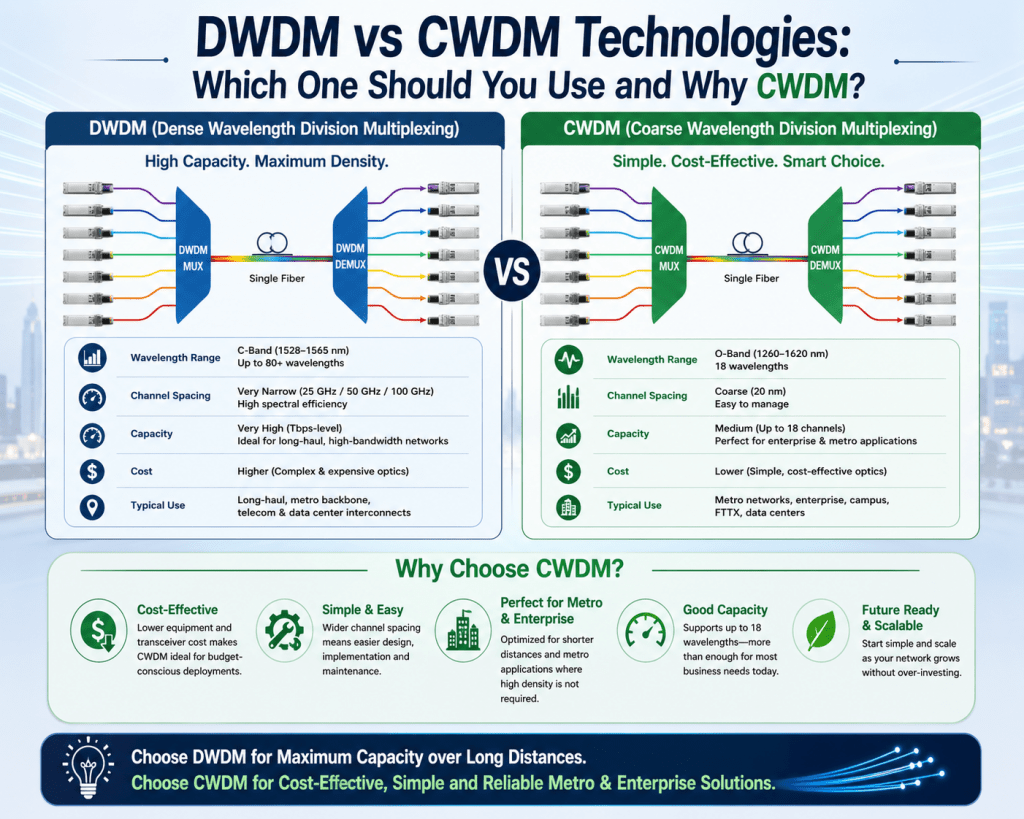
Modern communication infrastructure is built on the principle of transmitting vast amounts of data across optical fiber networks using light as the primary carrier medium. As global data consumption continues to increase due to cloud computing, digital media, real-time applications, and distributed systems, traditional single-channel fiber transmission methods are no longer sufficient to meet bandwidth requirements. Optical multiplexing emerged as a solution to this limitation by enabling multiple independent data streams to share a single optical fiber simultaneously. This is achieved through the use of different wavelengths of light, where each wavelength functions as an independent channel within the same physical medium. This transformation of fiber from a single-lane transmission path into a multi-channel system represents one of the most significant advancements in optical networking technology.
Within this domain, wavelength division multiplexing techniques have become the standard approach for scaling fiber capacity without increasing physical infrastructure. Two major implementations dominate this field: coarse wavelength division multiplexing and dense wavelength division multiplexing. While both rely on wavelength separation, their operational design, channel density, and deployment environments differ significantly. Coarse wavelength division multiplexing focuses on cost-effective, simpler deployment with moderate capacity expansion, whereas dense wavelength division multiplexing is designed for extremely high-capacity, long-distance communication systems. Understanding the foundational principles of coarse multiplexing is essential for comprehending how modern optical access and metropolitan networks are structured.
Fundamental Principles of Coarse Wavelength Division Multiplexing
Coarse wavelength division multiplexing is based on the concept of using widely spaced optical wavelengths to carry multiple data streams over a single fiber. Each channel operates on a distinct wavelength, and these wavelengths are separated by relatively large intervals compared to dense systems. This wide spacing reduces the complexity of optical filtering and allows the use of simpler, more cost-effective components. Unlike tightly packed optical systems, coarse multiplexing does not require ultra-precise wavelength stabilization, making it more tolerant of environmental variations such as temperature fluctuations and minor hardware inconsistencies.
The primary objective of this system is not maximum channel density but efficient utilization of existing fiber infrastructure in a simplified manner. By combining multiple data streams into a single optical path, network operators can significantly increase bandwidth without deploying additional physical fiber cables. This approach is particularly beneficial in environments where budget constraints, deployment speed, and operational simplicity are more important than achieving the highest possible spectral efficiency.
In practical terms, coarse multiplexing divides the usable optical spectrum into a limited number of channels, each separated by a wide wavelength gap. These channels are then used to transmit independent data streams such as internet traffic, voice communication, video transmission, and enterprise data services. The simplicity of this structure makes it highly suitable for regional networks and enterprise-level communication systems.
Optical Spectrum Organization and Channel Distribution
The optical spectrum used in coarse multiplexing systems is structured in a way that prioritizes separation between channels. Each wavelength occupies a distinct portion of the spectrum, and these portions are spaced far enough apart to minimize interference and crosstalk. This spectral arrangement ensures that signals remain stable even when operating conditions vary.
Because the channels are not densely packed, the system can operate without requiring extremely precise wavelength calibration. This reduces the cost and complexity of optical transmitters and receivers. In addition, the relaxed spectral design allows easier integration with existing fiber infrastructure, making it possible to upgrade legacy networks without complete system overhauls.
The distribution of wavelengths also plays a role in ensuring signal integrity across multiple transmission paths. Each channel is treated independently, allowing different types of services to coexist on the same fiber without interfering with one another. This separation of data streams enhances network flexibility and enables service providers to offer multiple communication services using a single physical infrastructure.
Signal Multiplexing and Transmission Workflow
The operation of a coarse wavelength system begins at the transmission end, where multiple electrical data signals are converted into optical signals using transceiver modules. Each signal is assigned a specific wavelength based on the system configuration. These optical signals are then fed into a multiplexing device, which combines them into a single composite optical stream.
This multiplexed signal travels through a single optical fiber, carrying multiple independent data streams simultaneously. Despite sharing the same physical medium, each wavelength remains logically separate, ensuring that data integrity is preserved throughout transmission. The fiber acts as a shared highway where each wavelength functions as a distinct lane carrying its own traffic.
At the receiving end, a demultiplexing device separates the combined optical signal back into its individual wavelength components. Each separated signal is then converted back into an electrical form and delivered to its respective destination device or network segment. This process ensures accurate and efficient delivery of multiple data streams over a single fiber link without requiring parallel physical connections.
Core Components of Coarse Wavelength Systems
A functioning coarse wavelength multiplexing system consists of several interconnected optical components that work together to enable signal transmission and reception. Optical transceivers are responsible for converting electrical signals into optical signals and vice versa. These devices serve as the interface between digital networking equipment and optical transmission infrastructure.
Multiplexers are used to combine multiple wavelength channels into a single optical output. These devices ensure that each wavelength remains distinct while sharing the same fiber medium. Demultiplexers perform the reverse operation by separating the combined signal into its original wavelength components.
Single-mode optical fiber is typically used in these systems due to its ability to support long-distance transmission with minimal signal degradation. This type of fiber is optimized for carrying light signals over extended distances with low dispersion and attenuation.
In addition to these primary components, connector systems such as LC and SC interfaces are used to ensure proper alignment between optical devices. These connectors play a critical role in maintaining signal integrity by minimizing insertion loss and reflection.
Optical power management components may also be included in the system to regulate signal strength across different channels. This ensures that all wavelengths maintain consistent performance levels throughout the transmission process.
Transmission Performance and Distance Limitations
The performance characteristics of coarse wavelength systems are influenced by several factors, including wavelength spacing, fiber quality, and optical power distribution. Because the system uses wider channel spacing, it experiences lower levels of inter-channel interference, which improves signal stability.
However, optical signals naturally degrade over distance due to attenuation and dispersion. As a result, coarse multiplexing systems are typically limited to regional or metropolitan-scale deployments rather than long-haul communication. These systems are well-suited for distances up to approximately 100 kilometers, depending on fiber quality and network design.
Unlike dense optical systems that rely heavily on amplification and signal regeneration for long-distance communication, coarse systems focus on minimizing complexity within shorter transmission ranges. This makes them more practical for enterprise networks, campus environments, and urban communication systems where ultra-long-distance transmission is not required.
Network Integration and Infrastructure Efficiency
One of the key advantages of coarse wavelength multiplexing is its ability to integrate seamlessly with existing fiber infrastructure. Instead of requiring new fiber installation, it allows multiple data streams to be transmitted over a single existing fiber link. This significantly reduces infrastructure costs and simplifies network expansion.
In enterprise environments, this capability is particularly valuable because it allows organizations to scale their communication networks without major physical upgrades. Multiple services such as data transfer, voice communication, and video conferencing can be consolidated onto a single fiber connection, improving efficiency and reducing complexity.
From an operational perspective, this integration also simplifies network design. Fewer physical connections mean reduced cable management complexity, lower maintenance requirements, and improved system reliability. As a result, coarse wavelength systems are widely used in environments where practical deployment considerations are as important as performance capabilities.
Role in Modern Communication Ecosystems
Coarse wavelength multiplexing plays an important role in modern communication ecosystems by serving as a bridge between basic fiber connectivity and high-capacity optical backbone systems. It enables efficient data aggregation at the network edge and provides a scalable foundation for more advanced optical technologies.
While it may not offer the extreme capacity of dense systems, its simplicity and cost-effectiveness make it an essential component in layered network architectures. It supports the growing demand for bandwidth in enterprise, institutional, and metropolitan environments, ensuring that data can be transmitted efficiently across expanding digital infrastructures.
As communication networks continue to evolve, coarse wavelength systems remain a practical solution for mid-range optical transport, offering a balance between performance, cost, and operational simplicity that is difficult to achieve with more complex optical technologies.
Introduction to Dense Wavelength Division Multiplexing in Modern Fiber Networks
Dense Wavelength Division Multiplexing (DWDM) represents one of the most advanced methods of optical communication used in modern fiber networks to maximize data transmission capacity. As global data traffic continues to grow due to cloud computing, streaming platforms, distributed applications, artificial intelligence workloads, and inter-data-center connectivity, the demand for ultra-high bandwidth transport systems has increased significantly. DWDM addresses this requirement by enabling a large number of optical signals to be transmitted simultaneously over a single optical fiber using extremely closely spaced wavelengths.
Unlike simpler optical transmission techniques, DWDM is engineered for high-density channel allocation, long-distance signal propagation, and scalable backbone network design. It transforms a single fiber strand into a high-capacity transmission medium capable of carrying massive volumes of data across regional, national, and global communication infrastructures. This makes it a foundational technology in internet backbone networks, telecom carrier systems, and large-scale cloud interconnection architectures.
Core Architecture of Dense Optical Channel Systems
The fundamental architecture of DWDM is built around the concept of tightly packed wavelength channels, where each channel represents an independent data stream carried by a specific optical frequency. These wavelengths are carefully spaced within a standardized optical grid to ensure precise separation and avoid interference. The spacing between channels is significantly smaller than in coarse multiplexing systems, allowing a much higher number of channels to coexist within the same spectral range.
This dense arrangement of wavelengths dramatically increases overall network capacity without requiring additional fiber installation. Each channel operates independently, enabling simultaneous transmission of multiple high-speed data streams such as internet traffic, enterprise communication, video streaming, and cloud service synchronization. The system effectively converts a single fiber into a multi-channel communication highway capable of handling terabits of data per second.
The architecture relies on extremely precise optical engineering, where even minor wavelength deviations can impact signal quality. This requires highly stable laser sources, advanced modulation techniques, and strict control of environmental factors to maintain consistent performance.
Spectral Efficiency and Channel Density Optimization
One of the defining characteristics of DWDM systems is their exceptional spectral efficiency. By reducing the spacing between wavelengths to extremely narrow intervals, DWDM systems maximize the use of available optical spectrum. This allows a significantly higher number of channels to be transmitted over a single fiber compared to broader spacing systems.
Each wavelength is precisely controlled to prevent overlap with adjacent channels. Advanced filtering technologies ensure that signals remain isolated even under high-density conditions. This level of precision enables network operators to scale capacity exponentially without increasing physical infrastructure.
However, this high spectral efficiency comes with increased system complexity. The closer channel spacing makes the system more sensitive to variations in temperature, laser drift, and fiber nonlinearities. As a result, DWDM systems require advanced stabilization mechanisms to maintain performance integrity.
Despite these challenges, the ability to maximize bandwidth within a limited spectral window makes DWDM one of the most powerful technologies in optical communication networks.
Long-Distance Transmission and Optical Amplification
DWDM systems are specifically designed for long-haul and ultra-long-haul communication networks where signals must travel across vast distances. As optical signals propagate through fiber, they experience attenuation and dispersion, which gradually degrade signal quality. To overcome this limitation, DWDM systems incorporate optical amplification technologies that boost signal strength without converting optical signals back into electrical form.
These amplification stages are strategically placed along the transmission path to ensure continuous signal integrity. By amplifying all wavelength channels simultaneously, the system maintains efficiency while extending transmission range across hundreds or even thousands of kilometers.
This capability makes DWDM ideal for backbone networks that connect major cities, countries, and continents. It is widely used in submarine cable systems, intercontinental communication links, and high-capacity terrestrial fiber routes.
The integration of optical amplification ensures that DWDM systems can maintain high performance over extremely long distances while preserving data integrity across all channels.
Advanced Optical Amplification Techniques
DWDM networks often utilize multiple types of optical amplification technologies to maintain signal strength and quality. One of the most widely used methods is erbium-doped fiber amplification, which amplifies optical signals within a specific wavelength range. This method is highly efficient because it amplifies multiple channels simultaneously without requiring individual signal processing.
Another advanced technique is distributed Raman amplification, where the amplification process occurs directly within the transmission fiber itself. This approach provides continuous signal boosting over long distances, improving overall system performance and reducing signal degradation.
These amplification techniques are essential for maintaining the performance of high-density optical systems, especially in environments where signals must travel across large geographic regions without regeneration.
Signal Integrity and Dispersion Management
As the number of wavelengths increases in a DWDM system, maintaining signal integrity becomes more challenging. One of the key issues in dense optical environments is chromatic dispersion, where different wavelengths travel at slightly different speeds through the fiber. This can lead to signal distortion and data loss if not properly managed.
To address this, DWDM systems incorporate dispersion compensation techniques that correct timing differences between optical signals. These techniques ensure that data remains synchronized across all channels, preserving signal clarity even over long distances.
In addition to dispersion, nonlinear optical effects such as cross-phase modulation and four-wave mixing can also impact performance. These effects occur when high-intensity light signals interact within the fiber, potentially causing interference between channels. Advanced system design and power management strategies are used to minimize these effects and maintain stable operation.
Optical Transponders and Signal Processing Layers
DWDM systems rely heavily on optical transponders, which serve as the interface between electrical data signals and optical transmission channels. These devices convert electrical signals into specific optical wavelengths and ensure that each data stream is properly assigned to a designated channel.
Transponders also perform signal conditioning functions such as regeneration, reshaping, and retiming to improve transmission quality. In advanced systems, they support multiple modulation formats that allow higher data rates per channel, further increasing overall system capacity.
This layer of signal processing is essential for ensuring compatibility between different network segments and maintaining high-performance communication across complex optical infrastructures.
Network Topology and Core Transport Hierarchies
DWDM systems are typically deployed within hierarchical network structures that form the backbone of modern communication systems. At the core level, DWDM provides high-capacity long-distance transport between major network nodes. These core networks aggregate traffic from regional and access networks, enabling efficient large-scale data distribution.
At intermediate layers, DWDM systems may interconnect multiple metropolitan networks, forming regional transport rings that provide redundancy and load balancing. This hierarchical design ensures that data flows efficiently across different network tiers while maintaining high availability and fault tolerance.
The ability to support multiple layers of network aggregation makes DWDM a critical component in large-scale communication infrastructure design.
Reconfigurable Optical Networks and Dynamic Routing
Modern DWDM systems often incorporate reconfigurable optical add-drop multiplexers, which enable dynamic management of wavelength channels. These systems allow specific wavelengths to be added, removed, or rerouted without interrupting the entire network.
This capability introduces a high degree of flexibility into optical networks, allowing operators to adapt to changing traffic patterns in real time. It also enables more efficient use of network resources by dynamically allocating bandwidth where it is needed most.
Reconfigurable optical systems represent a significant advancement in network automation and intelligent traffic management, supporting the development of highly adaptive communication infrastructures.
Engineering Challenges in Dense Optical Environments
Despite their advantages, DWDM systems present several engineering challenges due to their high channel density and sensitivity to environmental factors. Precise wavelength control is essential to prevent channel overlap, and even minor deviations can affect system performance.
Thermal stability, fiber nonlinearities, and signal power balancing must all be carefully managed to ensure reliable operation. These challenges require advanced design methodologies and continuous monitoring to maintain system integrity.
The complexity of DWDM systems reflects their role in high-performance communication environments where maximum capacity and long-distance transmission are essential requirements.
Scalability in Global Communication Networks
One of the most important advantages of DWDM is its ability to scale network capacity without requiring additional fiber deployment. By increasing the number of wavelength channels within existing infrastructure, network operators can continuously expand bandwidth to meet growing demand.
This scalability is essential in modern digital ecosystems where data consumption increases rapidly due to cloud computing, artificial intelligence applications, video streaming, and global connectivity demands. DWDM provides a flexible and efficient foundation for supporting this growth without requiring constant physical infrastructure expansion.
As a result, DWDM has become a cornerstone technology in global communication networks, enabling the continuous evolution of high-speed digital infrastructure.
Architectural Comparison Between Coarse and Dense Wavelength Multiplexing Systems
Coarse Wavelength Division Multiplexing and Dense Wavelength Division Multiplexing represent two fundamentally different engineering approaches to optical fiber communication design. Although both technologies rely on the principle of transmitting multiple data streams over a single optical fiber using different wavelengths of light, their internal architectures differ significantly in terms of channel spacing, system complexity, scalability, and operational requirements.
Coarse multiplexing systems are designed with wider wavelength spacing, which reduces the precision requirements of optical components and simplifies system implementation. This results in lower cost, easier deployment, and reduced maintenance complexity. Dense multiplexing systems, in contrast, use extremely narrow wavelength spacing to maximize spectral efficiency, enabling a much higher number of channels within the same fiber. This design significantly increases capacity but also introduces higher engineering complexity and stricter operational constraints.
From a structural standpoint, coarse systems prioritize accessibility and practicality, while dense systems prioritize maximum performance and long-distance scalability. These differences define how each technology is positioned within modern network hierarchies.
Performance Trade-Offs in Optical Network Design
The selection between coarse and dense multiplexing is primarily determined by performance trade-offs related to capacity, cost, distance, and complexity. Coarse systems offer lower channel density but are significantly easier to deploy and maintain. They are well-suited for environments where moderate bandwidth expansion is required without extensive infrastructure investment.
Dense systems provide dramatically higher bandwidth capacity but require advanced optical engineering, precise wavelength control, and sophisticated signal management techniques. These systems are optimized for environments where large-scale data transfer is essential and where infrastructure cost is justified by performance requirements.
In practical network planning, engineers must evaluate not only current bandwidth needs but also future scalability requirements. Coarse systems may be sufficient for short-term or regional applications, while dense systems are necessary for long-term backbone infrastructure capable of supporting exponential traffic growth.
Distance Optimization and Transmission Reach Characteristics
One of the key differentiators between the two systems is their transmission distance capability. Coarse multiplexing systems are typically optimized for shorter to medium-range communication environments such as enterprise campuses, metropolitan networks, and regional connectivity systems. Their wider wavelength spacing reduces sensitivity to environmental variations but does not inherently extend transmission distance.
Dense multiplexing systems are specifically engineered for long-distance and ultra-long-distance communication. Through the use of optical amplification and advanced signal compensation techniques, they can transmit data across hundreds or even thousands of kilometers without significant degradation. This makes them ideal for backbone networks, submarine communication systems, and intercontinental connectivity infrastructure.
The difference in transmission reach reflects the underlying design philosophy of each system: coarse systems prioritize simplicity and accessibility, while dense systems prioritize global-scale performance and endurance.
Network Hierarchy and Layered Optical Architecture
Modern communication networks are structured in hierarchical layers, and both coarse and dense multiplexing systems play distinct roles within this structure. Coarse systems are typically deployed at the access and aggregation layers, where data from end users, enterprise environments, and localized networks is collected and consolidated.
Dense systems operate at the core and backbone layers of the network, where large volumes of aggregated traffic are transported between major network nodes. This layered architecture ensures efficient distribution of resources and allows each system to operate within its optimal performance domain.
The interaction between these layers creates a structured optical ecosystem in which data flows from localized access points through aggregation networks and into high-capacity backbone systems. This hierarchical design is essential for managing the complexity of modern global communication infrastructure.
Scalability and Capacity Expansion Strategies
Scalability is a critical factor in optical network design, and both coarse and dense systems provide mechanisms for increasing bandwidth without requiring additional fiber deployment. Coarse systems achieve scalability through limited channel expansion within a defined spectral range, allowing moderate increases in capacity.
Dense systems provide far greater scalability by enabling the addition of a large number of tightly packed wavelength channels within the same fiber. This allows network operators to incrementally expand capacity as demand increases without physically altering the underlying infrastructure.
In large-scale communication environments, this scalability is essential for accommodating continuous growth in data traffic driven by cloud services, video streaming, artificial intelligence workloads, and distributed computing applications. Dense systems, in particular, provide long-term scalability solutions that can support exponential increases in data demand.
Operational Complexity and Maintenance Considerations
The operational complexity of optical multiplexing systems varies significantly between coarse and dense implementations. Coarse systems require relatively simple configuration and maintenance procedures due to their relaxed wavelength spacing and lower sensitivity to environmental changes. This makes them easier to manage in enterprise and regional network environments.
Dense systems require advanced monitoring, calibration, and maintenance due to their high channel density and sensitivity to wavelength drift, temperature variation, and signal interference. These systems often incorporate automated monitoring tools and intelligent control mechanisms to ensure stable operation.
Maintenance activities in dense systems typically involve continuous performance monitoring and dynamic adjustment of optical parameters to maintain optimal signal quality. This increases operational overhead but is necessary to support high-capacity long-distance communication.
Integration with Data Center and Cloud Infrastructure
Both coarse and dense multiplexing systems play important roles in modern data center and cloud computing environments. Coarse systems are often used for short-range interconnections between servers, switches, and localized data center clusters. They provide cost-effective bandwidth expansion within confined infrastructure environments.
Dense systems are used for long-distance data center interconnects, enabling high-speed communication between geographically distributed facilities. This is essential for cloud service providers that operate multiple data centers across different regions and require seamless data synchronization.
The combination of both systems enables a flexible and scalable infrastructure where local traffic is handled efficiently by coarse systems, while global traffic is transported through dense high-capacity networks.
Traffic Engineering and Dynamic Network Optimization
Modern optical networks increasingly rely on advanced traffic engineering techniques to optimize data flow across wavelength channels. Dense systems, in particular, support dynamic wavelength allocation, allowing network operators to adjust bandwidth distribution based on real-time demand.
This capability enables more efficient utilization of network resources and reduces congestion in high-traffic environments. Coarse systems typically operate with more static configurations, but they still contribute to overall network efficiency by aggregating traffic at the edge.
Traffic engineering strategies often involve balancing load across multiple wavelength channels, rerouting traffic during peak usage periods, and optimizing signal paths for performance and reliability.
Technological Evolution and Emerging Trends
Optical multiplexing technologies continue to evolve in response to increasing global data demand. Advances in laser stability, modulation techniques, optical amplification, and digital signal processing are enhancing the performance of both coarse and dense systems.
Dense systems are evolving toward even higher spectral efficiency and greater automation, while coarse systems are becoming more cost-effective and easier to deploy in distributed environments. There is also a growing trend toward hybrid architectures that integrate both technologies into unified optical transport frameworks.
Future developments are expected to focus on increasing channel density, improving energy efficiency, and enhancing automation in network management systems. These advancements will further strengthen the role of optical multiplexing in the global communication infrastructure.
Strategic Importance in Global Communication Infrastructure
Coarse and dense wavelength multiplexing systems collectively form the backbone of modern optical communication networks. Coarse systems provide accessible, cost-efficient solutions for regional and enterprise connectivity, while dense systems enable high-capacity, long-distance global communication.
Together, they create a multi-layered optical ecosystem capable of supporting the growing demands of digital communication. This integrated approach ensures that data can flow efficiently from local access points to global backbone networks without interruption.
As digital transformation continues to expand across industries, the importance of scalable, efficient, and reliable optical transport systems will only increase. Coarse and dense wavelength multiplexing technologies will remain central to this evolution, supporting the continuous growth of global connectivity and high-speed data exchange.
Conclusion
The development of optical multiplexing technologies has fundamentally reshaped how modern communication networks are designed, scaled, and operated. Coarse Wavelength Division Multiplexing and Dense Wavelength Division Multiplexing, while built on the same foundational principle of wavelength-based data separation, serve distinctly different roles within the broader optical ecosystem. Together, they represent two complementary engineering approaches that address different layers of network demand, from localized enterprise connectivity to global-scale backbone transport systems.
At its core, wavelength division multiplexing solves a critical limitation in fiber optics: the constraint of single-channel transmission. By allowing multiple independent data streams to coexist on a single optical fiber, these systems dramatically increase bandwidth efficiency without requiring proportional expansion of physical infrastructure. This capability has become essential in an era defined by exponential data growth, driven by cloud computing, high-definition media streaming, distributed applications, artificial intelligence workloads, and globally interconnected digital services.
Coarse multiplexing systems are best understood as practical, cost-efficient solutions for moderate-capacity network environments. Their wider wavelength spacing reduces system complexity and makes them easier to deploy, configure, and maintain. This simplicity allows organizations to upgrade existing fiber networks without significant investment in highly specialized optical equipment. In real-world deployments, this translates into faster implementation cycles, lower operational overhead, and greater flexibility in enterprise and metropolitan communication environments. While their channel capacity is limited compared to dense systems, they provide a highly effective balance between performance and affordability for short to medium-range communication needs.
Dense multiplexing systems, in contrast, represent the high-performance tier of optical communication engineering. By tightly packing a large number of wavelengths into a narrow spectral range, they achieve exceptional data-carrying capacity over a single fiber. This design enables them to support backbone networks that span cities, countries, and continents. Their ability to transmit massive volumes of data over long distances makes them indispensable in global internet infrastructure, carrier-grade networks, and large-scale data center interconnection systems.
However, this level of performance comes with increased engineering complexity. Dense systems require precise wavelength control, advanced optical amplification, dispersion management, and continuous performance monitoring to maintain signal integrity. Even minor variations in temperature, laser stability, or fiber conditions can affect performance due to the tight spacing between channels. As a result, these systems demand higher levels of technical expertise and more sophisticated operational management compared to coarse multiplexing solutions.
Despite these differences, it is important to recognize that neither technology exists in isolation. Modern communication networks are built on layered architectures where both systems coexist and complement each other. Coarse multiplexing is often deployed at the edge of the network, where data is aggregated from end users, enterprise environments, and local systems. It functions as a flexible transport layer that consolidates multiple services into a unified optical stream. This aggregated traffic is then handed off to dense multiplexing systems at higher network layers, where it is transported across long distances through high-capacity backbone infrastructure.
This layered integration creates a highly efficient data flow model that balances cost, performance, and scalability. Each technology operates within its optimal domain, ensuring that network resources are used efficiently at every stage of data transmission. This architectural approach also allows network operators to scale incrementally, upgrading specific segments of the infrastructure without requiring complete system redesigns.
From a scalability perspective, both technologies play a critical role in enabling continuous network expansion. Coarse systems provide a straightforward method for increasing capacity in localized environments, while dense systems offer virtually exponential scaling potential within the same physical fiber infrastructure. This ability to expand bandwidth without deploying additional fiber is one of the most important advantages of wavelength division multiplexing technologies. It significantly reduces the cost and logistical challenges associated with physical network expansion, particularly in urban environments where fiber installation is complex and expensive.
Another important dimension of these technologies is their impact on operational efficiency. Coarse systems reduce complexity and simplify maintenance, making them ideal for environments where ease of management is a priority. Dense systems, while more complex, provide advanced automation and monitoring capabilities that allow for highly optimized traffic management in large-scale networks. The evolution of optical networking has increasingly focused on improving automation, reducing manual intervention, and enhancing real-time adaptability across both system types.
In addition to technical performance, these technologies also play a strategic role in supporting global digital transformation. The rapid expansion of cloud computing, remote services, video streaming, and data-driven applications has placed unprecedented demand on communication infrastructure. Without wavelength-based multiplexing, modern internet-scale systems would struggle to support current levels of traffic, let alone future growth. Both coarse and dense systems contribute to maintaining the stability, scalability, and responsiveness of global digital ecosystems.
Looking forward, optical communication systems are expected to continue evolving toward higher efficiency, greater automation, and increased integration between different multiplexing technologies. Advances in photonic integration, coherent transmission techniques, and intelligent network control systems will further enhance the capabilities of both coarse and dense wavelength systems. Hybrid architectures that combine the strengths of both approaches are likely to become more prevalent, enabling even more flexible and adaptive network designs.
Ultimately, the significance of wavelength division multiplexing lies not only in its technical capabilities but also in its foundational role in enabling modern digital communication. By transforming optical fiber into a multi-channel transmission medium, these technologies have made it possible to support the massive global exchange of data that defines contemporary digital life. Coarse and dense multiplexing systems, despite their differences, work together as essential components of a unified optical transport hierarchy, ensuring that data can move efficiently from local networks to global infrastructure and back again.
Their continued development and integration will remain central to the evolution of communication networks, supporting the growing demands of an increasingly connected world where speed, capacity, and reliability are no longer optional but fundamental requirements.