Cloud computing has fundamentally reshaped how modern organizations design, deploy, and manage digital systems. Instead of relying on traditional infrastructure that requires physical servers and localized data centers, businesses now operate through distributed cloud environments that provide scalability, flexibility, and global accessibility. This shift has not only changed the technical foundation of IT systems but has also redefined how organizations think about performance, reliability, and cost efficiency. Infrastructure is no longer treated as a fixed asset; instead, it is now a dynamic resource that can be scaled up or down in real time depending on demand. This flexibility has allowed companies to innovate faster, reduce operational overhead, and focus more on application development and user experience rather than hardware maintenance.
Among the leading platforms in this transformation, AWS has emerged as a dominant force due to its extensive service portfolio, global reach, and ability to support a wide variety of workloads. Its ecosystem includes computing services, storage systems, networking tools, databases, analytics platforms, and machine learning capabilities, all integrated into a unified cloud environment. This wide range of services enables organizations to build highly customized solutions tailored to their specific needs, whether they are running small applications or managing large-scale enterprise systems. AWS has also contributed significantly to standardizing cloud practices, making it easier for professionals to develop transferable skills that can be applied across different industries and job roles.
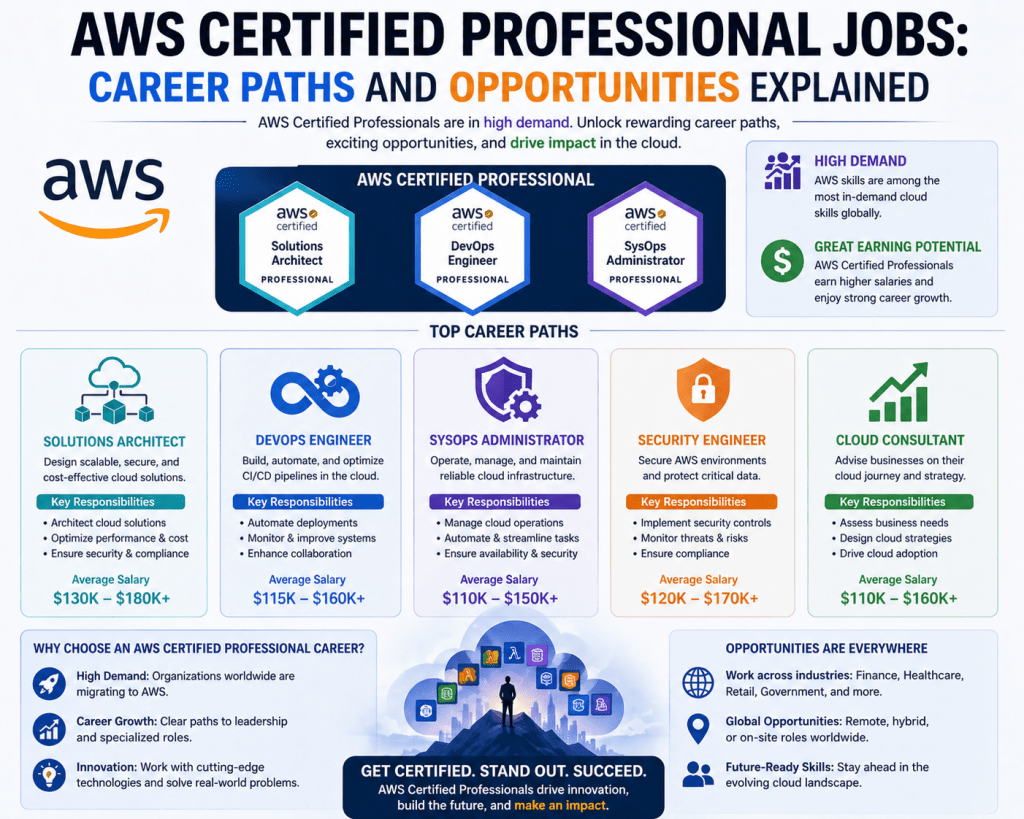
As a result, careers built around AWS technologies have expanded rapidly, creating opportunities across technical, operational, analytical, and managerial domains. These roles are not limited to high-end engineering positions but extend across multiple levels of expertise, making AWS knowledge relevant for beginners as well as experienced professionals. Entry-level roles often focus on support, monitoring, and basic system understanding, while intermediate roles involve development, administration, and operational management. Advanced roles move into architecture, security, data engineering, and system optimization. This layered structure allows professionals to grow gradually while continuously expanding their technical capabilities and industry knowledge.
Transformation of Entry-Level IT Roles in Cloud-Driven Environments
Entry-level IT roles have undergone significant transformation as organizations adopt cloud-based infrastructure. Traditionally, IT support professionals focused on maintaining physical hardware, troubleshooting local network issues, and managing software installations on individual machines. However, with the shift toward cloud computing, these responsibilities have expanded to include managing virtual systems, supporting cloud-hosted applications, and assisting users in navigating distributed environments. IT support specialists are now expected to understand how cloud services function, including identity management systems, virtual storage solutions, and remote access configurations. This evolution reflects the growing reliance on cloud infrastructure for daily business operations. Support professionals often interact with centralized dashboards that monitor system performance, user activity, and service availability across cloud platforms. In addition, they may be responsible for resolving issues related to authentication, permissions, and service connectivity. The ability to understand abstract computing resources, such as virtual machines and scalable storage systems, has become an essential skill in modern IT support environments. This transformation has elevated entry-level roles from purely reactive troubleshooting positions to more proactive and system-aware responsibilities.
Cloud Awareness in Technical Assistance and Operational Support Functions
Technical assistance roles have also evolved significantly in cloud-driven ecosystems. Instead of working solely with local systems or isolated software environments, professionals in these roles now support distributed applications that rely on cloud infrastructure. This includes assisting users with cloud-based login systems, managing access permissions, and troubleshooting issues related to remote applications. Cloud environments require support professionals to develop familiarity with system logs, monitoring tools, and performance dashboards that provide real-time insights into system health. In many cases, technical assistance roles involve collaboration with multiple teams, including developers, system administrators, and security specialists. This ensures that issues are resolved efficiently and that system performance remains stable across different environments. The shift toward cloud-based systems has also introduced the need for understanding service dependencies, where multiple applications rely on interconnected cloud services to function properly. As a result, technical support roles now require a more analytical approach to problem-solving, where understanding system behavior is just as important as resolving immediate user issues. This evolution reflects the broader shift toward distributed computing environments where services are interconnected and dynamically managed.
Cloud Project Coordination and Infrastructure Management Responsibilities
Project coordination roles within IT environments have become increasingly complex due to the adoption of cloud technologies. Coordinators are now involved in managing cloud migration projects, overseeing system deployments, and ensuring alignment between technical teams and business objectives. Unlike traditional project environments where infrastructure remained relatively stable, cloud systems introduce dynamic changes in resource allocation, scalability requirements, and deployment schedules. This requires project coordinators to understand cloud architecture principles and the operational implications of system changes. They must also manage communication between multiple stakeholders, including developers, infrastructure engineers, and business managers. Cloud projects often involve phased implementations, where systems are gradually migrated from on-premise environments to cloud platforms. Coordinators play a key role in ensuring that these transitions occur smoothly without disrupting business operations. Additionally, they are responsible for tracking project timelines, monitoring resource usage, and identifying potential risks associated with cloud adoption. The ability to understand both technical and organizational aspects of cloud systems makes project coordination a critical function in modern IT environments.
Cloud Financial Operations and Cost Management Roles
One of the most significant differences between traditional IT infrastructure and cloud computing is the financial model. Instead of fixed capital expenditures for hardware and infrastructure, cloud systems operate on a usage-based model where costs fluctuate depending on resource consumption. This has created new career opportunities in cloud financial management, where professionals analyze usage patterns and optimize spending across cloud services. Financial analysts working in cloud environments monitor compute usage, storage consumption, and data transfer activities to ensure efficient cost allocation. They evaluate billing reports, identify unnecessary resource utilization, and recommend strategies to reduce operational expenses. Unlike traditional financial analysis, cloud financial management requires continuous monitoring due to the dynamic nature of resource scaling. Professionals in this field must also understand pricing models associated with different cloud services and how architectural decisions impact overall costs. This role bridges the gap between technical infrastructure and financial planning, ensuring that cloud adoption remains economically sustainable. As organizations increasingly rely on cloud services, financial management has become an essential component of IT strategy and operational efficiency.
Customer-Focused Technical Roles in Cloud Service Environments
Customer-facing technical roles play an important part in ensuring that cloud services are effectively utilized by end users and organizations. These professionals act as intermediaries between technical systems and customer requirements, helping users understand cloud functionalities and resolve operational challenges. They are often responsible for onboarding new clients, explaining service features, and providing guidance on system usage. In addition to communication skills, these roles require a solid understanding of cloud architecture, service models, and operational workflows. Customer support professionals may assist with troubleshooting issues related to application access, system configuration, or service performance. They also collaborate with internal technical teams to escalate complex issues and ensure timely resolution. As cloud systems become more complex, the need for professionals who can translate technical concepts into clear and practical guidance continues to grow. These roles are essential in ensuring customer satisfaction and enabling organizations to fully utilize cloud services. The ability to combine technical awareness with communication skills makes this career path highly valuable in cloud-driven industries.
Foundational Cloud Knowledge as a Career Development Catalyst
Foundational knowledge of cloud computing serves as a critical starting point for individuals entering the IT industry. Understanding basic cloud principles such as service models, deployment strategies, and resource abstraction provides a strong base for future career growth. This knowledge allows professionals to interpret how distributed systems operate and how different services interact within a cloud ecosystem. Entry-level exposure also helps individuals develop a systems-oriented mindset, where they can understand the relationship between applications, infrastructure, and user interactions. As cloud technologies continue to evolve, foundational knowledge becomes increasingly important even for roles that are not directly technical. Many organizations now expect employees across different departments to have at least a basic understanding of cloud systems. This reflects the widespread integration of cloud computing into business operations. Foundational cloud knowledge also serves as a gateway to more advanced roles such as system administration, software development, and cloud architecture. By building a strong conceptual base early in their careers, professionals are better positioned to adapt to evolving technologies and take advantage of emerging opportunities within the cloud ecosystem.
Intermediate Cloud Career Development and Expansion of Technical Responsibility
As professionals progress beyond foundational cloud exposure, they enter a stage where technical responsibility increases significantly and day-to-day work becomes more deeply embedded in system design, operations, and optimization. Intermediate cloud careers are defined by practical engagement with real-world cloud environments where systems are actively deployed, maintained, and scaled. At this level, individuals are no longer only supporting or observing cloud systems; they are actively contributing to how these systems function. This includes participating in architectural decisions, managing operational workflows, automating infrastructure processes, and supporting application lifecycle management. The transition from entry-level awareness to intermediate proficiency represents a shift from conceptual understanding to applied technical execution. Professionals begin to work with greater independence while still collaborating with senior engineers and architects. The complexity of tasks increases as cloud environments are inherently dynamic, requiring continuous adaptation to changing workloads, system demands, and organizational requirements. This stage is critical in shaping long-term career direction, as it provides exposure to multiple domains within cloud computing and helps individuals identify areas of specialization.
Cloud Solutions Architecture and System Design in Distributed Environments
Cloud solutions architecture represents one of the most important intermediate to advanced roles in cloud ecosystems. Professionals in this area are responsible for designing scalable, secure, and efficient cloud systems that meet organizational requirements. This involves translating business needs into technical infrastructure using a combination of cloud services, networking configurations, storage solutions, and security controls. Unlike traditional system design, cloud architecture operates in an environment where resources are not fixed but dynamically allocated based on demand. This requires architects to design systems that are flexible, resilient, and capable of handling varying workloads without performance degradation. Architects must also consider cost efficiency, ensuring that system designs do not lead to unnecessary resource consumption. A key aspect of this role is understanding how different cloud services interact within a larger ecosystem. For example, computing services may need to integrate with storage systems, databases, and authentication mechanisms. Architects must ensure that these components function together seamlessly while maintaining performance and reliability. They also collaborate closely with development and operations teams to ensure that architectural designs are practical and implementable within real-world constraints.
Cloud System Administration and Operational Infrastructure Management
System administration in cloud environments involves managing virtualized infrastructure that replaces traditional physical server maintenance. Administrators are responsible for provisioning computing resources, configuring virtual machines, managing storage systems, and ensuring overall system stability. Unlike traditional environments where servers are static, cloud infrastructure is highly dynamic and can scale automatically based on usage patterns. This requires administrators to understand automation tools, resource allocation policies, and monitoring systems that track performance metrics in real time. Cloud system administrators also handle routine operational tasks such as software updates, system patching, backup management, and performance optimization. Monitoring plays a central role in this function, as administrators rely on dashboards and alerting systems to detect anomalies and respond to potential issues before they escalate. Troubleshooting in cloud environments often involves analyzing logs, identifying bottlenecks, and adjusting system configurations to restore optimal performance. This role requires a combination of technical expertise and analytical thinking, as administrators must interpret system behavior and make informed decisions to maintain operational continuity across distributed environments.
Cloud Application Development and Modern Software Engineering Practices
Software development in cloud environments has shifted significantly toward distributed and service-oriented architectures. Developers are no longer building monolithic applications but instead designing modular systems composed of multiple interconnected services. Each service performs a specific function and communicates with others through APIs or messaging systems. This approach improves scalability, flexibility, and maintainability. Cloud developers must understand how to design applications that can operate efficiently in distributed environments where components may be deployed across multiple regions or availability zones. Development workflows often include automated pipelines that handle code integration, testing, and deployment. These pipelines ensure that software changes are delivered consistently and reliably across environments. Cloud development also emphasizes integration with external services such as authentication systems, data storage solutions, and analytics platforms. Developers must consider scalability from the beginning of the design process, ensuring that applications can handle increased workloads without performance degradation. This requires knowledge of performance optimization techniques, resource management strategies, and system architecture principles. The cloud environment encourages continuous iteration, where applications are regularly updated based on performance feedback and evolving requirements.
DevOps Engineering and Automation-Driven System Delivery
DevOps engineering represents a major shift in how software systems are developed, deployed, and maintained within cloud environments. It integrates development and operations into a unified workflow that emphasizes automation, collaboration, and continuous delivery. The primary objective of DevOps is to reduce the time between code development and production deployment while maintaining system reliability and stability. Automation is central to this approach, enabling repetitive tasks such as testing, deployment, and infrastructure provisioning to be executed without manual intervention. DevOps engineers design pipelines that automate the entire software lifecycle, from code integration to production release. These pipelines ensure consistency across environments and reduce the risk of human error. Infrastructure is often managed through code-based configurations, allowing systems to be reproduced and modified programmatically. Continuous monitoring and feedback loops are essential components of DevOps, enabling teams to identify performance issues quickly and implement corrective measures. Collaboration is also a key aspect, as development, operations, and security teams must work closely together to achieve shared objectives. This integrated approach improves efficiency, accelerates innovation, and enhances system reliability in cloud-based environments.
Cloud Operations and System Reliability Engineering
Cloud operations focus on maintaining the stability, performance, and availability of distributed systems. Professionals in this area are responsible for ensuring that applications remain operational under varying conditions and that system disruptions are minimized. This involves continuous monitoring of infrastructure, analyzing performance metrics, and responding to incidents that affect service availability. Cloud operations teams rely heavily on automated monitoring systems that generate alerts when performance thresholds are exceeded. These alerts enable rapid response to potential issues before they impact end users. In addition to reactive incident management, operational engineers also focus on proactive optimization, identifying areas where system performance can be improved. This may include adjusting resource allocation, optimizing load distribution, or fine-tuning system configurations. Reliability engineering is another important aspect of cloud operations, involving the design of systems that can recover quickly from failures. This includes implementing redundancy, failover mechanisms, and disaster recovery strategies. The goal is to ensure consistent service delivery even in the presence of system disruptions or unexpected workload changes.
System Integration and Interoperability Across Cloud Platforms
Modern cloud environments are composed of multiple interconnected systems that must work together seamlessly. System integration professionals are responsible for ensuring that these components communicate effectively and operate as a unified system. This involves configuring APIs, managing data flows, and resolving compatibility issues between different services. Integration engineers often work with middleware systems that facilitate communication between applications and services. Cloud environments introduce additional complexity due to the diversity of services and platforms involved. Professionals must understand how data moves across systems and how dependencies impact overall performance. Integration also involves ensuring that systems remain flexible and adaptable as new services are introduced or existing services are modified. Interoperability is essential in environments where multiple cloud platforms or third-party services are used simultaneously. Engineers must ensure that systems can function across different environments without disruption. This requires careful planning, testing, and continuous monitoring to maintain system consistency and reliability.
Career Progression and Skill Expansion in Intermediate Cloud Roles
Intermediate cloud roles serve as a critical bridge between foundational knowledge and advanced specialization. Professionals at this stage gain hands-on experience with system design, infrastructure management, and application development in distributed environments. This exposure helps them develop a deeper understanding of how cloud systems function at scale and how different components interact within complex architectures. Career progression in this phase often involves taking on more responsibility in decision-making, system optimization, and technical implementation. Individuals begin to contribute to architectural discussions, operational strategies, and development planning. The skills developed during this stage form the foundation for advanced roles in cloud security, machine learning engineering, networking, and enterprise system design. Continuous learning is essential, as cloud technologies evolve rapidly and introduce new tools, frameworks, and service models. Professionals who actively engage with these changes are better positioned to advance into specialized domains and leadership roles within cloud-driven organizations.
Specialized Cloud Career Paths and Advanced Technical Domains
As cloud computing ecosystems continue to mature, career progression naturally leads toward highly specialized domains where professionals focus on deep technical expertise rather than broad operational exposure. These advanced roles exist to solve complex problems related to security, data engineering, networking, artificial intelligence, and enterprise-scale system integration. At this stage, cloud professionals are expected to move beyond general system understanding and develop mastery in a specific domain of infrastructure or application design. Specialized cloud roles are critical because modern cloud environments are no longer simple hosting platforms; they are highly interconnected, globally distributed systems that require precision engineering and continuous optimization. Each specialization represents a deep technical discipline with its own methodologies, tools, and architectural patterns. Professionals in these roles are often responsible for designing mission-critical systems, optimizing large-scale workloads, and ensuring that cloud environments remain secure, efficient, and scalable under unpredictable conditions. This level of expertise is achieved through years of hands-on experience, continuous learning, and exposure to real-world distributed system challenges.
Cloud Security Engineering and Protection of Distributed Infrastructure
Cloud security engineering is one of the most important and high-demand specialized domains in cloud computing. As organizations migrate sensitive data, business applications, and operational systems to cloud environments, the need for robust security frameworks becomes essential. Security engineers are responsible for designing and implementing protective mechanisms that safeguard cloud infrastructure against unauthorized access, cyber threats, and data breaches. This includes managing identity and access control systems, configuring encryption protocols, and monitoring security events across distributed environments. Unlike traditional security models that rely on perimeter-based protection, cloud security operates on a distributed model where security must be enforced at multiple layers simultaneously. This includes application-level security, network-level protection, and data-level encryption strategies. Security engineers also develop incident response plans that allow organizations to react quickly to breaches or anomalies. They continuously analyze system logs, identify vulnerabilities, and apply patches or configuration changes to strengthen system resilience. As cloud environments expand across multiple regions and platforms, security complexity increases, requiring professionals to manage risks across hybrid and multi-cloud architectures. This makes cloud security engineering a highly specialized and continuously evolving field.
Database Engineering and Large-Scale Data Architecture Management
Database engineering in cloud environments focuses on designing, maintaining, and optimizing data storage systems that support large-scale applications. Unlike traditional databases that operate in fixed server environments, cloud-based databases are distributed, scalable, and capable of handling massive volumes of structured and unstructured data. Database engineers are responsible for selecting appropriate database models based on application requirements, ensuring that data storage systems align with performance, scalability, and reliability needs. This includes working with relational databases for structured data and non-relational systems for flexible, high-speed data processing. Engineers also manage replication strategies, indexing mechanisms, and query optimization techniques to ensure efficient data retrieval. In cloud environments, data is often distributed across multiple geographic regions, requiring careful planning to maintain consistency and availability. Database engineers must also ensure that backup systems and disaster recovery mechanisms are in place to prevent data loss. Their work directly impacts application performance, as poorly optimized databases can lead to delays, inefficiencies, and system bottlenecks. As data continues to grow exponentially, database engineering becomes increasingly essential for supporting modern cloud-based applications.
Cloud Data Analytics and Large-Scale Information Processing
Data analytics roles within cloud environments focus on transforming raw data into meaningful insights that support business decision-making and system optimization. Cloud platforms provide the infrastructure needed to process large datasets in real time, enabling organizations to analyze trends, predict outcomes, and improve operational efficiency. Data analysts work with complex data pipelines that collect information from multiple sources, process it through distributed systems, and deliver actionable insights. These pipelines often involve data cleaning, transformation, and aggregation processes that prepare information for analysis. Analysts use cloud-based tools to identify patterns, track performance metrics, and generate predictive models. Their work supports strategic decision-making by providing visibility into customer behavior, system performance, and market trends. In addition to analysis, professionals in this domain may also be responsible for designing data models and ensuring data quality across systems. Cloud-based analytics systems allow organizations to handle vast amounts of data that would be impossible to process using traditional infrastructure. This makes data analytics a core component of modern cloud ecosystems and a critical driver of business intelligence.
Advanced Networking Engineering in Distributed Cloud Systems
Networking in cloud environments is significantly more complex than traditional network infrastructure due to the distributed and dynamic nature of cloud systems. Cloud network engineers are responsible for designing and managing communication pathways between virtual resources, ensuring that data flows efficiently and securely across systems. This includes configuring virtual networks, managing routing protocols, and optimizing traffic distribution to minimize latency. Cloud networks often span multiple regions and availability zones, requiring engineers to design architectures that maintain performance across geographically distributed systems. Load balancing plays a critical role in ensuring that network traffic is evenly distributed, preventing system overloads and improving reliability. Engineers must also manage bandwidth allocation and monitor network performance to identify potential bottlenecks or failures. Security is deeply integrated into cloud networking, as engineers must implement firewalls, encryption protocols, and access control mechanisms to protect data in transit. Advanced networking roles require strong analytical skills and a deep understanding of distributed communication systems, as well as the ability to troubleshoot complex connectivity issues across multi-layered environments.
Machine Learning Engineering and Intelligent Cloud Systems
Machine learning engineering represents one of the most advanced and rapidly expanding domains within cloud computing. Professionals in this field design systems that enable computers to learn from data and make predictions or automated decisions. Machine learning engineers work with large datasets, training algorithms to identify patterns and generate models that can be deployed in real-world applications. Cloud environments provide the computational power required to process large-scale machine learning workloads efficiently, making them essential for artificial intelligence development. Engineers are responsible for building data pipelines that prepare datasets for training, selecting appropriate algorithms, and optimizing model performance. Once models are trained, they are deployed into production environments where they can be used for tasks such as prediction, classification, and automation. Engineers also monitor model performance over time, ensuring that accuracy remains consistent as new data is introduced. In addition, they may retrain models or adjust parameters to improve performance. Machine learning systems often integrate with other cloud services, including storage, analytics, and application platforms. As artificial intelligence continues to expand across industries, machine learning engineering has become a highly specialized and influential career path within cloud ecosystems.
Enterprise Systems Integration and Large-Scale Organizational Infrastructure
Enterprise system integration focuses on connecting large-scale business applications within cloud environments. These systems include enterprise resource planning, customer management platforms, supply chain systems, and financial management tools. Professionals in this domain are responsible for ensuring that these complex systems operate seamlessly within cloud infrastructure. This involves configuring system integrations, managing data synchronization, and ensuring compatibility between different applications. Cloud-based enterprise systems provide flexibility and scalability, allowing organizations to adapt quickly to changing business needs. Integration specialists must ensure that data flows correctly between systems and that performance remains stable under high workloads. They also play a key role in optimizing system configurations to improve efficiency and reduce operational complexity. Enterprise systems often involve multiple layers of integration, including APIs, middleware platforms, and data exchange mechanisms. Professionals must understand how these components interact to maintain system stability. As organizations continue to adopt cloud-based enterprise solutions, system integration becomes a critical function for ensuring operational continuity and business efficiency.
Long-Term Evolution of Specialized Cloud Careers
Specialized cloud careers continue to evolve as technology advances and new computing paradigms emerge. Fields such as automation, artificial intelligence, cybersecurity, and distributed systems engineering are constantly expanding, creating new opportunities for professionals with advanced technical expertise. The future of cloud careers is closely linked to the evolution of digital infrastructure, where systems are becoming increasingly autonomous, intelligent, and interconnected. Professionals in specialized roles must continuously adapt to new tools, frameworks, and architectural models. This requires ongoing learning and practical experience with emerging technologies. Career growth in these domains is not linear but dynamic, with opportunities to move between specializations or expand into leadership and architectural roles. The increasing complexity of cloud systems ensures that demand for specialized expertise will continue to grow. Professionals who develop deep domain knowledge and maintain adaptability will remain highly valuable in shaping the future of cloud computing ecosystems across global industries.
Conclusion
Cloud computing has become one of the most important pillars of modern digital infrastructure, reshaping how organizations build, deploy, and manage technology systems. Instead of relying on traditional physical servers and localized environments, businesses now operate through distributed cloud platforms that offer scalability, flexibility, and global reach. Among these platforms, AWS has established itself as a leading ecosystem due to its wide range of services and ability to support everything from basic applications to highly complex enterprise workloads. As organizations continue to shift toward cloud-first strategies, careers built around AWS and cloud technologies have become central to the IT industry. This shift is not temporary or trend-based; it represents a long-term structural change in how technology systems are designed and operated.
One of the most significant outcomes of this transformation is the creation of a clear and structured career progression path. Professionals typically begin with foundational knowledge, where they learn basic cloud concepts, service models, and infrastructure principles. At this stage, the focus is on understanding how cloud systems function and how different services interact within a distributed environment. As individuals gain experience, they move into intermediate roles where they actively participate in system administration, application support, development workflows, and operational management. These roles provide hands-on exposure to real cloud environments, allowing professionals to understand system behavior under real-world conditions. Over time, they transition into more specialized roles that require deep technical expertise in areas such as security, networking, database engineering, machine learning, and enterprise integration. This layered progression ensures that professionals develop both breadth and depth in their skill sets, making them adaptable to a wide range of technical challenges.
Cloud careers are also characterized by a high level of role diversity and interconnection between different responsibilities. Unlike traditional IT structures where roles were often isolated, cloud environments require continuous collaboration between multiple disciplines. Architects design infrastructure systems, developers build applications that run on those systems, operations teams ensure stability and performance, security professionals protect data and access, and analysts interpret system behavior to guide decision-making. Each role is dependent on the others, creating an ecosystem where technical and operational functions are tightly integrated. This interconnected nature requires professionals to develop not only domain-specific expertise but also a broader understanding of how cloud systems operate as a whole. As cloud environments become more complex, this cross-functional awareness becomes increasingly important.
The widespread adoption of cloud computing across industries has further strengthened the demand for cloud professionals. Organizations in sectors such as finance, healthcare, retail, logistics, education, and government now rely heavily on cloud infrastructure to operate efficiently. Cloud systems support everything from data storage and application hosting to advanced analytics and artificial intelligence workloads. This universal adoption means that cloud careers are not limited to a single industry or niche but are relevant across the entire global economy. As digital transformation continues to accelerate, the dependency on cloud platforms will only increase, ensuring long-term stability and growth for professionals in this field. The scalability and flexibility of cloud systems make them essential for modern business operations, reinforcing the importance of skilled individuals who can design, manage, and optimize these environments.
Another defining aspect of cloud careers is the necessity for continuous learning and adaptation. Cloud technologies evolve rapidly, with new services, tools, and architectural patterns emerging regularly. This constant change means that professionals must continuously update their knowledge and skills to remain effective. Learning in this field is not limited to formal education; it also involves hands-on experimentation, real-world problem solving, and ongoing exposure to evolving system architectures. Professionals must stay familiar with updates in automation, security practices, deployment models, and performance optimization techniques. This continuous learning requirement ensures that cloud careers remain dynamic and intellectually engaging, while also demanding long-term commitment and adaptability from those working in the field.
Cloud professionals also play a critical role in driving digital transformation across organizations. Their work directly influences how systems are designed, how applications are delivered, and how data is managed at scale. They enable organizations to adopt modern technologies such as real-time analytics, machine learning systems, and globally distributed applications. Without cloud expertise, many of these innovations would not be possible at scale. Cloud professionals not only implement technical solutions but also shape strategic decisions related to infrastructure, cost efficiency, security, and scalability. Their contributions extend beyond technical execution and into the broader direction of organizational growth and innovation. As businesses continue to modernize, the strategic importance of cloud expertise becomes even more pronounced.
The future of cloud careers is closely tied to the ongoing evolution of technology itself. Emerging trends such as edge computing, artificial intelligence integration, automation, and distributed system optimization are continuously reshaping the cloud landscape. These advancements are creating new specializations while also redefining existing roles. Professionals who remain adaptable and committed to continuous development will be well positioned to take advantage of these changes. Cloud careers are not static roles but evolving pathways that grow alongside technological progress. This ensures long-term relevance and opportunity for individuals who invest in building strong foundational and specialized skills.
Ultimately, cloud computing represents a long-term shift in how technology is built and managed, and careers within this space reflect that transformation. From entry-level support roles to highly specialized engineering domains, the cloud ecosystem offers structured pathways for growth, diversification, and advancement. The demand for skilled professionals continues to rise as organizations deepen their reliance on cloud infrastructure. This makes cloud careers not only technically rewarding but also strategically important in the broader context of global digital transformation.