
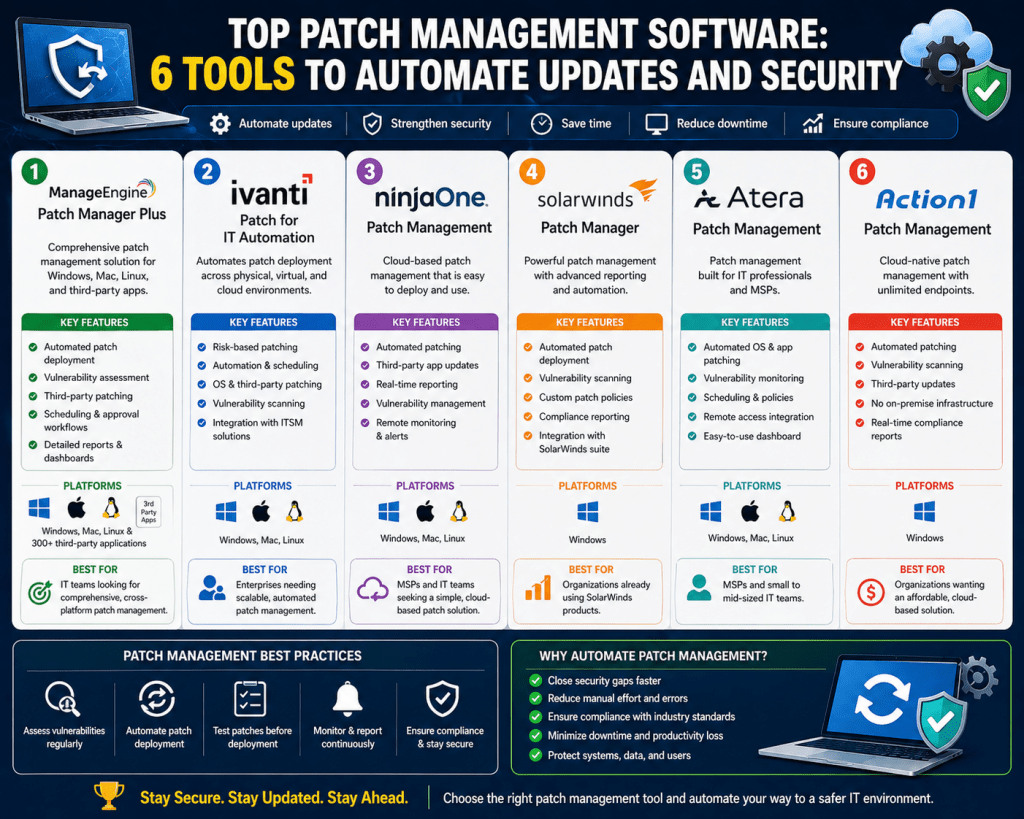
Patch management is a structured and continuous process used to maintain operating systems, applications, and supporting software by applying updates that fix vulnerabilities, improve performance, and correct system defects. In modern IT infrastructures, it has evolved into a complex lifecycle activity spanning endpoints, servers, virtual machines, cloud systems, and hybrid environments. Each layer of infrastructure may require different types of patches delivered at different times, making coordination essential. Updates include security patches, bug fixes, feature enhancements, and cumulative releases. As environments scale, dependencies between systems increase, meaning a patch in one component can affect others. This makes patch management a controlled, policy-driven process rather than an occasional maintenance task.
Importance of Patch Management for Security and Stability
Patch management is essential for reducing security risks and maintaining system reliability. Software vulnerabilities are regularly discovered and publicly documented, creating opportunities for attackers to exploit unpatched systems. Automated scanning tools often target known vulnerabilities, making outdated systems easy entry points into networks. Timely patching closes these security gaps and reduces exposure to cyber threats. Beyond security, patches also improve system stability by fixing crashes, memory leaks, performance issues, and compatibility problems. In enterprise environments, patch management is also tied to compliance requirements. Many regulatory frameworks require organizations to demonstrate that systems are updated and vulnerabilities are actively managed, making patching both a technical and governance necessity.
Challenges of Manual Patch Management
Manual patch management becomes unreliable and inefficient as infrastructure grows. One major issue is inconsistency, where some systems are updated while others are missed, creating security gaps. Another problem is lack of visibility, as administrators may not have a centralized view of patch status across all systems. Human error is also a significant risk, including missed updates, incorrect installations, or misconfigurations during patching. Manual processes require significant time and operational effort, reducing focus on strategic IT tasks. In distributed environments, coordination becomes even more difficult due to remote systems and network limitations. Over time, manual patching can also cause configuration drift, where systems become inconsistent due to uneven update application.
Role of Automated Patch Management Systems
Automated patch management systems address the limitations of manual processes by centralizing control and automating update deployment. These systems continuously scan environments to detect missing patches and apply them based on predefined policies. Automation ensures consistency across all systems and reduces human error. Policy-based controls allow organizations to define how patches are prioritized, scheduled, and deployed. Staged rollout mechanisms enable patches to be tested on a small group of systems before wider deployment, reducing operational risk. Many systems also include rollback capabilities to restore previous configurations if issues occur. Integration with vulnerability databases ensures patch data remains current, improving response to emerging threats. Reporting features provide real-time visibility into compliance status and system health.
Key Considerations When Selecting Patch Management Solutions
Selecting a patch management solution requires evaluating multiple technical and operational factors. Platform compatibility is essential, as environments often include multiple operating systems that must all be supported. Application coverage is important because many vulnerabilities exist in third-party software rather than operating systems alone. Scalability must be considered to ensure the system can handle growth without performance issues. Network efficiency is also critical in environments where large patch downloads can strain bandwidth. Security features such as encryption, role-based access control, and secure communication channels are necessary for protecting the patching process itself. Integration with existing IT systems improves efficiency, while reporting capabilities support compliance and audit requirements.
Deployment Models for Patch Management Systems
Patch management systems can be deployed using different models depending on organizational needs. On-premises deployment provides full control over infrastructure and data, making it suitable for environments with strict security requirements. Cloud-based deployment reduces infrastructure overhead and enables remote management, making it ideal for distributed organizations. Hybrid models combine both approaches, allowing sensitive operations to remain internal while leveraging cloud scalability. In hybrid setups, management functions may be cloud-hosted while patch distribution is handled locally to optimize performance and reduce bandwidth usage. The choice of deployment model depends on security policies, operational scale, and infrastructure complexity.
Foundations of an Effective Patch Management Strategy
An effective patch management strategy begins with clear policies defining how patches are evaluated, prioritized, and deployed. Testing is a critical step where patches are validated in controlled environments before production rollout. Environment segmentation helps reduce risk by separating systems into development, testing, and production groups, allowing staged deployment. Scheduling ensures patches are applied during appropriate maintenance windows to minimize disruption. Monitoring and validation confirm successful deployment and system compliance after updates. Exception handling manages systems that cannot be patched immediately due to operational constraints. Continuous refinement ensures the strategy evolves alongside infrastructure changes and emerging risks.
Overview of Patch Management System Categories
Patch management solutions vary based on scope and functionality. Some focus primarily on operating system patching, while others extend coverage to third-party applications. Integrated endpoint management systems combine patching with asset tracking, configuration management, and security monitoring. Enterprise-level solutions provide advanced automation, scalability, and detailed reporting for complex environments. Simpler tools are designed for smaller infrastructures where ease of use is prioritized. Some systems also include vulnerability assessment features to prioritize patching based on risk levels. As IT environments evolve toward distributed and cloud-native architectures, modern patch management systems increasingly emphasize automation, cross-platform support, and centralized control.
Overview of Enterprise Patch Management Tool Ecosystems
Enterprise patch management tools are designed to operate in complex, distributed, and high-scale IT environments where thousands of endpoints, servers, and applications must be continuously maintained. Unlike basic update mechanisms, these tools function as centralized control systems that coordinate patch discovery, validation, deployment, and reporting across heterogeneous infrastructures. Modern enterprises rarely rely on a single operating system or application stack, which means patch management solutions must support cross-platform environments including Windows, Linux distributions, and macOS systems, along with a growing range of containerized and cloud-native workloads. In addition, enterprise tools must handle both operating system patches and third-party application updates, as vulnerabilities are not limited to core system software. A key characteristic of these ecosystems is automation, where policies define how patches are evaluated and deployed without requiring constant manual intervention. These systems typically integrate with configuration management databases, vulnerability scanners, and security information systems to create a unified operational view. This integration ensures that patching decisions are informed by real-time risk data rather than isolated update schedules. Enterprise tools also emphasize scalability, allowing organizations to manage global infrastructures without performance degradation. This is achieved through distributed architectures, caching mechanisms, and regional deployment nodes that reduce latency and bandwidth consumption. As organizations adopt hybrid and multi-cloud strategies, patch management ecosystems are evolving to support dynamic environments where workloads shift frequently between on-premises and cloud platforms.
Architecture of Modern Patch Management Systems
The architecture of modern patch management systems is typically built around a centralized management console supported by distributed agents installed on endpoints. The management console acts as the brain of the system, responsible for policy definition, patch evaluation, scheduling, and reporting. It communicates with endpoint agents that execute patch-related tasks locally on devices. These agents regularly report system status, installed software inventory, and missing patches back to the central system. This agent-based architecture ensures that patch management operations can continue even when endpoints are temporarily disconnected from the network. In addition to agents, many systems use relay servers or distribution points that cache patches locally within network segments. This reduces external bandwidth usage and accelerates deployment in large environments. The architecture also includes a patch repository layer, which stores metadata and binaries for available updates. This repository is continuously synchronized with vendor sources or curated update feeds. Another important component is the policy engine, which determines how patches are prioritized and deployed based on organizational rules. Policies may consider factors such as severity level, system criticality, maintenance windows, and compliance requirements. Logging and analytics modules collect detailed information about patching activity, enabling administrators to track success rates, identify failures, and generate compliance reports. This modular architecture ensures flexibility, allowing organizations to scale or customize components based on operational needs.
Patch Discovery and Vulnerability Mapping Processes
Patch discovery is a foundational process in patch management that involves identifying missing updates across all managed systems. This is typically achieved through periodic scans performed by endpoint agents or centralized scanners. These scans analyze installed software versions and compare them against known patch databases. The result is a detailed inventory of missing updates categorized by severity, type, and applicability. Vulnerability mapping enhances this process by correlating missing patches with known security vulnerabilities. Each vulnerability is often assigned a severity rating that helps prioritize remediation efforts. This mapping process enables organizations to focus on high-risk vulnerabilities that could be actively exploited. In advanced systems, vulnerability intelligence is continuously updated through integration with external threat intelligence feeds. This ensures that newly discovered vulnerabilities are quickly identified and mapped to affected systems. Patch discovery also includes dependency analysis, where the system evaluates whether installing a patch may affect other software components. This is particularly important in enterprise environments where applications are interconnected. The discovery process is not static but continuous, ensuring that changes in software inventory or new vulnerability disclosures are promptly reflected in the system. Accurate discovery is essential for maintaining a reliable patching strategy, as incomplete or outdated data can lead to missed vulnerabilities or unnecessary updates.
Patch Testing and Validation Methodologies
Patch testing is a critical phase in the patch management lifecycle that ensures updates do not negatively impact system stability or application functionality. In enterprise environments, patches are rarely deployed directly to production systems without prior validation. Instead, they are first applied in controlled test environments that mirror production configurations as closely as possible. These environments allow administrators to observe how patches interact with existing software, dependencies, and system configurations. Testing typically includes functional validation, performance evaluation, and compatibility checks. Functional testing ensures that applications continue to operate as expected after patch installation. Performance testing evaluates whether the patch introduces latency, resource consumption changes, or system slowdowns. Compatibility testing focuses on ensuring that dependencies between software components remain intact. Some organizations also use automated testing frameworks that simulate user behavior or workload patterns to detect anomalies introduced by patches. In more advanced setups, machine learning models may be used to predict patch impact based on historical deployment data. Once testing is complete, patches are categorized based on risk level and deployment readiness. Only patches that pass validation criteria are approved for broader rollout. This structured approach significantly reduces the likelihood of system outages caused by faulty updates.
Patch Deployment Strategies in Large-Scale Environments
Patch deployment in large-scale environments requires carefully planned strategies to minimize disruption and ensure reliability. One common approach is phased deployment, where patches are gradually rolled out to different segments of the infrastructure. This allows administrators to monitor system behavior at each stage and detect potential issues early. Another widely used strategy is ring-based deployment, where systems are grouped into concentric layers such as pilot, early adopters, and production systems. Patches are first deployed to the pilot ring, which typically includes non-critical systems. If no issues are detected, the deployment expands to subsequent rings. Maintenance windows also play a critical role in deployment strategies, ensuring that patches are applied during periods of low system usage. In some environments, real-time or near-real-time patching is used for critical security updates that require immediate remediation. Automation is heavily relied upon during deployment to ensure consistency and reduce manual effort. However, human oversight remains important for handling exceptions or unexpected behavior. Deployment strategies also include rollback planning, which ensures that systems can be restored to previous states if a patch causes instability. This is particularly important in mission-critical environments where downtime has significant operational or financial impact.
Role of Automation and Policy Enforcement in Patch Management
Automation is a core component of modern patch management systems, enabling organizations to manage large and complex infrastructures efficiently. Automated systems reduce the need for manual intervention by executing predefined policies that govern patch evaluation, approval, and deployment. Policy enforcement ensures that these rules are consistently applied across all systems. Policies may define criteria such as patch severity thresholds, deployment schedules, and approval workflows. For example, critical security patches may be automatically approved for immediate deployment, while non-critical updates may require manual review. Automation also supports scheduling, allowing patches to be deployed during predefined maintenance windows without administrator intervention. Another important aspect of automation is self-healing capability, where systems automatically retry failed patch installations or trigger corrective actions. Policy enforcement extends to compliance requirements, ensuring that systems adhere to organizational or regulatory standards. This includes generating automated reports that document patch status and compliance levels. Automation also improves scalability, enabling organizations to manage thousands of endpoints without proportional increases in administrative workload. However, effective automation requires careful configuration to avoid unintended consequences such as premature deployment or conflicting updates.
Patch Management in Hybrid and Cloud-Integrated Environments
The shift toward hybrid and cloud-based infrastructures has significantly changed the way patch management is implemented. In hybrid environments, workloads are distributed across on-premises data centers and cloud platforms, requiring unified patch management strategies. Cloud-integrated patch management systems are designed to operate across these environments seamlessly, providing centralized visibility and control. One of the key challenges in hybrid environments is maintaining consistency between cloud and on-premises systems, especially when workloads move dynamically between platforms. Patch management tools must therefore support portable policies that can be applied regardless of system location. Cloud environments also introduce unique considerations such as ephemeral instances, where systems are created and destroyed frequently. In such cases, patching must be integrated into image management processes to ensure that new instances are deployed with up-to-date configurations. Network connectivity and bandwidth optimization are also important factors, particularly when large volumes of patch data are transferred across distributed environments. Cloud-based patch management solutions often leverage scalable infrastructure to handle fluctuating workloads efficiently. Additionally, integration with cloud-native services allows for automated patching of virtual machines, containers, and managed services.
Security Implications of Patch Management Failures
Failures in patch management can have severe security implications, often leading to system compromise or data breaches. Unpatched vulnerabilities are one of the most common attack vectors used by cybercriminals. When patches are delayed or missed, systems remain exposed to known exploits that can be easily automated. In many cases, attackers specifically target organizations that have not applied recently released security updates. Patch management failures can also lead to lateral movement within networks, where compromised systems are used to access other connected resources. This can escalate the impact of a single vulnerability into a full-scale security incident. Another risk associated with patching failures is privilege escalation, where attackers exploit unpatched flaws to gain higher system privileges. In addition to external threats, internal system instability caused by incomplete or incorrect patching can also create security gaps. Organizations that lack proper patch visibility may be unaware of exposed systems, increasing the risk of prolonged compromise. Effective patch management is therefore a critical component of any cybersecurity strategy, acting as a primary defense mechanism against known threats.
Operational Efficiency and Optimization in Patch Management Systems
Operational efficiency is a key objective in modern patch management systems, as organizations aim to minimize resource usage while maximizing update effectiveness. Optimization techniques include differential patching, where only changed components are downloaded instead of entire update packages. This reduces bandwidth consumption and accelerates deployment. Caching mechanisms also improve efficiency by storing patches locally within network segments, reducing repeated downloads from external sources. Scheduling optimization ensures that patch deployment occurs during low-usage periods, minimizing impact on system performance. Load balancing techniques distribute patching workloads across multiple servers or agents to prevent bottlenecks. Some systems also use predictive analytics to anticipate patching requirements based on historical data and system behavior. Automation contributes significantly to operational efficiency by reducing manual intervention and streamlining repetitive tasks. Reporting and analytics further enhance efficiency by providing insights into patch success rates, failure patterns, and system performance trends. These insights allow administrators to refine patching strategies and improve overall system reliability.
Advanced Patch Management Tool Features in Enterprise Environments
Modern patch management tools have evolved into highly sophisticated platforms that go far beyond simple update deployment. In enterprise environments, these systems incorporate advanced capabilities such as real-time vulnerability correlation, predictive risk analysis, and automated remediation workflows. One of the most significant advancements is contextual patch prioritization, where patches are not treated equally but ranked based on exploitability, system exposure, and business criticality. This ensures that high-risk vulnerabilities affecting critical infrastructure are addressed before lower-priority updates. Another advanced feature is dependency-aware patching, which analyzes relationships between software components to prevent conflicts during updates. This is particularly important in environments with complex application stacks where a single update can impact multiple services. Many tools also include behavioral analysis modules that monitor system performance after patch deployment to detect anomalies early. If unusual behavior is detected, the system can automatically trigger rollback procedures or alert administrators. Integration with security orchestration platforms is another key advancement, allowing patching to become part of a broader automated incident response workflow. In these setups, vulnerability detection, patch deployment, and threat mitigation are interconnected processes rather than isolated tasks. This level of automation significantly reduces response time and improves overall security posture.
Patch Compliance, Auditing, and Regulatory Alignment
Patch compliance is a critical requirement in modern IT governance, especially in industries subject to strict regulatory oversight. Compliance frameworks often require organizations to demonstrate that systems are consistently updated and that vulnerabilities are remediated within defined timeframes. Patch management tools play a central role in meeting these requirements by providing structured auditing and reporting capabilities. These systems generate detailed compliance reports that show patch status across all managed devices, including missing updates, successful deployments, and failed installations. Auditing features track every patch-related action, creating a comprehensive history of system changes. This audit trail is essential for regulatory inspections and internal governance reviews. Many tools also support policy-based compliance enforcement, where systems that fall out of compliance are automatically flagged or isolated. In some environments, non-compliant systems may be restricted from accessing sensitive resources until updates are applied. Alignment with regulatory standards is often achieved through predefined compliance templates that map patching activities to specific requirements. These templates simplify reporting and ensure consistency across different regulatory frameworks. Continuous compliance monitoring is another important capability, enabling organizations to maintain real-time visibility into their security posture rather than relying on periodic assessments.
Risk-Based Patch Prioritization Models
Risk-based prioritization is a fundamental concept in advanced patch management systems. Instead of treating all patches equally, these models assess the potential impact and likelihood of exploitation to determine priority levels. This approach is based on the understanding that not all vulnerabilities pose the same level of risk. Some may be theoretical or low-impact, while others may be actively exploited in the wild. Risk scoring systems typically combine multiple factors, including vulnerability severity ratings, exploit availability, system exposure, and asset criticality. For example, a vulnerability affecting an internet-facing production server would be prioritized higher than one affecting an isolated development system. Some systems also incorporate real-time threat intelligence to identify actively exploited vulnerabilities, allowing organizations to respond more quickly to emerging threats. Machine learning techniques are increasingly being used to refine risk scoring models based on historical patching outcomes and incident data. This enables more accurate prioritization over time. Risk-based models also support business alignment by incorporating operational importance into patching decisions, ensuring that critical business services receive appropriate protection. This approach helps organizations allocate resources more effectively and reduce overall security exposure.
Patch Management in Virtualized and Containerized Environments
Virtualization and containerization have introduced new complexities into patch management processes. In virtualized environments, multiple virtual machines run on shared physical infrastructure, each requiring independent patching. However, these systems are often dynamic, with virtual machines being created, modified, or decommissioned frequently. This requires patch management tools to maintain real-time visibility into virtual assets and ensure that new instances are automatically brought up to compliance standards. Hypervisor-level patching is also necessary to maintain the security of virtualization layers themselves. In containerized environments, patching is handled differently due to the ephemeral nature of containers. Instead of patching running containers, organizations typically update container images and redeploy them. This shifts patch management into the build pipeline, where updated images are created with the latest security fixes. Container orchestration platforms further complicate patching by dynamically scaling workloads across clusters. Patch management tools must therefore integrate with orchestration systems to ensure consistent updates across all nodes. Immutable infrastructure practices are often used in these environments, where systems are not patched in place but replaced entirely with updated versions. This approach reduces configuration drift and improves consistency across deployments.
Integration of Patch Management with Security Operations
Patch management is increasingly integrated with broader security operations frameworks to create unified defense mechanisms. In modern security architectures, patching is not treated as a standalone function but as part of an integrated security lifecycle. Security operations centers often rely on real-time data from patch management systems to identify vulnerable assets and prioritize incident response activities. Integration with threat detection systems allows organizations to correlate active attacks with missing patches, enabling faster remediation. For example, if a vulnerability is being actively exploited, the system can automatically escalate patching priority or trigger emergency deployment workflows. Security orchestration platforms further enhance this integration by automating responses across multiple systems. In such environments, detection of a vulnerability can automatically initiate patch deployment, isolate affected systems, or trigger forensic analysis. This level of integration significantly reduces response times and improves overall resilience. Patch management data is also used in security analytics to identify trends, such as frequently targeted systems or recurring vulnerability types. This information helps organizations strengthen their security posture over time and allocate resources more effectively.
Performance Optimization in Large-Scale Patch Deployment
Large-scale patch deployment requires careful optimization to ensure that system performance and network stability are not negatively impacted. One of the primary optimization techniques is staggered deployment, where patches are rolled out gradually across different segments of the infrastructure. This prevents network congestion and reduces the risk of widespread failure. Bandwidth optimization techniques such as delta updates are also commonly used, where only modified components of a patch are downloaded instead of full packages. This significantly reduces data transfer requirements. Peer-to-peer distribution models allow systems within the same network segment to share patch files, further reducing external bandwidth usage. Load balancing is another important technique, distributing patching workloads across multiple servers or agents to avoid performance bottlenecks. Scheduling optimization ensures that patch deployment occurs during off-peak hours when system usage is minimal. Some advanced systems also use predictive analytics to determine optimal deployment windows based on historical usage patterns. Performance monitoring during patch deployment helps identify potential issues in real time, allowing administrators to intervene before system performance is impacted. These optimization strategies are essential for maintaining operational stability in large enterprise environments.
Automation Challenges and Control Mechanisms in Patch Systems
While automation is a key advantage of modern patch management systems, it also introduces certain challenges that must be carefully managed. One of the primary concerns is over-automation, where patches are deployed too aggressively without sufficient testing or validation. This can lead to system instability or compatibility issues. To address this, control mechanisms such as approval workflows and policy-based restrictions are implemented. These mechanisms ensure that critical patches undergo validation before deployment. Another challenge is false positives in vulnerability detection, where systems incorrectly identify missing patches or misclassify risk levels. This can lead to unnecessary updates or misprioritization. Human oversight remains an important component in automated systems, particularly for high-impact environments. Exception handling mechanisms allow administrators to exclude specific systems from automated patching when necessary, such as in cases involving legacy applications or critical workloads. Audit logging and transparency features help maintain visibility into automated actions, ensuring that all changes are traceable. Balancing automation with control is essential to achieving both efficiency and reliability in patch management systems.
Evolution of Patch Management in Cloud-Native Infrastructure
Cloud-native infrastructure has fundamentally changed the way patch management is implemented. In traditional environments, systems are relatively static, but cloud-native architectures are highly dynamic and distributed. Services are often deployed as microservices, each running independently and scaling based on demand. This requires patch management systems to operate at a service level rather than a system level. In many cases, infrastructure is treated as ephemeral, meaning systems are created and destroyed frequently. As a result, patching must be integrated into automated deployment pipelines rather than applied manually after deployment. Infrastructure-as-code practices ensure that systems are built with consistent configurations, including updated software versions. Cloud providers also offer native patching capabilities for managed services, reducing administrative overhead. However, organizations must still manage patching for custom applications and workloads running within cloud environments. Multi-cloud strategies further increase complexity, as different platforms may have different patching mechanisms and schedules. To address this, unified management platforms are used to provide centralized visibility and control across multiple cloud environments.
Strategic Importance of Patch Management in Long-Term IT Governance
Patch management plays a strategic role in long-term IT governance by ensuring that systems remain secure, stable, and compliant over time. It is not merely a technical function but a core component of organizational risk management. Effective patch management reduces exposure to cyber threats, improves system reliability, and supports regulatory compliance. Over time, organizations that implement structured patching strategies experience fewer security incidents and lower operational downtime. Patch management also contributes to asset lifecycle management by ensuring that systems remain up to date throughout their operational lifespan. In strategic planning, patching is often aligned with broader IT governance frameworks that define risk tolerance, compliance objectives, and operational priorities. Continuous improvement processes ensure that patch management strategies evolve alongside technological changes and emerging threats. As IT environments become more complex and distributed, the importance of structured patch management continues to increase, making it a foundational element of modern enterprise infrastructure governance.
Conclusion
Patch management has evolved from a basic system maintenance task into a foundational discipline within modern IT governance, cybersecurity, and infrastructure reliability. In earlier computing environments, updating systems was a relatively straightforward activity performed manually on a limited number of machines. However, the scale, complexity, and interconnectivity of today’s digital ecosystems have fundamentally changed this landscape. Organizations now operate across hybrid infrastructures that include on-premises servers, cloud platforms, virtual machines, containerized applications, and globally distributed endpoints. Each of these layers introduces its own update requirements, dependencies, and operational constraints, making patch management a continuous and highly coordinated process rather than an occasional administrative activity.
At its core, patch management exists to reduce risk. The majority of successful cyberattacks exploit known vulnerabilities that already have available fixes. This creates a critical urgency in ensuring that updates are applied consistently and without delay. The challenge, however, is not simply the availability of patches but the ability to deploy them efficiently across diverse environments without disrupting business operations. This is where structured patch management frameworks and automation-driven tools play a central role. They provide visibility, control, and consistency in environments where manual processes would be too slow, error-prone, and operationally unsustainable.
Beyond security, patch management is deeply tied to system stability and performance optimization. Software systems are constantly evolving, and updates frequently include improvements that enhance efficiency, resolve bugs, and strengthen compatibility with other components. Without regular patching, systems gradually degrade in performance and become increasingly unstable. Over time, this can lead to unexpected downtime, service disruptions, and reduced productivity. In enterprise environments where availability and reliability are critical, such risks can translate into significant financial and operational consequences.
Another important dimension of patch management is regulatory compliance. Many industries operate under strict governance frameworks that require organizations to maintain up-to-date systems and demonstrate effective vulnerability management practices. Compliance is no longer a periodic audit activity but a continuous requirement. Organizations must be able to provide evidence that systems are patched within defined timelines, vulnerabilities are tracked, and remediation processes are consistently enforced. This has elevated patch management into a governance function that directly supports audit readiness and regulatory alignment. Without structured patching processes and reporting capabilities, meeting these obligations becomes extremely difficult.
The shift from manual to automated patch management has been one of the most significant transformations in IT operations. Manual patching, while still present in small-scale environments, does not scale effectively in modern infrastructures. It introduces inconsistencies, increases the likelihood of human error, and lacks the visibility required for enterprise-level governance. Automated systems address these limitations by centralizing control and enabling policy-driven execution. Through automation, organizations can define rules for patch prioritization, deployment scheduling, testing, and rollback procedures. This ensures that updates are applied consistently and in alignment with operational requirements.
However, automation alone is not sufficient without proper strategy and oversight. Effective patch management requires a balanced approach that combines automation with governance controls. Testing environments, staged rollouts, and risk-based prioritization are essential components of this balance. Patches must be validated before deployment to production systems to prevent unintended disruptions. Similarly, high-risk vulnerabilities must be prioritized over routine updates to ensure that security exposure is minimized. This structured approach ensures that efficiency does not come at the cost of stability or reliability.
The complexity of modern infrastructures further reinforces the importance of intelligent patch management strategies. In hybrid and multi-cloud environments, workloads are dynamic and often distributed across multiple platforms. Systems may scale up or down automatically, and instances may be short-lived. This requires patch management systems to operate with a high degree of adaptability. Traditional static patching approaches are no longer sufficient. Instead, organizations must integrate patching into continuous deployment pipelines, infrastructure-as-code workflows, and automated configuration systems. This ensures that systems remain compliant and secure regardless of where or how they are deployed.
Another critical aspect is the integration of patch management with broader cybersecurity operations. Patch management is no longer an isolated function but part of a larger security ecosystem that includes threat detection, incident response, vulnerability management, and security analytics. When integrated effectively, patching becomes a proactive defense mechanism rather than a reactive maintenance task. Security systems can correlate active threats with missing patches, enabling faster remediation and reducing exposure time. This integration significantly enhances an organization’s overall security posture and resilience against cyber threats.
Despite technological advancements, patch management still presents operational challenges. These include dependency conflicts, system compatibility issues, bandwidth limitations, and the risk of unintended disruptions during deployment. Addressing these challenges requires a combination of technical capabilities and operational discipline. Techniques such as staged deployment, delta updates, peer-to-peer distribution, and rollback mechanisms help mitigate risks and improve efficiency. At the same time, strong governance ensures that patching decisions align with business priorities and risk tolerance levels.
Looking at the broader IT landscape, patch management will continue to increase in importance as digital infrastructure becomes more complex and interconnected. The growth of edge computing, IoT devices, and distributed cloud services will further expand the number of systems requiring regular updates. At the same time, cyber threats are becoming more sophisticated, with attackers increasingly targeting unpatched vulnerabilities as entry points. This creates an ongoing tension between operational complexity and security urgency. Organizations that fail to maintain effective patch management practices will face higher exposure to risk, increased downtime, and greater compliance challenges.
In contrast, organizations that invest in mature patch management strategies gain significant advantages. These include improved security posture, reduced operational risk, enhanced system reliability, and stronger compliance alignment. Over time, effective patch management also contributes to cost efficiency by reducing the need for emergency remediation, minimizing downtime, and optimizing IT resource utilization. It also supports long-term scalability by ensuring that infrastructure remains stable and maintainable as it grows.
Ultimately, patch management should be viewed not as a routine technical task but as a strategic capability embedded within the broader IT and security architecture of an organization. It connects operational maintenance with cybersecurity defense, regulatory compliance, and system performance optimization. As technology continues to evolve, the organizations that prioritize structured, automated, and intelligence-driven patch management will be better positioned to maintain resilience, adaptability, and security in an increasingly complex digital world.