
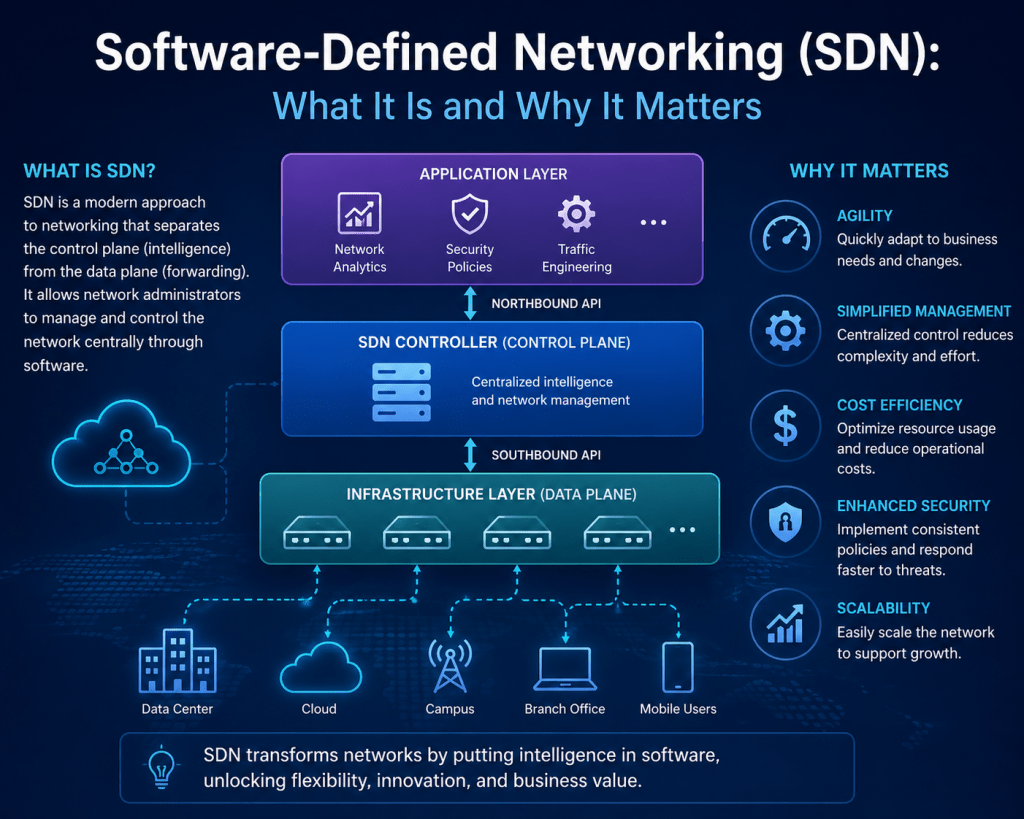
Software-Defined Networking (SDN) is a modern network architecture approach designed to simplify how networks are controlled, managed, and optimized. In traditional networking systems, each device such as routers, switches, and firewalls operates with its own embedded control logic, requiring manual configuration and device-by-device management. SDN changes this model by separating the control logic from the physical infrastructure, allowing centralized software to define and manage network behavior.
In SDN, the intelligence of the network is moved into a centralized controller, while the physical devices focus only on forwarding data. This separation enables network administrators to manage large-scale networks more efficiently, with improved automation, flexibility, and responsiveness to changing demands.
At its core, SDN is built on the principle of programmability. Instead of configuring each network device individually, administrators define policies and behavior through software, and the SDN system translates those instructions into device-level actions automatically.
Core Principle Behind SDN: Separation of Control and Data
The most important concept in SDN is the separation of the control plane and the data plane. These two components define how a network makes decisions and how it forwards traffic.
The control plane is responsible for deciding where traffic should go. It handles routing decisions, policy enforcement, and overall network intelligence. The data plane, on the other hand, is responsible for moving packets from one point to another based on instructions received from the control plane.
In traditional networking, both planes exist within each device. This creates complexity, especially when scaling or updating network configurations. SDN removes this limitation by centralizing the control plane in a software-based system while leaving the data plane in the physical hardware. This structure significantly reduces operational complexity and increases control over the entire network environment.
Evolution from Traditional Networking to SDN
Traditional networking relies heavily on manual configuration. Network administrators must individually configure every device, define routing paths, set up security policies, and maintain consistency across the entire infrastructure. This approach becomes increasingly difficult as networks grow in size and complexity.
In such environments, even small changes require multiple manual updates across various devices. This increases the risk of misconfiguration, delays in deployment, and operational inefficiencies. Additionally, troubleshooting network issues often requires deep inspection of individual devices, making resolution time-consuming.
SDN emerged as a response to these challenges. By centralizing network control, SDN eliminates the need for repetitive manual configuration. Instead, administrators define high-level policies, and the system automatically applies them across the entire network. This shift represents a move from hardware-centric management to software-driven orchestration.
Key Components of SDN Architecture
SDN architecture is generally structured into three main layers: the application layer, the control layer, and the infrastructure layer. Each layer has a distinct role in enabling efficient network operation and management.
Application Layer and Its Role in Network Intelligence
The application layer sits at the top of the SDN architecture. It consists of applications and services that define network behavior based on business or operational requirements. These applications communicate with the SDN controller using programmable interfaces.
At this layer, network policies are defined in abstract terms. For example, instead of configuring individual firewall rules, an application may specify that certain types of traffic should be prioritized or restricted. The SDN controller then translates these requirements into actionable configurations for the underlying network.
This layer enables advanced functionality such as traffic optimization, access control, load balancing, and quality of service management. It also allows integration with external systems, making it possible to align network behavior with broader organizational goals.
Control Layer as the Central Decision-Making System
The control layer is the core intelligence component of SDN architecture. It houses the SDN controller, which acts as the central brain of the network. This controller maintains a global view of the entire network infrastructure, allowing it to make informed decisions about traffic flow and resource allocation.
The control layer is responsible for interpreting policies received from the application layer and converting them into specific instructions for network devices. It manages routing decisions, enforces security policies, and ensures that network resources are used efficiently.
One of the most important advantages of this layer is its ability to provide centralized visibility. Instead of managing devices individually, administrators can monitor and control the entire network from a single point. This improves operational efficiency and reduces the complexity of network management.
Infrastructure Layer and Data Forwarding Operations
The infrastructure layer forms the foundation of SDN architecture. It consists of physical and virtual networking devices such as switches, routers, and access points. Unlike traditional systems, these devices do not independently decide how traffic should be handled. Instead, they rely on instructions received from the control layer.
The primary role of the infrastructure layer is to forward data packets based on rules defined by the SDN controller. These devices act as simple forwarding elements, executing instructions without needing to process complex decision-making logic locally.
This separation of responsibility allows infrastructure devices to be simpler, more efficient, and easier to scale. It also ensures consistency across the network since all devices follow centrally defined policies.
How SDN Enables Centralized Network Control
One of the defining features of SDN is centralized control. In this model, all network intelligence is consolidated into a single controller or a cluster of controllers. This centralized system has complete visibility into network traffic, device status, and policy configurations.
With centralized control, administrators can implement changes across the entire network instantly. For example, if a security policy needs to be updated, it can be applied universally without accessing individual devices. This reduces operational overhead and significantly improves response time.
Centralization also improves consistency. Since all devices follow instructions from a single source, the risk of configuration mismatch is minimized. This is particularly important in large-scale enterprise environments where multiple network segments must remain synchronized.
Programmability and Automation in SDN
SDN introduces programmability as a core feature of network management. Through software interfaces, administrators can define how the network should behave under different conditions. These instructions are then automatically executed by the SDN system.
This programmability enables automation, which is one of the most powerful aspects of SDN. Routine tasks such as provisioning new devices, updating configurations, or managing traffic policies can be automated, reducing the need for manual intervention.
Automation also enhances reliability. Since configurations are applied consistently through software, the likelihood of human error is significantly reduced. This leads to more stable and predictable network performance.
Integration of SDN with Modern Network Environments
SDN is designed to integrate with modern digital ecosystems where flexibility and scalability are essential. It works effectively in environments that require rapid deployment, dynamic resource allocation, and continuous optimization.
In many modern infrastructures, SDN is used alongside virtualized systems and automated deployment workflows. This integration allows networks to adapt quickly to changing workloads and user demands.
SDN also supports dynamic scaling, enabling networks to expand or contract based on usage patterns. This is particularly useful in environments with variable traffic loads, where resources must be allocated efficiently to maintain performance.
Early Understanding of SDN Benefits in Network Design
Even at a foundational level, SDN introduces several advantages over traditional networking models. It reduces operational complexity by centralizing control, improves flexibility by enabling software-based configuration, and enhances scalability by decoupling hardware from control logic.
Additionally, SDN improves visibility across the network, allowing administrators to monitor performance and detect issues more effectively. It also supports faster deployment of new services, making it easier for organizations to respond to changing requirements.
These characteristics make SDN a critical component of modern networking strategies, especially in environments that require agility, efficiency, and automation.
How SDN Changes the Operational Model of Networking
Software-Defined Networking introduces a fundamental shift in how networks are operated and maintained. Instead of treating each network device as an independent unit requiring manual configuration, SDN transforms the entire infrastructure into a centrally managed system driven by software logic.
In traditional environments, network administrators interact directly with individual devices. Every router, switch, or firewall must be configured separately, often requiring repetitive tasks and careful synchronization. This method increases complexity as networks expand and makes large-scale changes slow and error-prone.
SDN replaces this model with a centralized control approach. The network becomes programmable, meaning administrators define desired outcomes rather than device-specific instructions. The system then translates these high-level intentions into detailed configurations across all devices automatically.
This abstraction simplifies network operations significantly. Instead of managing hundreds or thousands of devices individually, administrators manage a single intelligent control system that governs the entire infrastructure.
Centralized Intelligence and Global Network Visibility
One of the most important advantages of SDN is centralized intelligence. In SDN-based environments, the controller maintains a global view of the entire network. This includes real-time information about traffic flows, device status, link performance, and policy enforcement.
This global visibility allows the network to behave more intelligently. Decisions are not made in isolation by individual devices but are instead based on a complete understanding of network-wide conditions. This leads to more efficient routing, better resource utilization, and improved overall performance.
In contrast, traditional networks operate in a distributed manner where each device makes independent decisions based on limited local information. This can lead to inefficiencies such as suboptimal routing paths or uneven traffic distribution.
With SDN, centralized intelligence ensures that all decisions are coordinated, consistent, and optimized based on real-time data.
Network Automation as a Core SDN Capability
Automation is one of the most transformative aspects of Software-Defined Networking. By separating control logic from hardware, SDN enables networks to be configured and managed through software-driven automation processes.
In traditional networks, provisioning a new device or service requires manual configuration. Administrators must log into multiple systems, apply settings, and ensure consistency across the infrastructure. This process is not only time-consuming but also prone to human error.
SDN eliminates much of this manual work by automating network provisioning. When a new device is added or a new service is requested, the SDN controller automatically applies the necessary configurations based on predefined policies.
This automation extends beyond initial setup. Ongoing management tasks such as traffic optimization, load balancing, and policy enforcement can also be automated. As network conditions change, the system dynamically adjusts configurations without requiring manual intervention.
Policy-Driven Networking and Intent-Based Control
A key concept in SDN is policy-driven networking. Instead of configuring devices with specific commands, administrators define policies that describe desired outcomes. These policies are then interpreted by the SDN controller and translated into technical configurations.
For example, rather than manually configuring firewall rules on multiple devices, an administrator might define a policy such as restricting access to certain applications or prioritizing critical business traffic. The SDN system ensures that these policies are enforced consistently across the entire network.
This approach is often described as intent-based networking because administrators specify what they want the network to achieve rather than how it should be implemented. The underlying system handles the complexity of execution.
This abstraction reduces operational burden and allows network teams to focus on higher-level design and strategy rather than device-level configuration details.
Improved Scalability in Modern Network Environments
Scalability is a critical requirement in modern networking environments, especially as organizations expand their digital infrastructure. SDN is designed to support large-scale networks efficiently by decoupling control logic from physical hardware.
In traditional systems, scaling a network requires significant manual effort. Adding new devices often involves configuring each one individually and ensuring compatibility with existing infrastructure. This process becomes increasingly difficult as the network grows.
In SDN environments, scaling is much simpler. New devices can be integrated into the network with minimal configuration, as they automatically receive instructions from the centralized controller. This allows organizations to expand their infrastructure quickly and efficiently.
Scalability in SDN is not limited to physical expansion. It also includes the ability to handle increased traffic loads dynamically. As demand fluctuates, the system can adjust resource allocation to maintain optimal performance.
Traffic Optimization and Intelligent Load Distribution
SDN enables advanced traffic optimization techniques that are difficult to achieve in traditional networks. Since the controller has a global view of network activity, it can analyze traffic patterns and make intelligent decisions about how data should flow.
One important capability is dynamic routing. Instead of relying on fixed routes, SDN can adjust traffic paths in real time based on network conditions. If a particular link becomes congested, traffic can be rerouted automatically to maintain performance.
Load balancing is another key feature. SDN can distribute traffic evenly across multiple paths or devices to prevent bottlenecks. This ensures that no single component becomes overwhelmed while others remain underutilized.
These optimization techniques improve network efficiency and reduce latency, resulting in a more responsive and reliable system overall.
Enhanced Security Through Centralized Control
Security is a major concern in modern networks, and SDN provides several advantages in this area. By centralizing control, SDN allows security policies to be enforced consistently across the entire infrastructure.
In traditional networks, security rules must be configured individually on each device. This increases the risk of misconfiguration and inconsistent policy enforcement. It also makes it difficult to respond quickly to security threats.
With SDN, security policies are defined centrally and automatically applied across all network devices. This ensures consistency and reduces the likelihood of configuration errors.
SDN also improves threat detection and response. Since the controller has visibility into all network traffic, it can identify unusual patterns or anomalies more effectively. When a threat is detected, the system can respond immediately by isolating affected areas or blocking malicious traffic.
This centralized approach significantly improves overall network security posture.
Reduced Operational Complexity in Large Networks
As networks grow, operational complexity increases significantly. Managing a large number of devices manually requires substantial effort and coordination. SDN reduces this complexity by centralizing control and automating routine tasks.
Instead of configuring each device individually, administrators manage policies at a higher level. This reduces the number of manual interactions required and simplifies network management workflows.
Troubleshooting also becomes easier in SDN environments. Since the controller has visibility into the entire network, it can quickly identify the source of issues and provide actionable insights. This reduces downtime and improves operational efficiency.
By simplifying both configuration and troubleshooting, SDN enables organizations to manage complex networks with fewer resources.
Integration with Automated Infrastructure Systems
Modern IT environments increasingly rely on automation frameworks to manage infrastructure. SDN integrates naturally with these systems by exposing programmable interfaces that allow external tools to interact with the network.
This integration enables networks to become part of larger automated workflows. For example, when a new application is deployed, the network can automatically adjust configurations to support it without manual intervention.
This level of integration is particularly important in environments where rapid deployment and continuous delivery are required. It ensures that the network can keep pace with application development and deployment cycles.
Flexibility in Network Design and Configuration
SDN provides a high degree of flexibility in how networks are designed and operated. Because control logic is separated from hardware, network behavior can be modified without changing physical infrastructure.
This flexibility allows organizations to adapt quickly to changing requirements. New services can be introduced, policies can be updated, and traffic patterns can be adjusted without disrupting existing operations.
It also enables experimentation and optimization. Network teams can test different configurations and strategies in a controlled manner, making it easier to identify the most efficient setups.
Efficiency Gains in Resource Utilization
Efficient use of network resources is another major benefit of SDN. By centralizing control, the system can allocate resources based on real-time demand rather than static configurations.
This ensures that bandwidth, processing power, and other resources are used optimally. Underutilized resources can be redistributed, while high-demand areas receive additional capacity as needed.
This dynamic allocation improves overall system efficiency and reduces waste. It also enhances performance during peak usage periods.
Role of SDN in Modern Digital Transformation
SDN plays a key role in digital transformation initiatives across industries. As organizations adopt cloud computing, virtualization, and automation, traditional networking models become less effective.
SDN provides the flexibility and scalability needed to support these modern architectures. It enables networks to evolve alongside application requirements, ensuring seamless integration with digital services.
This adaptability makes SDN an essential component of modern IT infrastructure strategies, particularly in environments that prioritize agility and continuous innovation.
Operational Efficiency Through Simplified Network Management
SDN simplifies many aspects of network management. Tasks that once required manual configuration across multiple devices can now be handled centrally through software.
This reduction in complexity leads to significant operational efficiency gains. Network teams can focus more on strategic planning and optimization rather than repetitive configuration tasks.
It also reduces the likelihood of configuration errors, improving overall system reliability and stability.
Foundation for Future Network Technologies
SDN is not just a standalone technology but also a foundation for future networking innovations. Its principles of centralization, programmability, and automation are being extended into emerging technologies such as network virtualization, edge computing, and cloud-native networking.
As networks continue to evolve, SDN provides the structural framework needed to support increasingly complex and dynamic environments.
SDN in Real-World Enterprise Network Environments
Software-Defined Networking is widely deployed in modern enterprise environments where flexibility, scalability, and centralized control are essential. Large organizations operate complex infrastructures that span multiple offices, data centers, and cloud environments, making traditional network management inefficient and difficult to scale.
In real-world deployments, SDN acts as a unifying control layer that connects distributed infrastructure into a single manageable system. Instead of treating each location or network segment separately, SDN enables administrators to apply consistent policies across the entire organization.
This centralized approach ensures that network behavior remains uniform regardless of geographic location or hardware diversity. It also simplifies coordination between different branches, allowing organizations to maintain consistent performance and security standards globally.
SDN is especially valuable in environments where network demand changes frequently. Enterprises that experience fluctuating traffic loads benefit from SDN’s ability to dynamically adjust resource allocation and optimize performance without manual intervention.
SDN in Data Centers and Large-Scale Infrastructure
Data centers are among the most common environments where SDN is implemented. Traditional data center networks are often complex, with thousands of interconnected devices requiring constant configuration and monitoring.
SDN simplifies this complexity by introducing centralized orchestration. Instead of managing each switch or router individually, administrators control the entire data center network through a single SDN controller.
This centralized approach allows for efficient workload distribution across servers and network paths. When demand increases, SDN can automatically adjust traffic flow to prevent congestion and maintain performance levels.
Another advantage in data center environments is rapid provisioning. New virtual machines, applications, or services can be deployed quickly, with the network automatically adapting to support them. This reduces deployment time and improves overall operational efficiency.
SDN in Cloud Computing Architectures
Cloud computing environments rely heavily on SDN principles. The dynamic nature of cloud infrastructure requires networks that can scale, adapt, and reconfigure automatically based on user demand.
SDN enables cloud platforms to create virtual networks that operate independently of physical hardware. These virtual networks can be created, modified, or removed dynamically, allowing cloud providers to allocate resources efficiently.
This flexibility is essential in multi-tenant environments where multiple users share the same physical infrastructure. SDN ensures isolation between tenants while still optimizing resource utilization across the system.
In cloud environments, SDN also supports automated service provisioning. When a user deploys an application, the network configuration adjusts automatically to support connectivity, security, and performance requirements.
SDN in Telecommunications and Service Provider Networks
Telecommunication networks benefit significantly from SDN due to their large scale and complexity. Service providers must manage vast numbers of devices, customers, and traffic flows across wide geographic areas.
SDN enables telecom operators to centralize control over these distributed networks. This allows for more efficient traffic management, faster service deployment, and improved customer experience.
One important use case is network slicing, where SDN enables the creation of multiple virtual networks over a shared physical infrastructure. Each slice can be customized for specific requirements such as high bandwidth, low latency, or enhanced security.
This capability is especially important for supporting modern services such as mobile broadband, video streaming, and emerging technologies that require specialized network performance.
SDN and Network Virtualization
Network virtualization is a key concept closely related to SDN. It involves abstracting physical network resources into logical units that can be managed independently.
SDN enables network virtualization by decoupling control functions from hardware. This allows multiple virtual networks to run on the same physical infrastructure without interfering with each other.
Each virtual network can have its own policies, configurations, and performance characteristics. This improves resource utilization and allows organizations to run multiple environments efficiently on shared infrastructure.
Virtualization also enhances flexibility, as networks can be created or modified without physical changes to the underlying hardware.
Security Architecture in SDN Environments
Security in SDN is fundamentally different from traditional network security models. Instead of applying security rules individually on each device, SDN centralizes security policy enforcement.
The SDN controller plays a critical role in managing security across the entire network. It defines policies that govern access control, traffic filtering, and threat mitigation.
Because the controller has a global view of the network, it can detect anomalies more effectively. Unusual traffic patterns or unauthorized access attempts can be identified quickly and addressed centrally.
SDN also enables micro-segmentation, which involves dividing the network into smaller segments with strict security controls. This reduces the attack surface and limits the spread of potential threats.
In the event of a security incident, SDN systems can respond automatically by isolating affected areas or redirecting traffic away from compromised segments.
Automation-Driven Security Enforcement
One of the most powerful aspects of SDN security is automation. Security policies are not manually applied to each device but are instead distributed automatically across the entire infrastructure.
This ensures consistency in policy enforcement and reduces the risk of human error. When security rules are updated, they are propagated instantly throughout the network.
Automation also enables real-time threat response. If suspicious activity is detected, the system can immediately apply mitigation strategies without waiting for manual intervention.
This rapid response capability is essential in modern cybersecurity environments where threats evolve quickly.
Challenges in Implementing SDN
Despite its advantages, SDN implementation comes with certain challenges. One of the primary challenges is complexity during initial deployment. Transitioning from traditional networking to SDN requires careful planning and infrastructure changes.
Another challenge is compatibility. Not all network devices support SDN protocols or interfaces, which can create integration difficulties in mixed environments.
Scalability of the SDN controller itself can also be a concern. Since the controller manages the entire network, it must be highly reliable and capable of handling large volumes of traffic and requests.
Security of the controller is another critical consideration. Because it acts as the central point of control, it becomes a high-value target for potential attacks.
Interoperability and Vendor Dependencies
In ideal scenarios, SDN would operate independently of hardware vendors. However, in real-world implementations, vendor compatibility often plays a significant role.
Different vendors may use proprietary technologies or protocols, which can limit interoperability. This can lead to partial dependence on specific ecosystems.
Although efforts exist to improve standardization, full cross-vendor compatibility is still evolving. Organizations often need to carefully select compatible hardware and software combinations to ensure optimal performance.
Performance Considerations in SDN Networks
SDN introduces an additional layer of communication between the controller and network devices. This can introduce latency if not properly optimized.
To address this, SDN systems are designed with efficient communication protocols and distributed controller architectures. In large-scale environments, multiple controllers may be used to balance load and reduce response time.
Performance tuning is an important aspect of SDN deployment. Proper design ensures that the benefits of centralized control do not come at the cost of reduced network speed or responsiveness.
Scalability Challenges and Distributed Controllers
As networks grow, a single centralized controller may not be sufficient to manage all devices effectively. To address this, SDN architectures often use distributed controller models.
In a distributed setup, multiple controllers work together to manage different segments of the network. These controllers communicate with each other to maintain consistency and coordination.
This approach improves scalability and ensures that the network can handle large-scale deployments without performance degradation.
SDN in Hybrid and Multi-Cloud Environments
Modern organizations often use a combination of on-premises infrastructure and multiple cloud providers. SDN plays a critical role in enabling seamless connectivity across these hybrid environments.
By abstracting network control, SDN allows consistent policies to be applied across different platforms. This ensures that applications can move between environments without requiring major network reconfiguration.
In multi-cloud setups, SDN provides unified visibility and control, simplifying management across diverse infrastructure ecosystems.
Future Evolution of SDN Technologies
SDN continues to evolve as networking requirements become more complex. Future developments are expected to focus on deeper automation, artificial intelligence integration, and greater autonomy in network decision-making.
Networks are gradually moving toward self-managing systems where SDN controllers can predict traffic patterns, optimize configurations, and respond to issues without human intervention.
This evolution is closely linked to the development of intent-based networking, where systems understand high-level goals and independently determine how to achieve them.
Integration with Artificial Intelligence and Machine Learning
Artificial intelligence is increasingly being integrated into SDN systems to enhance decision-making capabilities. By analyzing large volumes of network data, AI models can identify patterns and predict future behavior.
Machine learning algorithms can optimize routing decisions, detect anomalies, and improve resource allocation. This leads to more intelligent and adaptive network behavior.
As AI continues to develop, SDN systems are expected to become more autonomous, reducing the need for manual configuration even further.
Role of SDN in Next-Generation Networks
SDN is a foundational technology for next-generation networking systems, including 5G and beyond. These networks require ultra-low latency, high scalability, and dynamic resource management.
SDN enables these capabilities by providing centralized control and real-time adaptability. It ensures that network resources are allocated efficiently based on application demands.
This makes SDN a critical enabler for future technologies such as autonomous vehicles, smart cities, and advanced IoT ecosystems.
Long-Term Impact on Network Engineering
The adoption of SDN is reshaping the role of network engineers. Instead of focusing primarily on device-level configuration, engineers are increasingly working with software-defined systems, automation tools, and policy-driven architectures.
This shift requires new skill sets, including programming, automation, and systems design. Network engineering is becoming more aligned with software development principles, reflecting the broader transformation of IT infrastructure.
As SDN continues to evolve, it will remain a central component of modern networking, influencing how networks are designed, deployed, and managed across industries.
Conclusion
Software-Defined Networking represents a fundamental shift in how modern networks are designed, controlled, and optimized. Instead of relying on rigid, device-centric configurations, SDN introduces a software-driven model that prioritizes centralized control, automation, and programmability. This transformation is not simply an incremental improvement in networking technology; it is a structural redesign of how networks function at their core.
One of the most significant outcomes of SDN adoption is the separation of intelligence from physical infrastructure. By decoupling the control logic from hardware devices, networks gain the ability to operate with far greater flexibility and responsiveness. This separation allows organizations to move away from manual configuration models that require device-by-device management, replacing them with centralized policy-driven systems that can scale effortlessly.
In traditional networking environments, complexity increases rapidly as the infrastructure grows. Each additional device introduces new configuration requirements, potential inconsistencies, and operational overhead. SDN addresses this challenge by consolidating decision-making into a unified control system. This centralization reduces fragmentation and ensures that network behavior remains consistent across all layers of the infrastructure.
Another defining strength of SDN lies in its ability to enable automation at scale. Modern digital environments demand rapid deployment cycles, continuous updates, and real-time responsiveness. Manual network management cannot keep pace with these requirements. SDN introduces automation as a core principle, allowing networks to self-configure based on predefined policies and dynamic conditions. This reduces human intervention while increasing accuracy and reliability.
Automation in SDN is not limited to initial configuration. It extends across the entire lifecycle of the network, including monitoring, optimization, troubleshooting, and scaling. As network conditions change, automated systems can adjust routing paths, allocate resources, and enforce security policies without requiring manual input. This level of adaptability is essential in environments where performance and uptime are critical.
Security also benefits significantly from the SDN model. Centralized control enables consistent enforcement of security policies across the entire network infrastructure. Instead of relying on distributed configurations that may vary between devices, SDN ensures uniform application of rules. This reduces the likelihood of misconfiguration, which is one of the most common causes of security vulnerabilities in traditional networks.
Furthermore, SDN enhances threat detection and response capabilities. With a global view of network activity, the centralized controller can identify unusual patterns or anomalies more effectively than isolated devices. When potential threats are detected, corrective actions can be applied immediately across the entire network. This proactive security model strengthens overall resilience against attacks and unauthorized access.
Scalability is another critical advantage of SDN. As organizations grow, their network requirements expand accordingly. Traditional systems often struggle to scale efficiently due to the manual effort required to configure new devices and maintain consistency. SDN simplifies this process by allowing new components to be integrated seamlessly into the existing network. Once connected, these components automatically receive configuration instructions from the centralized controller, enabling rapid expansion without operational bottlenecks.
This scalability extends beyond physical growth. SDN also supports dynamic scaling of network resources based on demand. In environments with fluctuating traffic patterns, resources can be allocated or reallocated in real time to maintain optimal performance. This ensures efficient utilization of infrastructure while minimizing waste and congestion.
The impact of SDN is also evident in its ability to improve operational efficiency. By reducing the need for manual configuration and repetitive tasks, network teams can focus on higher-level responsibilities such as optimization, planning, and innovation. This shift in workload not only improves productivity but also reduces the risk of human error, which is often a major factor in network failures.
In addition to operational benefits, SDN plays a key role in enabling modern digital ecosystems. As organizations adopt cloud computing, virtualization, and distributed architectures, the need for flexible and programmable networking becomes more important. SDN provides the foundation for these environments by enabling networks to adapt dynamically to changing application requirements.
This adaptability is particularly important in hybrid and multi-cloud environments where infrastructure spans multiple platforms. SDN ensures consistent network behavior across diverse systems, allowing seamless connectivity and coordination. It also simplifies the integration of new services and applications, reducing the complexity associated with multi-environment deployments.
Despite its advantages, SDN also introduces new considerations that must be carefully managed. Centralization, while powerful, also creates dependency on the control system. Ensuring reliability, redundancy, and resilience of the centralized controller is essential to maintaining network stability. Similarly, performance optimization is necessary to prevent bottlenecks in large-scale deployments.
Interoperability remains another important factor. As networks often consist of hardware and software from multiple vendors, ensuring compatibility is critical for successful SDN implementation. Although progress has been made in standardization, careful planning is still required to ensure smooth integration across different systems.
Even with these challenges, the long-term trajectory of SDN adoption continues to grow. Its principles align closely with the direction of modern technology, where automation, intelligence, and software-defined systems are becoming the norm. Networks are no longer static infrastructures; they are dynamic, adaptive systems that must respond in real time to evolving demands.
The future of networking is increasingly shaped by concepts such as intent-based networking and autonomous systems. In these models, administrators define desired outcomes rather than detailed configurations. The network then determines how to achieve those outcomes using intelligent decision-making processes. SDN serves as the foundation for this evolution by providing the necessary abstraction and control mechanisms.
Integration with artificial intelligence and machine learning further enhances the capabilities of SDN. By analyzing large volumes of network data, intelligent systems can optimize performance, predict failures, and improve resource allocation. This leads to networks that are not only automated but also adaptive and self-improving over time.
As digital transformation continues across industries, the importance of SDN will only increase. Organizations require networks that can support rapid innovation, global connectivity, and increasingly complex applications. SDN provides the architectural flexibility needed to meet these demands while maintaining efficiency and control.
Ultimately, SDN represents a transition from static infrastructure management to dynamic network intelligence. It replaces manual configuration with automation, fragmentation with centralization, and rigidity with adaptability. This transformation is reshaping the foundation of modern networking and enabling a new generation of digital systems that are more responsive, scalable, and intelligent than ever before.