
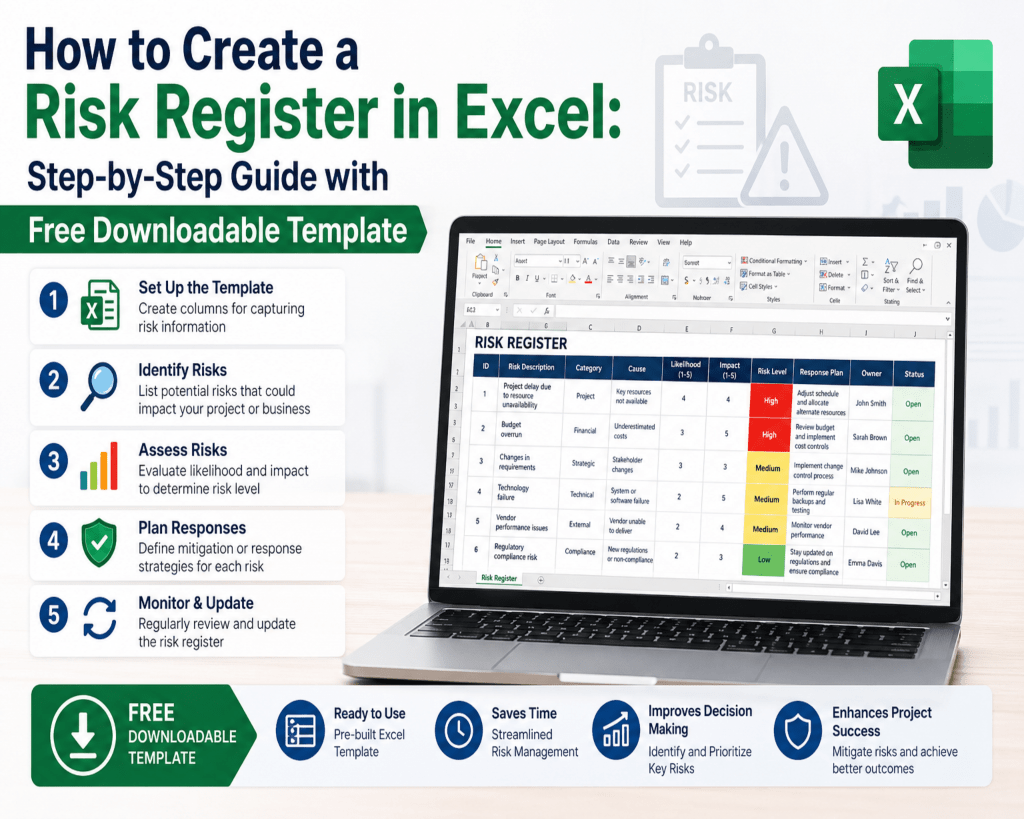
A risk register is a structured system used in project management to record, evaluate, and track potential risks that may affect project outcomes. It is typically created in spreadsheet form and serves as a central reference point for all identified uncertainties. Each risk is documented along with details such as its probability of occurring, its possible impact on project objectives, and the planned response strategy. This structured approach allows project teams to maintain control over uncertainty and make informed decisions throughout the project lifecycle. In modern IT and business environments, where projects are influenced by changing requirements, technical dependencies, and resource limitations, a risk register becomes an essential governance tool for maintaining stability and direction.
Importance of Risk Awareness in IT and Project Execution
Project environments are inherently unpredictable. Requirements may evolve, technical issues may arise unexpectedly, and external dependencies can introduce delays or complications. Without a structured system to manage these uncertainties, teams often rely on informal communication methods that lack consistency and traceability. A risk register introduces discipline into this process by ensuring that every potential issue is recorded, assessed, and monitored in a standardized manner. This improves transparency across teams and ensures that no critical risk is overlooked. In IT environments especially, where systems are interconnected and highly sensitive to disruption, early identification of risks helps prevent escalation into major operational failures.
Role of Structured Documentation in Managing Uncertainty
Structured documentation plays a central role in effective risk management. A risk register consolidates all risk-related information into a single source, allowing teams to view the entire risk landscape at a glance. This structured approach replaces fragmented communication with a clear and organized system. Each risk entry typically includes descriptive details and measurable indicators that help teams prioritize actions. By maintaining a consistent format, organizations ensure that risks are not only identified but also evaluated in a comparable way. This consistency is critical when multiple stakeholders are involved in decision-making processes, as it ensures alignment and reduces ambiguity in interpretation.
How Risk Registers Support Decision-Making in Projects
One of the most valuable aspects of a risk register is its ability to support decision-making. By assigning measurable values to risks, such as likelihood and impact, project teams can objectively evaluate which risks require immediate attention. This prevents subjective judgment from dominating risk prioritization. Decision-makers can quickly identify high-priority risks and allocate resources accordingly. Additionally, documented mitigation strategies provide a clear path for addressing issues before they escalate. This structured decision-making process enhances project efficiency and reduces the likelihood of unexpected disruptions affecting timelines or budgets.
Understanding Risk Visibility and Accountability
A key benefit of using a risk register is improved visibility across the entire project. When risks are documented in a centralized system, all stakeholders gain access to the same information. This eliminates confusion and ensures that everyone understands the current risk environment. Alongside visibility, accountability is also strengthened. Each risk is assigned to a responsible individual who is tasked with monitoring and managing it. This ensures that risks are not ignored or forgotten over time. Accountability encourages proactive engagement and ensures that mitigation actions are executed in a timely manner.
Core Structure of a Risk Register in Practical Use
A standard risk register follows a structured format that includes multiple fields designed to capture all relevant aspects of a risk. Each entry typically begins with a unique identifier that distinguishes it from other risks. A detailed description explains the nature of the risk in clear terms. Categories are used to group similar risks, such as technical, financial, operational, or external risks. Likelihood and impact are assigned numerical values to quantify the severity of the risk. These values are then used to calculate a risk score, which helps determine priority levels. Additional fields such as mitigation plans and risk ownership provide actionable direction for managing each risk effectively. Status tracking ensures that progress can be monitored over time.
Why Spreadsheet-Based Risk Registers Are Widely Used
Spreadsheet-based risk registers remain one of the most widely used formats due to their simplicity and accessibility. Most teams are already familiar with spreadsheet tools, which reduces the learning curve and allows for quick implementation. Spreadsheets also offer flexibility, enabling users to customize fields, apply formulas, and organize data according to project requirements. This adaptability makes them suitable for both small-scale projects and more complex initiatives. While advanced systems exist, spreadsheets continue to be a preferred starting point for organizations that want a lightweight yet effective risk management solution.
Introduction to Risk Scoring and Prioritization Concepts
Risk scoring is a fundamental concept in structured risk management. It involves assigning numerical values to the likelihood of a risk occurring and the severity of its impact. These values are multiplied to produce a risk score, which provides a clear indication of overall risk priority. Higher scores indicate more critical risks that require immediate attention, while lower scores represent less urgent issues. This scoring mechanism allows teams to compare risks objectively and focus their efforts where they are needed most. Prioritization based on scoring ensures that resources are allocated efficiently and that critical risks are addressed before they can affect project outcomes.
Establishing Consistency in Risk Evaluation Practices
Consistency is essential when evaluating risks across a project. Without standardized criteria, different team members may assess risks differently, leading to inconsistent prioritization. A structured risk register resolves this issue by defining clear evaluation scales for likelihood and impact. These standardized scales ensure that all risks are assessed using the same criteria, which improves accuracy and fairness in decision-making. Consistent evaluation also enhances communication between stakeholders, as everyone interprets risk levels in the same way. This alignment is especially important in large projects where multiple teams are involved.
Early Identification of Risks in Project Lifecycles
Early identification of risks is one of the most important advantages of using a risk register. By documenting risks at the beginning of a project, teams can anticipate potential challenges before they occur. This proactive approach allows for the development of mitigation strategies in advance, reducing the likelihood of disruption during execution. Early risk identification also supports better planning, as teams can adjust timelines, budgets, and resource allocation based on potential uncertainties. This forward-looking approach improves overall project resilience and reduces reactive problem-solving during critical phases.
Integration of Risk Tracking into Project Workflows
A well-designed risk register is not a static document but an active part of project workflows. It is continuously updated as new risks emerge and existing risks evolve. Regular reviews ensure that the register remains relevant and accurate throughout the project lifecycle. Integrating risk tracking into routine project activities encourages ongoing awareness and reinforces the importance of risk management within the team. This continuous monitoring process helps ensure that risks are managed dynamically rather than being addressed only at isolated points in time.
Setting Up the Foundation of a Risk Register in Excel
Building a risk register in Excel begins with creating a structured foundation that supports clarity, consistency, and scalability. The objective at this stage is not complexity but organization. A well-structured spreadsheet ensures that every risk is recorded in a uniform way, making it easier to analyze and prioritize later. The first step involves opening a blank worksheet and defining a clear header structure that reflects the essential components of risk management. These typically include identifiers, descriptions, categorization fields, scoring metrics, ownership assignments, and status tracking elements. The structure should be designed in a way that allows expansion without breaking formatting or logic. A disciplined layout ensures that as the number of risks grows, the document remains readable and functional rather than becoming cluttered or inconsistent.
Designing Logical Columns for Effective Risk Tracking
Each column in a risk register serves a specific purpose and contributes to the overall understanding of project risk exposure. The Risk ID column provides a unique reference for each entry, ensuring that risks can be tracked without confusion. The Risk Description column captures the essence of the issue in a concise but informative manner, allowing stakeholders to understand the nature of the risk without requiring additional explanation. The Category column groups risks into meaningful classifications such as technical, financial, operational, or external, enabling easier filtering and analysis. Likelihood and Impact columns introduce quantifiable measurement, which forms the basis of prioritization. Risk Score and Priority columns translate raw data into actionable insights. Mitigation Plan, Risk Owner, and Status columns ensure that every risk has a defined response strategy and accountability structure. Together, these fields create a complete ecosystem for structured risk management within a spreadsheet environment.
Establishing Standardized Risk Scoring Mechanisms
A critical element of a functional risk register is the ability to measure risk objectively. This is achieved through a scoring system that evaluates both the probability of occurrence and the severity of impact. Likelihood is typically rated on a numerical scale, often ranging from one to five, where lower values indicate rare occurrences and higher values indicate highly probable events. Impact follows a similar scale, representing the level of disruption a risk could cause to project objectives. By multiplying these two values, a composite risk score is generated. This score provides a quantifiable measure that allows risks to be compared directly. The advantage of this approach is that it removes subjectivity from prioritization and replaces it with a consistent mathematical model. As a result, decision-making becomes more structured and defensible, particularly in environments where multiple stakeholders are involved.
Implementing Formula Logic for Automation in Excel
One of the strengths of using Excel for risk registers is the ability to automate calculations through formulas. Automation reduces manual effort and minimizes errors in risk evaluation. The Risk Score column can be calculated using a simple multiplication formula that links Likelihood and Impact values. Once entered for a single row, this formula can be applied across all entries, ensuring consistency throughout the dataset. The Priority column can also be automated using conditional logic. By defining thresholds for high, medium, and low categories, the spreadsheet can dynamically classify risks based on their calculated scores. This eliminates the need for manual interpretation and ensures that prioritization remains consistent even as new risks are added or existing risks are updated. Automation transforms the risk register from a static document into a responsive analytical tool.
Creating a Structured Prioritization System
Prioritization is one of the most important functions of a risk register. Without a clear prioritization system, all risks appear equally important, which undermines effective decision-making. A structured prioritization model assigns different levels of urgency based on calculated risk scores. High-priority risks typically represent combinations of high likelihood and high impact and require immediate attention. Medium-priority risks may require monitoring and planned mitigation, while low-priority risks are often tracked without immediate action. This hierarchical classification allows project teams to focus resources where they are most needed. It also helps prevent resource dilution, where attention is spread too thin across low-impact issues. A well-defined prioritization system ensures that critical risks receive appropriate focus while maintaining awareness of less severe issues.
Enhancing Data Integrity Through Controlled Input
Data integrity is essential in maintaining the reliability of a risk register. Inconsistent or inaccurate data can lead to incorrect prioritization and flawed decision-making. One way to maintain integrity is by controlling input values through standardized formats. Likelihood and Impact fields should be restricted to predefined numerical ranges to prevent irregular entries. Dropdown selections or validation rules help ensure that only acceptable values are entered into the system. This reduces variability and ensures that scoring calculations remain accurate. Maintaining data integrity also improves collaboration, as multiple users can contribute to the register without introducing inconsistencies. A well-maintained dataset increases confidence in the insights generated from the risk register.
Applying Conditional Formatting for Visual Risk Analysis
Visual representation of data plays an important role in interpreting risk levels quickly. Conditional formatting allows users to apply visual cues such as color coding to highlight different risk categories. High-risk items can be highlighted in one color, medium risks in another, and low risks in a third. This visual differentiation makes it easier to scan large datasets and identify critical issues at a glance. It also improves communication during meetings or reporting sessions, as stakeholders can quickly understand the risk landscape without analyzing numerical values in detail. Visual formatting enhances usability and transforms the spreadsheet into a more intuitive decision-support tool.
Building Role-Based Accountability in Risk Registers
Assigning responsibility is a fundamental aspect of effective risk management. Each risk should be linked to a specific individual or role responsible for monitoring and managing it. This ensures that risks are not left unattended and that accountability is clearly defined. The Risk Owner field serves this purpose by designating responsibility for each entry. This structure encourages proactive engagement and ensures that mitigation actions are implemented as planned. Role-based accountability also improves communication flow, as stakeholders know exactly who to contact regarding specific risks. In complex projects involving multiple teams, this clarity becomes essential for maintaining coordination and preventing oversight.
Structuring Mitigation Plans for Actionable Response
A risk register is not only a tracking tool but also a planning instrument. The Mitigation Plan column transforms risk identification into actionable response strategies. Each risk should have a corresponding plan that outlines steps to reduce likelihood, minimize impact, or manage consequences if the risk occurs. These plans should be practical, specific, and aligned with project constraints. A well-defined mitigation strategy ensures that risks are not only documented but actively addressed. This proactive approach reduces uncertainty and improves project resilience. Over time, mitigation planning also contributes to organizational learning by capturing effective strategies for future reference.
Tracking Risk Status Throughout Project Lifecycles
Risk management is a continuous process rather than a one-time activity. The Status column allows teams to monitor the lifecycle of each risk from identification to resolution. Common status indicators include active, monitoring, mitigated, or closed. Regular updates ensure that the risk register reflects the current state of the project environment. This ongoing tracking process helps teams understand how risks evolve over time and whether mitigation strategies are effective. It also provides historical insight that can be valuable for future project planning. Continuous status updates ensure that the risk register remains a living document rather than a static record.
Maintaining Scalability in Excel-Based Risk Systems
As projects grow in complexity, the number of identified risks may increase significantly. A well-designed Excel-based risk register must therefore be scalable. Scalability refers to the ability of the system to accommodate additional data without losing performance or clarity. This can be achieved through structured formatting, consistent column definitions, and efficient formula design. Proper organization ensures that even large datasets remain manageable. Filtering and sorting functions can also be used to navigate extensive risk lists effectively. A scalable design ensures that the risk register remains usable across different project sizes and complexity levels.
Integrating Risk Registers into Project Workflows
A risk register should not exist in isolation but should be integrated into broader project workflows. This means it should be regularly reviewed during project meetings, updated as new risks emerge, and referenced during decision-making processes. Integration ensures that risk management becomes part of daily project operations rather than an occasional activity. When embedded into workflows, the risk register becomes a dynamic tool that influences planning, execution, and evaluation phases. This integration strengthens organizational awareness of risks and promotes a culture of proactive management.
Evolving Risk Registers with Project Complexity
As projects evolve, so do their risk profiles. New risks may emerge while existing risks may change in likelihood or impact. A well-maintained risk register adapts to these changes by allowing continuous updates. This adaptability ensures that the document remains relevant throughout the project lifecycle. It also enables teams to refine their understanding of risk patterns over time. As complexity increases, additional fields such as dependency tracking or escalation paths may be introduced to enhance functionality. This evolutionary approach ensures that the risk register remains aligned with project needs at every stage.
Evolving the Risk Register into an Advanced Management Tool
A risk register in its basic form serves as a structured log of uncertainties, but in more advanced usage scenarios, it evolves into a strategic decision-support system. As projects increase in scale and complexity, the register must support deeper analysis, faster updates, and more dynamic interpretation of risk data. This evolution involves refining the structure, improving data relationships, and enhancing usability for multiple stakeholders. In mature project environments, the risk register becomes more than a tracking sheet; it becomes an integrated mechanism that supports forecasting, prioritization, and governance decisions across the entire project lifecycle.
Improving Risk Analysis Through Data Structuring Techniques
Effective risk analysis depends heavily on how data is structured within the register. A poorly structured dataset limits visibility and reduces analytical accuracy, while a well-organized structure enhances clarity and interpretation. Advanced structuring involves ensuring that each risk entry follows a consistent format and that relationships between different fields are logically aligned. Grouping risks by category allows for pattern identification, while consistent scoring ensures comparability across different types of risks. Over time, structured datasets enable teams to identify recurring risk themes, which can inform long-term process improvements and strategic planning.
Enhancing Decision Support Through Risk Prioritization Models
Risk prioritization becomes more sophisticated as the register matures. Instead of relying solely on basic scoring thresholds, advanced prioritization models consider multiple dimensions of risk exposure. These may include urgency, dependency impact, and cumulative effect on project objectives. By layering additional logic into prioritization systems, teams can distinguish between risks that appear similar numerically but differ significantly in real-world consequences. This multidimensional approach allows for more accurate allocation of resources and ensures that critical risks are not overlooked due to oversimplified scoring models.
Integrating Risk Dependency Mapping in Project Environments
In complex projects, risks rarely exist in isolation. One risk can trigger or amplify another, creating a chain of dependencies that significantly affects project outcomes. Dependency mapping introduces a relational perspective to risk management, where risks are analyzed in terms of their interconnected effects. By identifying dependencies, teams can understand how mitigating one risk may reduce multiple downstream risks. This approach improves strategic planning and helps prioritize risks that have broader systemic impact rather than isolated consequences.
Strengthening Accountability Through Structured Ownership Models
Accountability is a critical component of effective risk management, especially in collaborative environments where multiple teams contribute to a single project. A structured ownership model ensures that every risk is assigned to a specific individual or role responsible for monitoring and managing it. This assignment creates clarity in responsibility distribution and prevents risks from being overlooked. In advanced usage scenarios, ownership may be extended to include escalation hierarchies, ensuring that unresolved risks are automatically elevated to higher authority levels when necessary. This layered accountability structure improves responsiveness and reinforces disciplined risk management practices.
Optimizing Risk Registers for Large-Scale Projects
As the number of risks increases, maintaining efficiency within the register becomes increasingly important. Optimization techniques focus on improving usability, performance, and accessibility. Large-scale registers benefit from structured filtering systems that allow users to isolate risks based on category, priority, or status. Efficient layout design ensures that key information remains visible without overwhelming the user. In addition, consistent formatting reduces cognitive load, allowing stakeholders to interpret data more quickly. Optimization ensures that even extensive datasets remain functional and manageable in real-time project environments.
Using Historical Data for Predictive Risk Analysis
One of the most powerful advancements in risk management is the use of historical data to anticipate future risks. By analyzing previously recorded risks, teams can identify patterns that indicate recurring issues or common failure points. This historical perspective allows for predictive analysis, where potential risks are anticipated based on past project behavior. Over time, this approach shifts risk management from reactive to proactive, enabling organizations to address issues before they materialize. Historical insights also improve planning accuracy and contribute to more realistic project forecasting.
Enhancing Communication Through Structured Risk Reporting
Effective communication is essential in ensuring that risk information is understood and acted upon correctly. A well-structured risk register serves as a communication tool that translates complex risk data into clear and actionable insights. Structured reporting formats allow stakeholders to quickly understand the status of project risks without needing to interpret raw data. This clarity is particularly important in multi-stakeholder environments where decision-makers may not be directly involved in day-to-day project activities. Clear communication ensures alignment and reduces the likelihood of misinterpretation or delayed responses.
Maintaining Data Accuracy in Dynamic Project Environments
Project environments are constantly changing, and risk registers must adapt accordingly. Maintaining data accuracy requires continuous updates and validation of existing entries. As new information becomes available, risk attributes such as likelihood, impact, and status may need to be revised. Failure to update the register can lead to outdated information influencing critical decisions. Regular review cycles ensure that the data remains current and reliable. In dynamic environments, accuracy is not a one-time requirement but an ongoing responsibility that directly impacts the effectiveness of risk management efforts.
Integrating Risk Registers into Governance Frameworks
In structured organizational environments, risk registers often form part of broader governance frameworks. These frameworks define how risks are identified, assessed, escalated, and resolved across projects. Integration ensures that risk management is aligned with organizational policies and standards. It also provides a consistent approach across multiple projects, enabling centralized oversight and reporting. Governance integration enhances accountability at organizational levels and ensures that risk-related decisions are aligned with strategic objectives rather than isolated project considerations.
Improving Collaboration Through Shared Risk Visibility
Collaboration plays a key role in effective risk management, particularly in team-based project environments. A shared risk register ensures that all stakeholders have access to the same information, promoting transparency and collective responsibility. When risks are visible to all team members, collaboration becomes more structured and informed. Teams can collectively identify mitigation strategies and coordinate responses more effectively. Shared visibility also reduces communication gaps and ensures that risk-related information is not siloed within specific departments or individuals.
Adapting Risk Registers for Agile and Traditional Methodologies
Risk registers can be adapted to suit different project management methodologies, including both traditional and agile approaches. In traditional environments, risk registers are often updated at predefined intervals and used as part of formal reporting structures. In agile environments, they may be updated more frequently and integrated into iterative planning cycles. Regardless of methodology, the core function remains the same: identifying and managing uncertainty. The flexibility of a structured risk register allows it to be applied across different operational frameworks without losing its effectiveness.
Scaling Risk Management Practices Across Multiple Projects
In organizations managing multiple concurrent projects, risk registers may need to operate at both project and portfolio levels. At the project level, they focus on specific risks affecting individual initiatives. At the portfolio level, they aggregate risks across multiple projects to identify broader organizational threats. This dual-layered approach enables better strategic oversight and ensures that risks are not evaluated in isolation. Scaling risk management practices in this way enhances visibility across the entire project ecosystem and supports more informed resource allocation decisions.
Enhancing Risk Registers Through Continuous Improvement Cycles
Continuous improvement is essential for maintaining the effectiveness of risk management systems. A risk register should not remain static but should evolve based on feedback, performance evaluation, and changing project conditions. Continuous improvement cycles involve reviewing existing processes, identifying gaps, and refining structures to improve clarity and efficiency. Over time, this leads to more accurate risk identification, better prioritization, and more effective mitigation planning. Continuous refinement ensures that the risk register remains relevant and aligned with evolving project demands.
Long-Term Value of Structured Risk Management Systems
The long-term value of a structured risk register extends beyond individual projects. It contributes to organizational learning, improves decision-making frameworks, and strengthens overall project delivery capabilities. As organizations accumulate historical risk data, they develop deeper insights into common failure points and effective mitigation strategies. This accumulated knowledge enhances future project planning and reduces uncertainty over time. Structured risk management becomes not just a project tool but a strategic asset that improves organizational resilience and performance consistency across initiatives.
Conclusion
A risk register represents far more than a simple tracking sheet or administrative document. It functions as a structured decision-support system that brings clarity, discipline, and foresight into environments that are naturally uncertain. In IT and project management contexts, where change is constant and unpredictability is unavoidable, the ability to systematically identify and manage risks becomes a defining factor in project success. The real strength of a risk register lies not in its complexity, but in its consistency and adaptability. When properly designed and maintained, it transforms uncertainty into structured information that can be analyzed, prioritized, and acted upon with confidence.
At its core, a risk register creates visibility. Many project failures do not occur because risks were unknown, but because they were not properly documented, communicated, or tracked. Without a centralized system, risk information tends to become fragmented across emails, meetings, and informal discussions. This fragmentation leads to gaps in awareness and delays in response. A structured register eliminates this issue by consolidating all risk-related information into a single, unified view. This ensures that every stakeholder is working from the same source of truth, reducing miscommunication and improving alignment across teams.
Another important value of a risk register is accountability. By assigning ownership to each identified risk, responsibility becomes clear and actionable. This prevents risks from being overlooked or assumed to be someone else’s concern. Accountability ensures that every risk has a designated point of contact responsible for monitoring its status and executing mitigation strategies when necessary. This structure promotes proactive engagement rather than reactive crisis management. When individuals know they are responsible for specific risks, they are more likely to monitor conditions closely and respond promptly to emerging issues.
Risk registers also play a critical role in improving decision-making quality. In complex project environments, decisions must often be made under pressure and with incomplete information. A structured risk register helps reduce uncertainty by providing quantified insights into potential issues. Through the use of scoring systems that evaluate likelihood and impact, risks can be prioritized objectively. This removes ambiguity and ensures that attention is directed toward the most significant threats first. Decision-makers are able to allocate resources more effectively, focusing effort where it will have the greatest impact on project stability and success.
Beyond immediate decision-making, risk registers contribute to long-term organizational learning. Each recorded risk becomes part of a growing knowledge base that reflects real project experiences. Over time, patterns begin to emerge, revealing common risk types, recurring challenges, and effective mitigation strategies. This historical perspective allows organizations to refine their planning processes and anticipate future issues more accurately. Instead of approaching each project in isolation, teams can draw on accumulated insights to improve forecasting and reduce uncertainty in future initiatives.
A well-maintained risk register also strengthens communication across all levels of a project. Stakeholders with different roles and technical backgrounds can interpret risk information in a standardized format. This shared understanding improves collaboration and reduces the likelihood of misinterpretation. Clear communication is especially important in environments where multiple teams or departments are involved, as it ensures that everyone understands not only what the risks are, but also how they are being managed. This transparency builds trust and supports more effective coordination.
In addition to communication benefits, risk registers improve project control. By continuously monitoring risk status, teams can detect early warning signs before issues escalate into major disruptions. This proactive monitoring enables timely intervention, reducing the likelihood of schedule delays, budget overruns, or quality failures. Control is further enhanced through structured updates, where risks are regularly reviewed and adjusted based on evolving project conditions. This ensures that the register remains accurate and relevant throughout the entire lifecycle of the project.
Another significant advantage lies in scalability. Whether applied to small initiatives or large, complex programs, the underlying principles of a risk register remain consistent. It can expand to accommodate increasing numbers of risks without losing structure or clarity, provided it is designed correctly. This adaptability makes it suitable for a wide range of environments, from early-stage projects to enterprise-level operations. As complexity increases, the register can evolve by incorporating additional fields, enhanced scoring models, or more detailed categorization systems, all while maintaining its core purpose of organizing and managing uncertainty.
The discipline of maintaining a risk register also encourages a proactive mindset within teams. Instead of reacting to problems after they occur, teams are encouraged to anticipate potential issues and prepare responses in advance. This shift from reactive to proactive thinking is one of the most valuable cultural changes that structured risk management can introduce. It leads to better planning, improved resource allocation, and greater overall resilience in the face of unexpected challenges.
Furthermore, risk registers contribute to improved efficiency in project execution. By identifying potential bottlenecks early, teams can adjust plans before problems arise. This reduces the need for emergency interventions, which are often more costly and disruptive than planned responses. Efficiency is also improved through automation features available in spreadsheet-based systems, where calculations, prioritization, and formatting can be handled automatically. This reduces manual effort and allows teams to focus more on analysis and decision-making rather than administrative tasks.
In modern project environments, where speed and accuracy are equally important, structured risk management provides a competitive advantage. Organizations that consistently apply risk registers are better equipped to handle uncertainty, adapt to change, and maintain stability under pressure. This reliability becomes particularly important in IT and digital transformation initiatives, where system dependencies and rapid development cycles increase exposure to risk.
Ultimately, the value of a risk register is measured not by the number of risks it contains, but by the quality of decisions it enables. It serves as a foundation for disciplined thinking, structured analysis, and informed action. When used effectively, it transforms risk from an abstract concern into a manageable and measurable component of project delivery. This transformation is what allows teams to move with confidence, even in environments defined by uncertainty.
A well-implemented risk register does not eliminate risk, but it ensures that risk is understood, controlled, and integrated into decision-making processes. It empowers teams to move forward with clarity rather than hesitation, supported by structured insights rather than assumptions. In doing so, it becomes one of the most practical and powerful tools available in modern project management practice.