
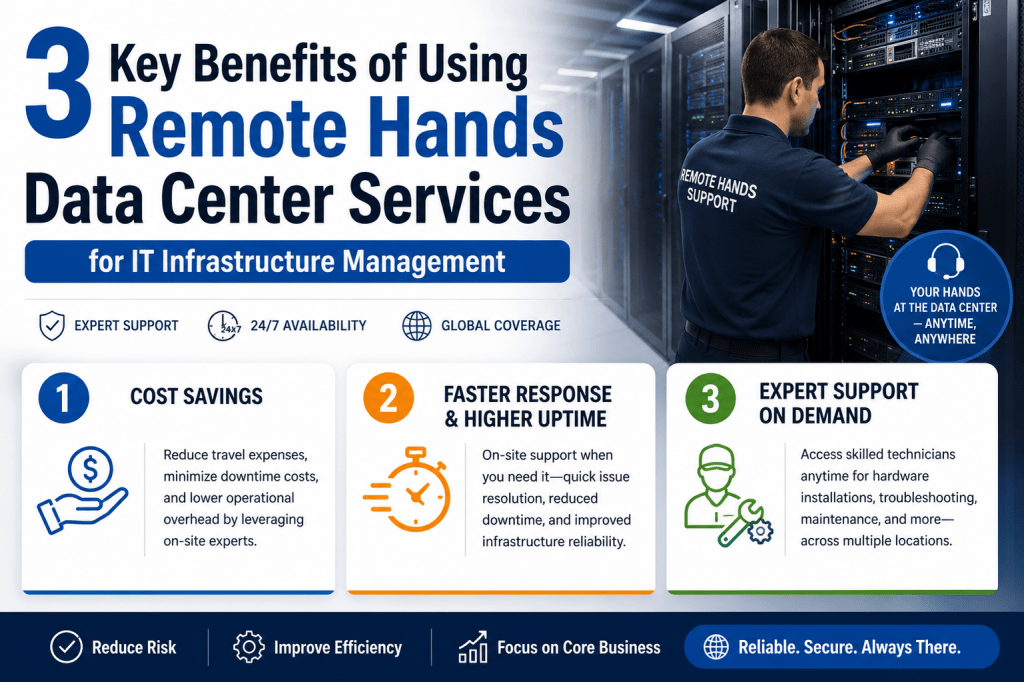
Managing co-located infrastructure is one of the biggest operational challenges for businesses that rely on physical servers. Unlike cloud-hosted environments where everything can be controlled virtually, co-located servers are stored inside professional facilities that may be located hundreds or even thousands of miles away from the company using them. Accessing those facilities often requires authorization, scheduled visits, and security clearances, making direct management difficult for internal IT teams.
To solve this challenge, many organizations rely on remote hands data center services. These services provide on-site technical assistance for businesses that need support with their equipment without physically traveling to the facility. Remote hands technicians act as an extension of your internal IT department by handling physical tasks inside the data center whenever needed. Their support can include hardware installations, cable replacements, device reboots, diagnostics, inventory checks, shipment handling, and other operational duties that require a physical presence.
For companies that depend heavily on uptime and operational continuity, remote hands support becomes an essential component of infrastructure management. Instead of dispatching internal technicians for every issue, organizations can rely on trained personnel already present inside the facility. This creates a more efficient and cost-effective approach to server management while ensuring systems remain operational around the clock.
Why Businesses Still Use Co-Located Data Centers
Although public cloud services have become increasingly popular, many businesses continue to rely on co-located data centers for specific operational and compliance reasons. Organizations dealing with sensitive information, high-performance workloads, or specialized hardware often require more control than standard cloud environments can provide. Co-location allows companies to maintain ownership of their servers while benefiting from enterprise-grade infrastructure.
One major advantage of co-location is access to advanced facilities designed specifically for uptime and reliability. These environments are built with redundant power systems, advanced cooling technologies, high-speed connectivity, fire suppression systems, and physical security controls. Creating a similar setup internally would require enormous financial investment and ongoing maintenance costs that many businesses cannot justify.
Energy efficiency is another important factor. Data centers are strategically positioned in areas where electricity costs are lower and infrastructure is optimized for large-scale operations. Businesses that host servers internally often struggle with rising electricity expenses, cooling demands, and hardware maintenance. Co-location helps reduce these operational burdens while delivering a more stable environment for mission-critical systems.
Scalability also plays a significant role. As organizations grow, their infrastructure needs evolve rapidly. Expanding an internal server room can become expensive and time-consuming. Co-located facilities offer flexible growth options, allowing businesses to add racks, bandwidth, or power resources without rebuilding their infrastructure from scratch.
Despite these advantages, one major challenge remains: physical distance. When equipment is stored far from company headquarters, businesses need reliable support personnel inside the facility. This is where remote hands services become incredibly valuable.
The Role of Remote Hands Technicians
Remote hands technicians are trained professionals who work directly inside data center environments. Their primary responsibility is to perform physical tasks on behalf of customers who cannot be present onsite. These technicians provide immediate assistance for operational issues, reducing downtime and improving response times during emergencies.
One of the most common remote hands tasks involves equipment troubleshooting. If a server becomes unresponsive, a technician can physically inspect the device, check indicator lights, reconnect cables, replace failed components, or perform a manual reboot. These seemingly simple tasks become extremely important when the facility is located far away from the customer.
Remote hands teams also assist with hardware deployment. When businesses purchase new servers, switches, or storage devices, the equipment can be shipped directly to the data center. Technicians then receive the shipment, verify inventory, install the hardware, connect networking cables, and ensure everything is properly mounted and operational.
In many situations, remote hands staff also support network maintenance activities. They may trace cables, replace transceivers, check port connections, or help coordinate troubleshooting efforts with network engineers working remotely. This level of support significantly improves operational efficiency for businesses managing distributed infrastructure.
Another important responsibility involves monitoring physical conditions within the server environment. Technicians can visually inspect racks, identify unusual hardware behavior, verify airflow conditions, and report physical concerns before they become major issues. This proactive assistance helps organizations maintain system stability while reducing operational risks.
How Smart Hands Services Expand Technical Support
Some facilities offer an enhanced level of assistance known as smart hands services. While remote hands support generally focuses on basic operational tasks, smart hands services involve more advanced technical expertise. Businesses requiring deeper troubleshooting capabilities often choose this additional level of support to reduce reliance on external contractors or internal travel.
Smart hands technicians typically possess stronger technical backgrounds and can perform more complex tasks involving networking, operating systems, storage systems, and infrastructure configuration. They may assist with switch replacements, firmware updates, hardware diagnostics, patch management, or advanced cabling implementations.
For organizations operating critical infrastructure, smart hands services provide additional peace of mind. Instead of relying solely on remote troubleshooting from internal engineers, businesses gain access to skilled professionals capable of executing technical procedures directly within the facility.
The distinction between remote hands and smart hands services varies depending on the provider. Some facilities clearly separate the two offerings with different pricing structures and service-level agreements, while others include advanced assistance within their standard support plans. Understanding these differences is essential when evaluating a co-location provider.
Businesses with highly specialized environments often benefit significantly from smart hands support because it minimizes downtime during technical incidents. Having experienced personnel available onsite can accelerate problem resolution and improve overall operational continuity.
The Importance of Physical Infrastructure Management
Even in highly digital environments, physical infrastructure management remains critical. Servers, networking equipment, power supplies, and storage devices all require occasional physical interaction. Software tools can monitor systems remotely, but they cannot replace failed hardware components or reconnect disconnected cables.
Many organizations underestimate how frequently physical interventions become necessary. Hardware failures, accidental cable disconnections, failed power supplies, and storage device issues can occur unexpectedly. Without remote hands services, resolving these problems could require costly emergency travel or long periods of downtime.
Data centers operate continuously, meaning issues can arise at any hour. Internal IT teams may not have the resources to maintain around-the-clock onsite coverage, especially when facilities are located in different geographic regions. Remote hands services bridge this gap by providing immediate physical assistance whenever needed.
Physical infrastructure management also becomes more complex as businesses scale operations across multiple locations. Managing distributed environments requires reliable onsite support capable of maintaining consistency across facilities. Remote hands teams help organizations standardize operational procedures while reducing logistical challenges.
For businesses with limited IT staffing, these services become even more valuable. Smaller organizations often lack dedicated personnel for infrastructure management, making remote hands support an efficient alternative to hiring additional full-time employees.
Reducing Operational Downtime Through Immediate Support
Downtime can have devastating consequences for businesses that depend on digital systems. Lost revenue, damaged reputation, disrupted operations, and reduced customer trust are just a few of the risks associated with prolonged outages. One of the biggest advantages of remote hands data center services is the ability to reduce downtime through rapid onsite intervention.
When hardware issues occur, response time matters. Waiting for internal staff to travel to a remote facility can significantly delay recovery efforts. Remote hands technicians already positioned inside the data center can begin troubleshooting immediately after receiving instructions.
This rapid response capability is especially important for businesses operating customer-facing platforms, financial systems, healthcare applications, or critical communication services. Even minor outages can affect thousands of users or interrupt essential business functions.
Many data center providers include service-level agreements that define guaranteed response times for remote hands requests. These agreements help businesses establish predictable recovery expectations and improve incident management planning.
Immediate support also reduces pressure on internal IT teams. Instead of coordinating emergency travel arrangements or attempting complex recovery efforts remotely without physical assistance, engineers can work directly with onsite technicians to resolve issues faster and more effectively.
Improving Infrastructure Reliability
Infrastructure reliability is one of the most important goals for any organization operating servers or networking equipment. Reliable systems ensure business continuity, maintain customer confidence, and reduce operational disruptions. Remote hands services contribute significantly to overall infrastructure reliability by providing consistent operational support.
Routine maintenance activities are essential for preventing unexpected failures. Remote hands technicians can assist with scheduled hardware inspections, cable management, equipment replacements, and rack organization. These preventative tasks improve airflow, reduce overheating risks, and help maintain optimal equipment performance.
Hardware monitoring is another key area where remote hands services provide value. When monitoring systems detect unusual behavior, technicians can physically inspect affected equipment before problems escalate into major outages. Early intervention often prevents costly downtime and reduces long-term repair expenses.
Remote hands teams also support disaster recovery efforts by assisting with backup equipment deployment, hardware swaps, and emergency troubleshooting. During high-pressure situations, having skilled personnel available onsite improves coordination and accelerates recovery processes.
Consistency is equally important for reliability. Facilities with experienced remote hands staff typically follow standardized operational procedures, ensuring maintenance activities are performed correctly and safely. This reduces the likelihood of human error while improving overall infrastructure stability.
Supporting Business Growth and Expansion
As businesses expand, infrastructure demands increase rapidly. Additional applications, users, data storage requirements, and networking resources place greater pressure on IT environments. Remote hands services help organizations scale operations more efficiently without dramatically increasing internal staffing requirements.
Expanding into new geographic markets often requires infrastructure deployment in multiple regions. Managing these distributed environments internally can become operationally overwhelming. Remote hands support provides localized assistance that enables businesses to maintain operational control without establishing large onsite teams in every location.
New hardware deployments become significantly easier with remote hands assistance. Equipment can be shipped directly to the facility, installed by technicians, and configured remotely by internal engineers. This streamlined process accelerates infrastructure expansion while minimizing logistical complexity.
Scalable support is particularly valuable for growing companies with limited budgets. Instead of hiring additional full-time staff for every expansion phase, businesses can leverage remote hands services as needed. This flexible operational model supports growth while controlling infrastructure management costs.
Organizations also benefit from reduced travel expenses during expansion projects. Frequent trips to remote facilities can become costly and time-consuming. Remote hands technicians eliminate much of this burden by handling physical implementation tasks directly inside the data center.
Enhancing Coordination Between Remote Teams
Modern IT operations often involve distributed teams working from multiple locations. System administrators, network engineers, security specialists, and support personnel may all collaborate remotely to manage infrastructure. Remote hands services improve coordination between these teams by providing reliable onsite execution.
During troubleshooting sessions, internal engineers can communicate directly with technicians inside the facility. This collaboration allows remote teams to gather real-time information about hardware conditions, indicator lights, cable connections, and environmental factors that may not be visible through monitoring software alone.
Remote hands personnel essentially become the physical extension of remote engineering teams. Their presence inside the data center allows organizations to execute technical procedures more efficiently while maintaining centralized operational control.
This collaborative model is particularly valuable during critical incidents. Engineers can focus on diagnostics and decision-making while technicians perform physical actions required to resolve the issue. The result is faster problem resolution and improved operational efficiency.
Strong coordination also improves project execution during infrastructure upgrades, migrations, or hardware refresh cycles. Remote hands technicians help ensure implementation steps are completed accurately while internal teams oversee configuration and validation processes remotely.
24/7 Availability Creates Operational Stability
One of the biggest reasons businesses choose remote hands data center services is the ability to maintain continuous operational support without interruption. Servers and networking systems operate every second of the day, and technical problems rarely happen during convenient business hours. Hardware failures, connectivity interruptions, overheating issues, and unexpected outages can occur in the middle of the night, during holidays, or on weekends when internal IT teams may not be immediately available.
Remote hands support solves this challenge by ensuring trained technicians remain onsite around the clock. Instead of waiting for employees to travel to the facility or delaying recovery efforts until office hours, organizations can request immediate assistance whenever problems arise. This constant availability helps reduce downtime and protects critical services from prolonged disruptions.
Businesses that operate online platforms, e-commerce systems, financial applications, or customer support environments depend heavily on uptime. Even short interruptions can result in lost revenue, damaged reputation, and frustrated customers. Having access to onsite support at any hour gives organizations confidence that technical incidents can be addressed quickly before they escalate into larger operational failures.
Continuous availability also improves incident response planning. Many companies build disaster recovery procedures around the assumption that remote hands technicians will be available during emergencies. This allows internal teams to focus on diagnostics and decision-making while onsite personnel perform physical troubleshooting tasks.
Organizations with global operations benefit even more from around-the-clock support because infrastructure often serves users across multiple time zones. A problem affecting customers in another region cannot wait until local business hours. Remote hands services help ensure infrastructure remains operational regardless of where users are located.
Rapid Incident Response Improves Uptime
When technical issues occur, response speed is one of the most important factors influencing recovery time. Remote hands technicians provide immediate physical access to equipment, allowing businesses to begin troubleshooting without delay. This rapid response capability significantly improves overall uptime and reduces the business impact of outages.
Many infrastructure problems require physical interaction that cannot be performed remotely. A server may need a hard reboot, a disconnected cable may need to be reattached, or a failed component may require replacement. Without onsite support, these issues could remain unresolved for hours while organizations coordinate travel or locate third-party assistance.
Remote hands teams eliminate this delay by remaining physically present inside the facility. Technicians can respond to tickets immediately after receiving instructions, accelerating the recovery process and minimizing downtime.
Quick response times are especially valuable during mission-critical outages. Businesses operating healthcare systems, payment processing platforms, cloud services, or enterprise applications often cannot tolerate extended service interruptions. Every minute of downtime may affect customers, employees, or business operations.
Many co-location facilities offer guaranteed response times through service-level agreements. These agreements establish expectations for how quickly technicians will begin working on support requests. Predictable response windows help organizations improve operational planning and strengthen business continuity strategies.
Fast incident response also reduces stress on internal IT teams. Instead of scrambling to organize emergency travel or relying solely on remote diagnostics, engineers gain immediate assistance from personnel already onsite. This collaborative approach helps resolve technical problems more efficiently while reducing operational pressure.
Reducing the Need for Emergency Travel
Traveling to remote data center facilities can be expensive, time-consuming, and operationally disruptive. Businesses with infrastructure located in distant cities often face significant logistical challenges whenever physical intervention becomes necessary. Remote hands services greatly reduce this burden by providing onsite support without requiring internal employees to travel frequently.
Emergency travel creates several operational problems for IT departments. Flights, hotel accommodations, transportation expenses, and overtime costs can quickly accumulate, especially during urgent situations. In many cases, the cost of sending an employee to the data center may exceed the cost of the repair itself.
Remote hands support provides a more efficient alternative. Instead of dispatching internal staff for every issue, businesses can rely on trained technicians already working inside the facility. This reduces operational expenses while allowing employees to remain focused on strategic responsibilities rather than travel logistics.
Eliminating unnecessary travel also improves productivity. Internal engineers can continue supporting projects, monitoring systems, and managing infrastructure remotely instead of spending valuable time commuting to and from data centers. This allows organizations to maximize the efficiency of their technical teams.
For businesses operating multiple facilities across different regions, travel reduction becomes even more important. Managing infrastructure spread across several geographic locations would require constant movement from internal personnel without remote hands assistance. Onsite support teams make distributed infrastructure management far more practical and scalable.
Travel restrictions and unexpected disruptions can also complicate infrastructure management. Weather conditions, transportation delays, or emergency situations may prevent internal employees from reaching facilities quickly. Remote hands services ensure organizations maintain access to onsite support regardless of external circumstances.
Predictable Support Costs Improve Budget Planning
Financial predictability is essential for effective IT management. Organizations need accurate cost forecasting to allocate budgets properly and avoid unexpected operational expenses. Remote hands data center services help businesses achieve greater financial stability by providing predictable support pricing models.
Without remote hands support, infrastructure maintenance costs can fluctuate significantly. Emergency travel expenses, contractor fees, overtime payments, and urgent hardware interventions often create unpredictable financial strain. These unexpected costs make long-term budgeting more difficult for IT departments.
Many co-location providers offer structured pricing for remote hands services. Businesses may receive a set number of support hours each month or pay fixed rates for specific tasks. This predictable billing structure allows organizations to estimate operational expenses more accurately and maintain tighter financial control.
Predictable costs also support strategic investment planning. When businesses understand their infrastructure support expenses in advance, they can allocate additional resources toward modernization, security improvements, or capacity expansion instead of reserving large contingency budgets for unexpected emergencies.
Smaller organizations benefit particularly from predictable pricing because they often operate with limited IT budgets. Remote hands services provide access to professional support without the financial burden of hiring additional full-time employees or maintaining dedicated onsite teams.
Stable operational costs also improve communication between IT departments and executive leadership. Financial transparency helps justify infrastructure investments while demonstrating responsible resource management. Businesses can better evaluate the long-term value of co-location services when support expenses remain consistent and manageable.
Flexible Service Models Meet Different Business Needs
Not all organizations require the same level of infrastructure support. Some businesses only need occasional assistance for simple maintenance tasks, while others depend heavily on continuous technical support. Remote hands services offer flexibility that allows companies to choose support models aligned with their operational requirements.
Basic remote hands support typically includes services such as server reboots, cable checks, shipment handling, and visual inspections. These tasks cover many routine operational needs and provide essential physical assistance for businesses managing infrastructure remotely.
Organizations with more complex environments may choose enhanced support options that include advanced troubleshooting, hardware replacement, network diagnostics, or smart hands services. This flexibility ensures businesses can access the level of expertise appropriate for their infrastructure complexity.
Flexible support models are particularly valuable for growing companies. As infrastructure demands evolve, businesses can expand their support agreements without completely restructuring operations. This scalability helps organizations adapt more efficiently to changing operational requirements.
Some companies prefer pay-as-you-go support structures, while others choose monthly support packages with predefined service hours. These options allow businesses to balance operational flexibility with financial predictability based on their specific priorities.
Customized support agreements also help organizations address industry-specific requirements. Businesses operating highly regulated environments may require stricter access controls, detailed documentation procedures, or specialized maintenance protocols. Flexible remote hands services can often accommodate these operational needs.
Supporting Hybrid Infrastructure Environments
Modern IT environments increasingly combine physical infrastructure with cloud-based services. Many organizations operate hybrid systems that rely on both co-located hardware and public cloud platforms. Remote hands services play an important role in supporting these hybrid infrastructure strategies.
Certain workloads perform better on dedicated hardware due to performance, compliance, or customization requirements. At the same time, cloud services provide scalability and flexibility for other applications. Managing this combination of environments requires reliable physical infrastructure support alongside cloud management capabilities.
Remote hands technicians help maintain the physical side of hybrid environments by ensuring servers, networking equipment, and storage systems remain operational. Their support allows businesses to integrate physical and virtual infrastructure more effectively while maintaining centralized operational control.
Hybrid environments often involve complex networking architectures connecting cloud platforms with co-located hardware. Physical connectivity issues within the data center can disrupt communication between systems. Remote hands support helps resolve these problems quickly and maintain stable integration between infrastructure components.
Businesses transitioning from traditional infrastructure to cloud-based environments also benefit from remote hands services during migration projects. Technicians can assist with hardware installation, cable management, and equipment replacement while internal teams focus on software migration and application configuration.
As hybrid infrastructure strategies continue growing in popularity, the importance of reliable onsite support will likely increase as well. Organizations need dependable physical infrastructure management to maintain seamless integration between their various technology platforms.
Improving Equipment Deployment Efficiency
Deploying new hardware inside a data center involves several logistical and technical challenges. Equipment must be received, inspected, installed, connected, and tested before becoming operational. Remote hands services simplify this process by handling physical deployment tasks directly within the facility.
When businesses purchase new servers or networking equipment, devices can be shipped directly to the data center rather than company offices. Remote hands technicians receive the shipments, verify inventory, and prepare the equipment for installation. This streamlined process accelerates deployment timelines while reducing handling complexity.
Rack installation is another important aspect of deployment support. Proper mounting procedures are essential for equipment stability, airflow management, and cable organization. Experienced technicians ensure devices are installed correctly according to facility standards and manufacturer recommendations.
Cabling and connectivity tasks also require careful attention during deployment projects. Incorrect cable placement or poor organization can create operational problems and complicate future maintenance activities. Remote hands teams help maintain clean, organized infrastructure layouts that improve reliability and simplify troubleshooting.
Deployment efficiency becomes increasingly important during large-scale expansion projects. Organizations adding multiple servers or networking devices benefit significantly from having skilled onsite personnel manage physical implementation tasks. This allows internal engineering teams to focus on configuration and system integration instead of installation logistics.
Faster deployment cycles help businesses respond more quickly to growth opportunities and operational demands. Remote hands services reduce delays associated with equipment installation and improve overall infrastructure scalability.
Strengthening Collaboration Between IT Teams and Facilities
Successful infrastructure management requires strong collaboration between businesses and data center providers. Remote hands services create an effective communication bridge between internal IT teams and facility personnel, improving coordination during routine operations and emergency situations.
Technicians working onsite provide valuable real-time information about hardware conditions, environmental factors, and facility operations. This direct communication helps internal engineers make more informed decisions during troubleshooting and maintenance activities.
Collaboration becomes especially important during infrastructure incidents. Internal teams may identify potential problems through monitoring systems, but onsite technicians can physically inspect affected equipment and confirm the exact issue. This combination of remote diagnostics and physical verification improves troubleshooting accuracy and accelerates resolution times.
Remote hands personnel also support planned maintenance activities by coordinating directly with customer teams. Scheduled upgrades, hardware replacements, and cabling projects often require careful timing and communication to minimize operational disruptions. Onsite support helps ensure these activities proceed smoothly and efficiently.
Strong collaboration improves operational consistency as well. Facilities with experienced remote hands teams often develop detailed familiarity with customer environments, allowing them to provide more effective support over time. This ongoing relationship enhances service quality and operational reliability.
For businesses managing complex or distributed infrastructure, collaborative support models are essential. Remote hands services strengthen the connection between organizations and their data center environments while improving overall infrastructure management efficiency.
Enhanced Security for Critical Infrastructure
Security is one of the most important reasons businesses rely on remote hands data center services. Modern organizations store enormous amounts of sensitive information within their infrastructure, including customer records, financial transactions, intellectual property, healthcare data, and confidential operational systems. Protecting this information requires far more than software security alone. Physical infrastructure security plays an equally critical role in maintaining a safe and compliant environment.
Remote hands services contribute to stronger security by ensuring only authorized personnel interact with critical equipment inside the data center. Instead of allowing multiple employees, contractors, or third-party vendors unrestricted access to sensitive infrastructure, businesses can centralize physical management through approved technicians working within the facility.
This controlled access model reduces operational risk significantly. Every physical interaction with hardware introduces potential security concerns, whether accidental or intentional. Remote hands services help minimize unnecessary physical access while ensuring infrastructure maintenance tasks are still completed efficiently and professionally.
Professional data centers also operate under strict physical security standards. Facilities often include biometric authentication systems, surveillance monitoring, access logs, locked cages, security checkpoints, and restricted entry procedures. Remote hands technicians work within these controlled environments, helping organizations maintain higher security standards than many internal server rooms can provide.
For businesses handling regulated information, secure infrastructure management is not optional. Industries such as healthcare, finance, legal services, and government contracting often require strict compliance with data protection regulations. Remote hands services support these requirements by ensuring infrastructure remains physically protected at all times.
Physical Security Matters as Much as Cybersecurity
Many organizations focus heavily on cybersecurity while underestimating the importance of physical security. Firewalls, encryption, endpoint protection, and intrusion detection systems are essential, but they cannot fully protect infrastructure if unauthorized individuals can physically access the hardware.
Physical access creates opportunities for data theft, hardware tampering, sabotage, and operational disruption. A single unauthorized interaction with a server can compromise sensitive information or damage critical systems. This is why professional data centers implement extensive security measures designed to restrict and monitor access to infrastructure.
Remote hands services strengthen physical security by reducing the need for frequent visits from internal employees or external contractors. Instead of multiple individuals entering the facility for routine tasks, organizations can rely on trusted onsite technicians already authorized to operate within secure areas.
This approach simplifies access management while improving accountability. Remote hands activities are typically logged, documented, and monitored according to facility procedures. Businesses gain better visibility into who interacted with their equipment and what actions were performed.
Secure physical infrastructure also supports operational continuity. Facilities with strong access controls are less vulnerable to theft, vandalism, accidental damage, or unauthorized modifications. Combined with remote hands support, these protections create a more resilient infrastructure environment capable of supporting mission-critical operations.
As cybersecurity threats continue evolving, businesses increasingly recognize that digital protection must be combined with robust physical security measures. Remote hands services play an important role in maintaining this balanced security strategy.
Meeting Regulatory Compliance Requirements
Compliance requirements continue becoming more demanding across many industries. Governments, regulatory agencies, and industry organizations now impose strict standards regarding how businesses store, process, and protect sensitive information. Remote hands data center services help organizations meet these requirements more effectively.
Healthcare organizations, for example, often operate under strict regulations governing patient information security. Financial institutions face detailed compliance obligations related to transaction data and customer privacy. Companies handling personal information may also need to comply with international data protection laws and industry-specific security frameworks.
Many of these regulations include physical security requirements alongside technical controls. Businesses may be required to limit physical access to servers, maintain access records, implement surveillance systems, and ensure infrastructure remains protected against unauthorized interaction.
Professional co-location facilities are often designed specifically to support compliance-focused operations. Their infrastructure includes controlled access environments, redundant security systems, environmental monitoring, and operational procedures aligned with industry standards. Remote hands services extend these protections by providing trusted onsite support personnel operating within approved security frameworks.
Using remote hands services also reduces the number of individuals requiring physical access authorization. Instead of approving multiple employees or contractors for data center entry, organizations can restrict direct access while relying on authorized technicians for routine operational tasks.
Compliance audits become easier when infrastructure management procedures remain consistent and well-documented. Many facilities maintain detailed service records, access logs, and operational documentation supporting regulatory reporting requirements. This documentation helps businesses demonstrate compliance more effectively during inspections and audits.
Reducing Human Error in Sensitive Environments
Human error remains one of the leading causes of infrastructure outages and security incidents. Improper cable handling, accidental disconnections, incorrect hardware installations, and unauthorized modifications can all create serious operational problems. Remote hands services help reduce these risks by relying on trained technicians experienced in data center operations.
Professional technicians understand the importance of following standardized operational procedures. They work within structured environments where tasks are carefully documented and executed according to established guidelines. This disciplined approach reduces the likelihood of mistakes that could affect infrastructure stability or security.
Businesses benefit from having experienced personnel manage physical tasks rather than relying on employees unfamiliar with the specific facility environment. Remote hands technicians regularly work with racks, power systems, networking equipment, and server hardware, giving them practical expertise that improves operational accuracy.
Reduced human error also contributes to stronger uptime performance. Mistakes during maintenance activities can trigger unexpected outages, damage hardware, or interrupt critical services. Skilled technicians help minimize these risks while improving overall infrastructure reliability.
Documentation procedures further strengthen operational consistency. Many remote hands activities are recorded in service tickets or maintenance logs, providing clear visibility into completed tasks. This transparency supports better change management practices and simplifies troubleshooting if issues arise later.
For businesses operating sensitive systems, minimizing operational risk is essential. Remote hands services provide a controlled and professional approach to physical infrastructure management that reduces exposure to preventable mistakes.
Secure Hardware Handling Protects Valuable Equipment
Enterprise hardware represents a major financial investment for many organizations. Servers, networking devices, storage systems, and specialized computing equipment can cost thousands or even millions of dollars depending on the infrastructure scale. Protecting these assets requires proper handling, installation, and maintenance procedures.
Remote hands technicians are trained to work safely within data center environments. They understand equipment handling protocols, electrostatic discharge precautions, cable management practices, and rack installation procedures designed to prevent accidental damage.
Improper hardware handling can create both immediate and long-term problems. Physical damage may lead to equipment failure, performance degradation, connectivity issues, or shortened hardware lifespan. Even minor installation mistakes can affect cooling efficiency or increase operational instability.
Professional support reduces these risks significantly. Remote hands personnel use standardized installation methods that help maintain equipment integrity and ensure infrastructure remains organized and operational.
Shipping and receiving procedures also benefit from professional oversight. When new equipment arrives at the facility, technicians can inspect packages for visible damage, verify inventory accuracy, and ensure devices are stored properly before installation. This reduces the chance of deployment delays or operational issues caused by mishandled equipment.
Secure hardware management becomes especially important for businesses operating high-density or specialized environments. Advanced infrastructure often requires precise power distribution, cooling alignment, and cabling organization that inexperienced personnel may struggle to maintain properly.
By relying on trained onsite technicians, organizations improve equipment protection while reducing operational risks associated with physical infrastructure management.
Improving Access Control and Accountability
Access control is a critical component of infrastructure security. Businesses need to know exactly who can interact with their systems, when access occurs, and what activities are performed. Remote hands services support stronger accountability by centralizing physical interactions through approved personnel operating within monitored environments.
Every visit to a secure data center typically involves authentication procedures, access verification, and activity logging. Remote hands technicians operate within these controlled systems, ensuring all physical interactions remain documented and traceable.
This accountability provides several operational benefits. Businesses gain visibility into maintenance activities, infrastructure changes, and support procedures performed inside the facility. Detailed records improve transparency and support better operational oversight.
Centralized access control also simplifies security management. Instead of coordinating credentials and permissions for multiple internal employees or external contractors, organizations can rely on designated technicians already authorized within the facility. This reduces administrative complexity while minimizing potential security gaps.
Accountability becomes particularly important during incident investigations. If operational problems or security concerns arise, documented service records help organizations identify what actions were performed and when they occurred. This information supports faster root-cause analysis and improves incident response processes.
Consistent access management also strengthens customer trust. Businesses handling sensitive client information must demonstrate responsible infrastructure security practices. Remote hands services help organizations maintain tighter operational control while supporting compliance and security objectives.
Disaster Recovery Support Strengthens Business Continuity
Disaster recovery planning is essential for organizations that depend heavily on digital infrastructure. Hardware failures, power disruptions, network outages, and environmental incidents can all threaten operational continuity. Remote hands services play a major role in supporting disaster recovery strategies by providing immediate onsite assistance during emergencies.
When infrastructure incidents occur, recovery speed becomes extremely important. Remote hands technicians can begin executing recovery procedures immediately after receiving instructions from internal teams. This rapid response capability helps reduce downtime and accelerates service restoration.
Technicians may assist with hardware replacements, equipment reboots, cabling adjustments, backup device deployment, or physical diagnostics during disaster recovery operations. Their onsite presence eliminates delays associated with emergency travel or third-party coordination.
Professional data centers also provide infrastructure redundancy that strengthens disaster recovery planning. Backup power systems, redundant cooling, multiple network providers, and advanced monitoring systems improve resilience against operational disruptions. Combined with remote hands support, these facilities create highly reliable recovery environments.
Businesses operating distributed infrastructure benefit even more from onsite support during emergencies. Managing recovery efforts across multiple geographic locations would be extremely difficult without technicians available within each facility.
Disaster recovery exercises also become more effective with remote hands assistance. Organizations can test recovery procedures, hardware failover systems, and emergency response workflows more efficiently when onsite personnel are available to support physical implementation tasks.
Reliable disaster recovery capabilities protect revenue, customer trust, and operational stability. Remote hands services provide critical support that helps businesses recover more quickly from unexpected infrastructure disruptions.
Supporting Secure Infrastructure Scaling
As businesses grow, their infrastructure requirements expand rapidly. Additional applications, users, data storage demands, and network capacity all require new hardware deployments and operational adjustments. Remote hands services help organizations scale infrastructure securely while maintaining operational consistency.
Infrastructure growth often introduces new security and management challenges. More equipment means additional cabling, increased power demands, expanded rack space, and more complex operational procedures. Without proper oversight, rapid expansion can create organizational problems and increase operational risk.
Remote hands technicians support secure scaling by ensuring new hardware deployments follow standardized installation procedures. Proper rack organization, cable management, labeling, and equipment handling help maintain infrastructure stability as environments become more complex.
Scalable onsite support also reduces pressure on internal teams during expansion projects. Businesses can deploy new equipment more efficiently without overloading existing staff or requiring constant travel to remote facilities.
Security consistency is another important advantage. As infrastructure grows, maintaining uniform operational procedures becomes increasingly difficult. Remote hands teams help ensure all installations, maintenance activities, and hardware interactions follow established security and operational standards.
Organizations expanding into multiple regions benefit especially from standardized support processes. Remote hands services allow businesses to maintain consistent infrastructure management practices across geographically distributed facilities.
Secure scaling supports long-term business growth while reducing operational complexity. By combining professional onsite support with structured infrastructure management, organizations can expand their environments more confidently and efficiently.
Why Remote Hands Services Continue Growing in Importance
The importance of remote hands data center services continues increasing as businesses become more dependent on digital infrastructure. Organizations require reliable, secure, and cost-effective ways to manage physical systems distributed across multiple locations. Remote hands support addresses these challenges by combining operational efficiency with professional onsite expertise.
The rise of hybrid infrastructure environments, edge computing, and distributed data processing has made physical infrastructure management more complex than ever before. Businesses now operate systems across numerous facilities while supporting global users and continuously available services.
Remote hands services provide the operational flexibility needed to manage this complexity effectively. Businesses gain immediate access to onsite technical support without maintaining large physical teams in every location.
Security concerns also continue driving demand for professional infrastructure management. As regulatory requirements expand and cyber threats evolve, organizations need stronger physical security controls alongside digital protections. Remote hands services help businesses maintain secure and compliant environments while reducing operational risk.
Cost efficiency remains another major factor influencing adoption. Organizations increasingly seek ways to reduce travel expenses, optimize staffing, and improve infrastructure scalability without sacrificing reliability. Remote hands support offers a practical solution that balances operational performance with financial control.
As technology environments continue evolving, reliable onsite support will remain essential for businesses operating physical infrastructure. Remote hands data center services provide the expertise, responsiveness, and operational consistency needed to support modern infrastructure management successfully.
Evaluating Long-Term Operational Value
When businesses invest in co-located infrastructure, they are not simply renting rack space inside a data center. They are building the operational foundation that supports applications, customer services, communication systems, and critical business processes. Remote hands data center services add long-term value to this investment by ensuring infrastructure remains accessible, secure, and professionally managed at all times.
Instead of struggling with constant travel, unpredictable emergency costs, delayed incident response, or limited physical access to hardware, organizations gain immediate onsite support from trained technicians capable of handling essential operational tasks quickly and efficiently. These services improve uptime, strengthen physical security, support regulatory compliance, reduce operational complexity, and help businesses scale infrastructure more effectively.
Whether an organization operates a small co-located environment or a large distributed infrastructure network, remote hands support provides the flexibility and reliability needed to maintain stable operations in an increasingly digital business environment.
Conclusion
Remote hands data center services have become an essential solution for businesses managing co-located infrastructure. They provide reliable onsite support that helps organizations maintain uptime, improve security, reduce operational costs, and respond to technical issues faster without depending on constant physical travel. From routine maintenance and hardware installations to emergency troubleshooting and compliance support, remote hands technicians serve as a valuable extension of internal IT teams. As infrastructure environments continue growing more complex, businesses need dependable operational support capable of maintaining both performance and security standards. Choosing the right remote hands provider allows organizations to focus on business growth and technology innovation while ensuring their critical infrastructure remains professionally managed, protected, and continuously operational.